For The Nauruan
pp. 38-39 · Read in the full issue
The "Hard Sell"
Has Paid Off
By a Staff Writer
The Nauruans’ decision to ei ploy economic and legal advise (PIM, June, p. 15) to help the get a better deal from the At tralian Government has paid o AT talks in Canberra in June, th negotiated substantially high royalties for phosphate and an agn ment to set up a Legislative Coun and an Executive Council on Nau next January.
The royalties for phosphates ha been increased from 3/8 a ton 13/6 a ton for 1964-65 and 17 a ton for 1965-66. But the extract! rate has been increased from 1.6 rr lion tons to two million tons annual The Nauruans have also extract promises that: • An independent technical coi mittee of experts will be establish as soon as practicable to look ir the question of rehabilitating worke out mining land on Nauru shipping soil to the island. • The Australian Governme will co-operate with the Nauruans “actively pursue” any promisi proposals that might lead to the i settlement of the Nauruans elsewhe on a basis acceptable to them a with their national identity present These concessions came towar the end of a conference which di ing the first few days looked li ending in an unhappy stalemate.
No Independence
The Nauruans did not get ar where with their demand th January 31, 1968, should be set a target date for independence < Nauru.
The Legislative Council, whi will have an elected Nauru; majority, will have no say in t phosphate industry, external affa and defence, and its ordinances w be subject to disallowance by t Australian Governor-General; ai voting rights in the Executive Couu will be such that the Austral!
Administrator will have fir authority.
Even so, the concessions that t Nauruans have achieved are betf than they almost dared to hope, a: their Head Chief, Hammer deßobu went off to a meeting of the Unit
lations Trusteeship Council in New brk after stating that the results f the Canberra talks were “most itisfactory”.
However, he was still concerned bout what would happen to his eople when Nauru’s phosphate was idiausted in about a generation, and e was still adamant that Nauru lould have independence—whether r not the Nauruans knew how to irvive when they got it.
In the Trusteeship Council, the lead Chief found (as usual) that le Soviet delegate supported him n the question of independence.
But otherwise, no one seemed to ave much to complain about.
In fact, Australia got what was robably the biggest pat on the back has ever had over Nauru when le British delegate, Mr. Peter Hope, lid he believed Australia had “fully let and overtaken” the recommenda ons of a UN visiting mission to the jrritory in 1962 and of the Council ist year.
The report of this year’s visiting IN mission, released in June, made ;w recommendations because of the nminence of the Canberra talks.
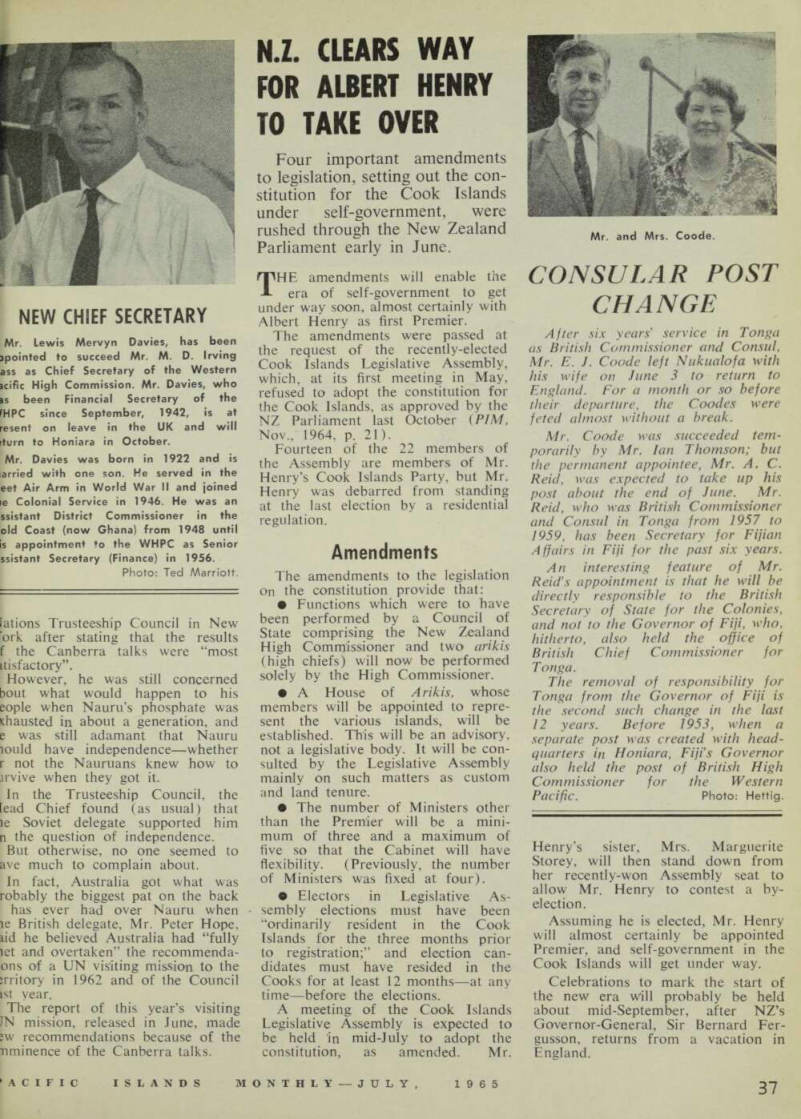
New Chief Secretary
Mr. Lewis Mervyn Davies, has been jpointed to succeed Mr. M. D. Irving ass as Chief Secretary of the Western icific High Commission. Mr. Davies, who ns been Financial Secretary of the IHPC since September, 1942, is at resent on leave in the UK and will iturn to Honiara in October.
Mr. Davies was born in 1922 and is iarried with one son. He served in the eet Air Arm in World War II and joined le Colonial Service in 1946. He was an ssistant District Commissioner in the old Coast (now Ghana) from 1948 until is appointment to the WHPC as Senior ssistant Secretary (Finance) in 1956.
Photo: Ted Marriott.