The Floating Showcase
pp. 31-35 · Read in the full issue

Some Stone-Throwing At The Floating Showcase
From a Rabaul Correspondent In Papua-New Guinea a chamber of commerce has ex pressed disappointment and concern at the Sletholm floating xhibition which has been attempting to bolster Australian xport trade in the South Pacific.
LJSTRALIAN, English, New Zealand, Chinese, French and an businessmen in the islands of South Pacific inspected the ibition in May and June as it red from port to port, he predominantly Australian abership chamber of commerce Rabaul, New Guinea, might in circumstances be accused of onal sabotage and lack of iotism in its outspoken criticism the trade promotion venture. unfortunately, the criticism in jral is only too true. In any it might be best in the interests Australian industry to support the nber of commerce and point out t seems to have gone astray.
Trade Loss
he venture was organised by Aus an Export Promotions Ltd. in unction with the Australian artment of Trade. Export Pro ions is made up of the Chamber Manufactures and the Associated mbers of Commerce in Australia, he Australian Trade Com lioner for the South Pacific, Mr.
H. Sullivan, who took part in the tour, said that Australia’s earnings from exports to the South Pacific were increasing from year to year.
The project had been organised, however, to increase Australia’s share of the trade which was pro gressively falling.
The hold of the Scandinavian ship Sletholm was fitted out as a two-storey display hall, and the ship left Sydney early in May. It was preceded from port to port by a chartered aircraft carrying 25 officials and sales representatives.
In Papua-New Guinea the ship visited Port Moresby, Lae, Madang and Rabaul, and then it moved on to Honiara, Vila, Lautoka, Suva and Noumea where the tour ended on June 8.
There was some trouble in the early stages of the venture in filling the available display space, although this was offset by a last-minute rush of applications.
Criticism of the venture started early when New Guineans at the first port of call, Port Moresby, accused the organisers of catering for sophisticated markets rather than
for the mass of the Pacific Islands native population.
Stronger, and perhaps more significant, was the criticism which arose later in the Trust Territory of New Guinea when the ship began to contact the hard-core commercial interests of the territory.
The criticism centred round the almost complete absence of the raw requirements of construction and maintenance so essential in the South Pacific engineering, wood working and general purpose tools, building materials, constructional re quirements, water craft and equip ment, and agricultural equipment and aids.
Australia has made rapid advances in recent years in the development of specialised building materials— internal and external surface sheets, roofing, partially pre-cut materials for speedy construction, fastenings and builders’ hardware. Yet the only representation in this class was a display of door locks and fittings.
They were of fine quality, but repre sented only a fraction of what the construction trades could have shown.
Mr. Chipper's View
A submission criticising the absence of construction materials and of other essential products in the South Pacific was submitted to the Rabaul Chamber of Commerce by one of its executive councillors, Mr. J. L. Chipper. The council endorsed Mr. Chipper’s submissions, and a dispassionate analysis seems to bear out what was said.
Reporters who visited the ship
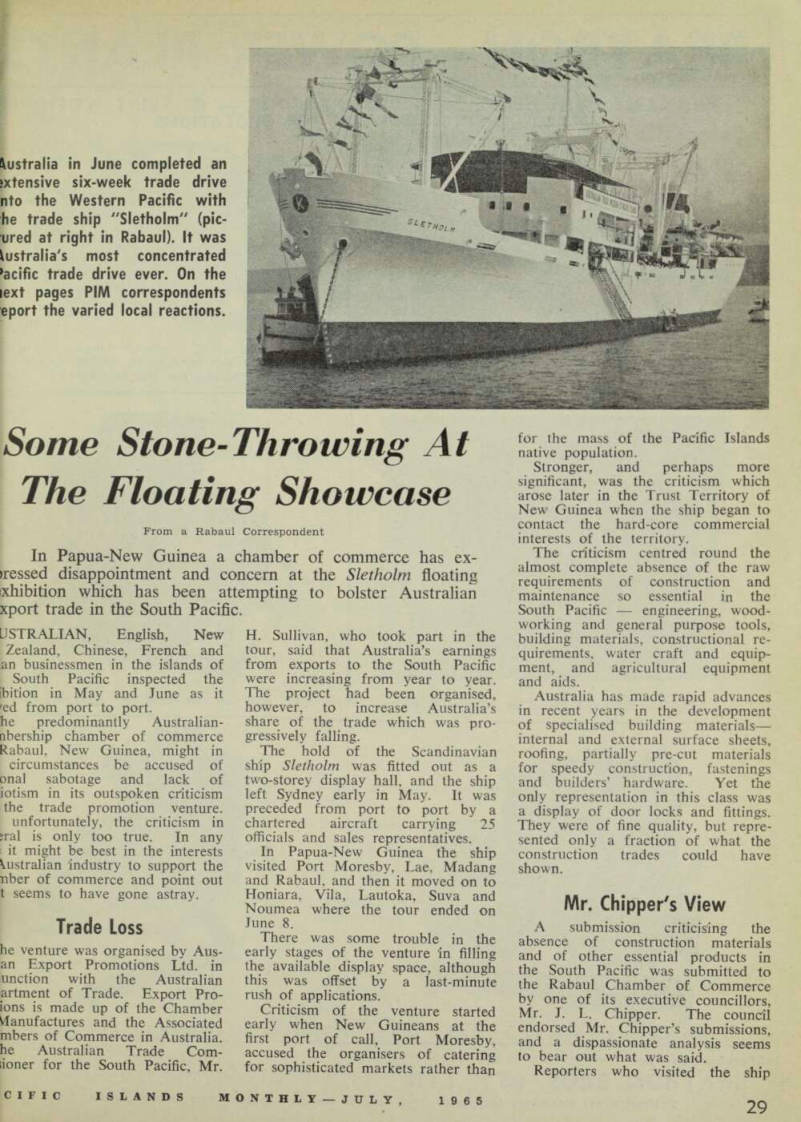
Australia in June completed an xtensive six-week trade drive to the Western Pacific with he trade ship "Sletholm" (pic ured at right in Rabaul). It was Australia's most concentrated Pacific trade drive ever. On the text pages PIM correspondents eport the varied local reactions.
ere met by a hard-sell publicity ficer whose main worry seemed to * making sure that the popularity : the venture did not get missed in e Australian Press.
But no-one was arguing about the >pularity of the mission. In terms : visitors per day—or even per inute —the response was outstand g. Thousands trooped on and off e ship. They drank sample drinks f the gallon, ate quantities of really [cellent cheese and filled their arms ith booklets and advertising aterials. They enjoyed the lavish ispitality of their hosts at a party -every-port. It must be mentioned, cidentally, that the foodstuffs Ivertised formed the strongest part ! the display but most of the •oducts were already well known roughout the Pacific.
The popularity of the venture, jwever, does not necessarily bear ly relationship to its success as a les promotion tour.
Officials announced at the end of e Papua-New Guinea leg of the ur that orders had been taken for \500,000 worth of goods. Many wnmercial interests feel that the 'ders were going to be lodged lyway, and that the buyers had erely held off pending the arrival : the ship.
Some of these interests had hoped r something new out of the visit, id when nothing new materialised ey followed their normal ordering ittern, which was channelled rough the representatives in the ade ship.
It would be wrong to say that the sit was ineffective. On the mtrary, it gave Australia credit for
laking an attempt to contact her rer-the-seas consumers.
Two important lessons must be arnt from the project.
The first is the vital need to send i advance party which can meet immercial interests in every port id find out exactly what sort of K>ds fits the local market. This Ivance party needs to make its trip ell before any space is allocated in trade ship.
The second point is that a central ithority should then decide the type goods which should be displayed id should invite—or even persuade •the appropriate manufacturers to ke part.
It is no good merely throwing icn the space for any manufacturer 10 wants to use it, and it is bad r prestige to leave home without presentattion from some of the ajor industries.