T ropicalities
p. 23 · Read in the full issue
n Australia, the question of literary censorship is one that we are sldom allowed to forget for long, because the Customs )epartment, which has sweeping powers over what might Drrupt our morals, is always banning books that are freely vailable elsewhere in the English-speaking world.
TtACH time a new ban goes on a -4 book of recognised literary icrit, there are angry, but usually uitless, howls in the Press from :ader writers, university professors, [id the like, who claim with truth lat, when it comes to books, Aus alians are treated like children.
As a result, the public’s curiosity , often aroused to read such cur mtly-banned books as Nabakov’s olita, and The Carpetbaggers, by [arold Robbins, which most people mild not otherwise bother about.
A further result is that Australians avelling overseas in less prudish, or iss particular, countries, are tempted > buy copies of the forbidden books nd smuggle them home for their lends.
One country that itinerant Aus alians have always looked on as a >urce of forbidden fruit is Fiji. This i not because its morals are anywise ixer than Australia’s, but because, ookwise, Fiji’s Customs Depart icnt does not trouble itself about rotecting the public’s morals except here a book is patently porno raphic.
Own Censors
Fiji’s booksellers take it upon lemselves to be their own censors, nd if they find that they have un fittingly imported a book, which, i their opinion, would be offensive ) the public, they remove it from leir shelves. The system seems to fork pretty well.
One bookseller who is especially articular about this is Shanti Lai )esai, of Suva, Fiji’s leading book ;ller. At one time he was chairman f a now-defunct unofficial censor hip committee.
But no bookseller ever manages > read all the books he puts on his helves, and so it happened recently, s it was bound to, that Mr. Desai ut on sale several copies of a book diich had won for itself some nemies.
The book was the giant-sized My Afe and Loves by Frank Harris,
which George Bernard Shaw once described as “abominable” and which has so many lurid passages that the ban on it by the Australian Customs Department is likely to stay forever, although you can buy it freely in America and the UK.
One day in January, someone in formed the police that My Life and Loves was on sale in Mr. Desai’s shop; the police forthwith made a raid; and early in June Mr. Desai found himself in court on a charge of importing and having in his pos session copies of an obscene book.
He pleaded guilty.
Helped Search
In evidence, it was stated that Mr.
Desai had assisted the police to make a search of his shop without a search warrant; that he had not read the book before importing it or before putting it on sale; and that he had relied on lists of best-sellers supplied by publishers when importing the book rather than on any personal knowledge of its contents.
Mr. Desai’s counsel, Mr. D. M. N.
McFarlane, quoted a letter that Mr.
Desai had received from an English firm of publishers, W. H. Allen and Co., in which they stated that the book was available in public libraries in England and that they had had to reprint it five times.
Mr. McFarlane said that the law in Fiji was about 100 years out of date in its attitude towards censor ship in literature; and that it was not possible to set up artistic or literary merit as a defence as it now was in England.
He added that if the book were banned in England, and Mr. Desai had then ordered it, it could be argued that he had imported it with intent. But this was not the case.
Fining Mr. Desai £lO, which was about the smallest fine he could im pose, the magistrate, Mr. I. R.
Thompson, said a considerable burden was cast on booksellers by the law, but that was something which persons
entering that trade would have to accept.
“It is clear that the accused has not deliberately imported obscene printed matter, and did not know it was obscene,’’ the magistrate added.
“What he has done is to fail to find out that it is obscene before im porting or selling it.”
In view of this judgment, and in view of the wide intepretation that can be placed on the word “obscene”, Fiji’s booksellers are likely to be far more circumspect in future when ordering books, especially from lists of best-sellers.
In fact, they may go so far as to consult the Australian Customs Department’s banned list before put ting in a single order.
If they do this, they will certainly be protected from all possibility of error. But they will also cut them selves out of a lucrative trade with travelling Australians and gain for Fiji a reputation in censorship as narrow and restrictive as Australia’s.
End Of The Road
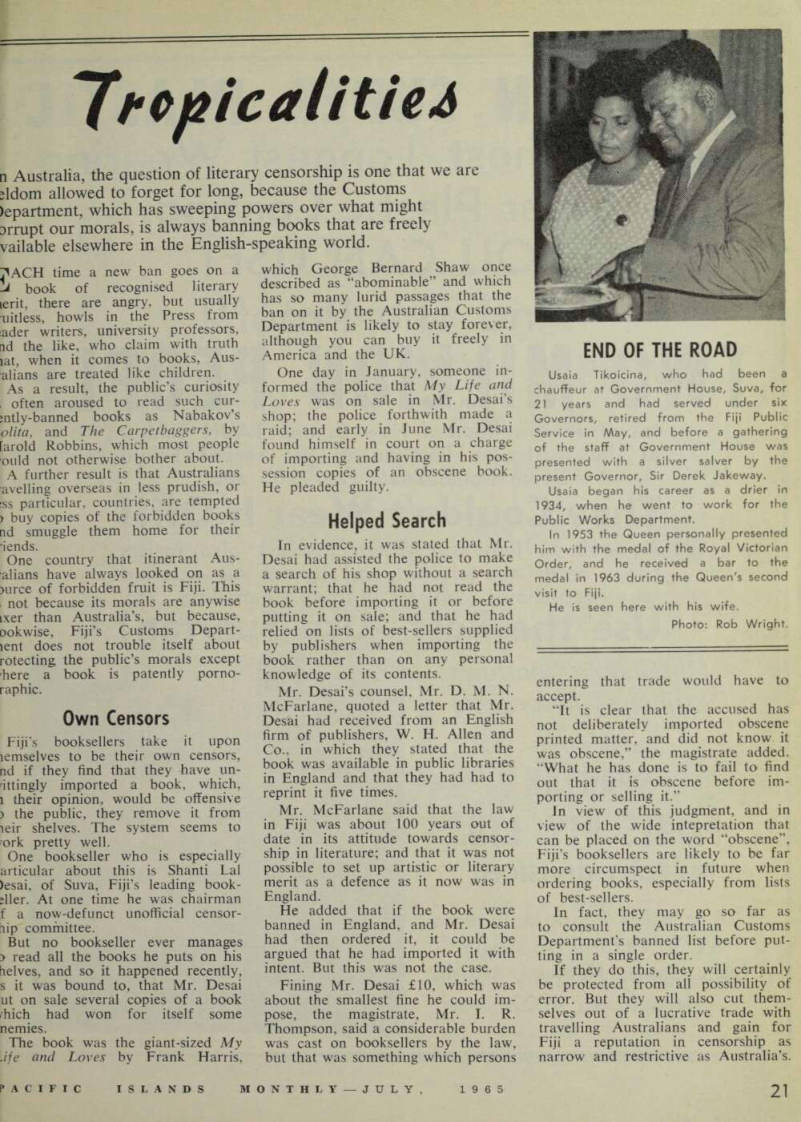
Usaia Tikoicina, who had been a chauffeur at Government House, Suva, for 21 years and had served under six Governors, retired from the Fiji Public Service in May, and before a gathering of the staff at Government House was presented with a silver salver by the present Governor, Sir Derek Jakeway.
Usaia began his career as a drier in 1934, when he went to work for the Public Works Department.
In 1953 the Queen personally presented him with the medal of the Royal Victorian Order, and he received a bar to the medal in 1963 during the Queen's second visit to Fiji.
He is seen here with his wife.
Photo: Rob Wright.