Fiji Political Horizon
p. 15 · Read in the full issue
Dark Clouds Lift On The Fiji Political Horizon
From a Suva Correspondent Virtually on the eve of the London constitutional con ference to begin on July 26 some of the dark clouds that menace Fiji’s political future are being blown away.
pHE clearing skies are the result L of a Suva meeting on June 25, rtween members of the National ongress of Fiji, and Fijian and uropean members of the Legislative ouncil—described by those present > a “turning point towards racial iderstanding and tolerance”.
Its significance was that responsible idians challenged the manoeuvres ; the A. D. Patel group. The Indians the meeting condemned the action r Mr. Patel in refusing to co-operate ith other Legislative Council embers in an effort to work out pre-conference solution, and said e vast majority of Fiji s Indian tpulgtion were dismayed by the grettable atmosphere created by .. . . r , The National Congress was born the efforts of Ayodhya Prasad, meral secretary of the Indian cane rmers union, the Fiji Kisan mgh, and others. It has emerged an implacable opponent of Patels idian Federation Party, which for onths has been noisily holding the age j n Fiji.
The Congress kicked off on the rong foot several months ago when suggested to the UN that Indians ight leave Fiji unless they got a ;tter deal on land. But it has since ade up leeway, and even increased \ stature among both Fijians and
Indians, by its efforts to come to an understanding with the Fijian As sociation—the leading Fijian organisa tion.
At public meetings Congress speakers have repudiated the Patel Federation’s demand for a common roll, saying that if the Fijians didn’t want it, then the Indians didn’t want it. The moderate policies of the Congress have been helping con siderably to lower the political tem perature.
Federation Party members ob viously haven ’ t liked the success of the Congress and there has been much heckling at Congress meetings, one Nadi heckler was removed by police Congress pres ident, Mr.
Manikam V, Pillai, at that meeting, did Mr Pate ,. s position no good by quoting from spee ches by the late Pandit NehrUj who told Indians jn Africa that he would not support , hem in their demand for privilege , ha , went against the AfrimrU ’ , ft you can t get on with the r ! car f, s ’ y° u have to get out of N e liru had told them, Mr.
Pulai pointed out that this advice applied with equal force in Fiji.
The Suva meeting with the Con gress leaders was attended by all six Fijian members of the Legco, and by
Mr. R. A. Kearsley, MLC and Mr.
J. N. Falvey, MLC.
The meeting agreed that at present elections on a common roll were neither desirable nor acceptable. To attempt to force a common roll at present would aggravate racial dif ferences. So many things in Fiji were not common to all races that it would be illogical to try to superimpose a common political structure.
As an example of the opposition of many Indians to the Patel, campaign for a common roll it was stated that the Muslim League had said it represented 38,000 people who were for a communal roll and against a common roll.
There will be further meetings between Congress and Legco members before and after the London con ference. All 18 unofficial members of the Legco will go to London.
Earlier in June, at a Suva meeting attended by about 500 people of mixed nationality, the general sec retary of the Fijian Democratic Party, Apisai Mohammed Tora, a Fijian, declared “Fiji for the Fijians!” and added that “any other respect able aliens may stay with us if they wish to do so—with the exception of the Indians. The Indians must go!”
He said if the Indians stayed in Fiji the inevitable result would be “bloodshed, with capital letters”.
It was fighting talk and inflamma tory stuff not needed in Fiji, from a man generally regarded as being in the political wilderness.
But it was an indication of the strengthening opposition to Mr. Patel and his supporters, and further proof, if any were needed, that when Mr.
Patel speaks at the London con ference his views will not be re presentative of Fiji opinion, what ever he might claim.
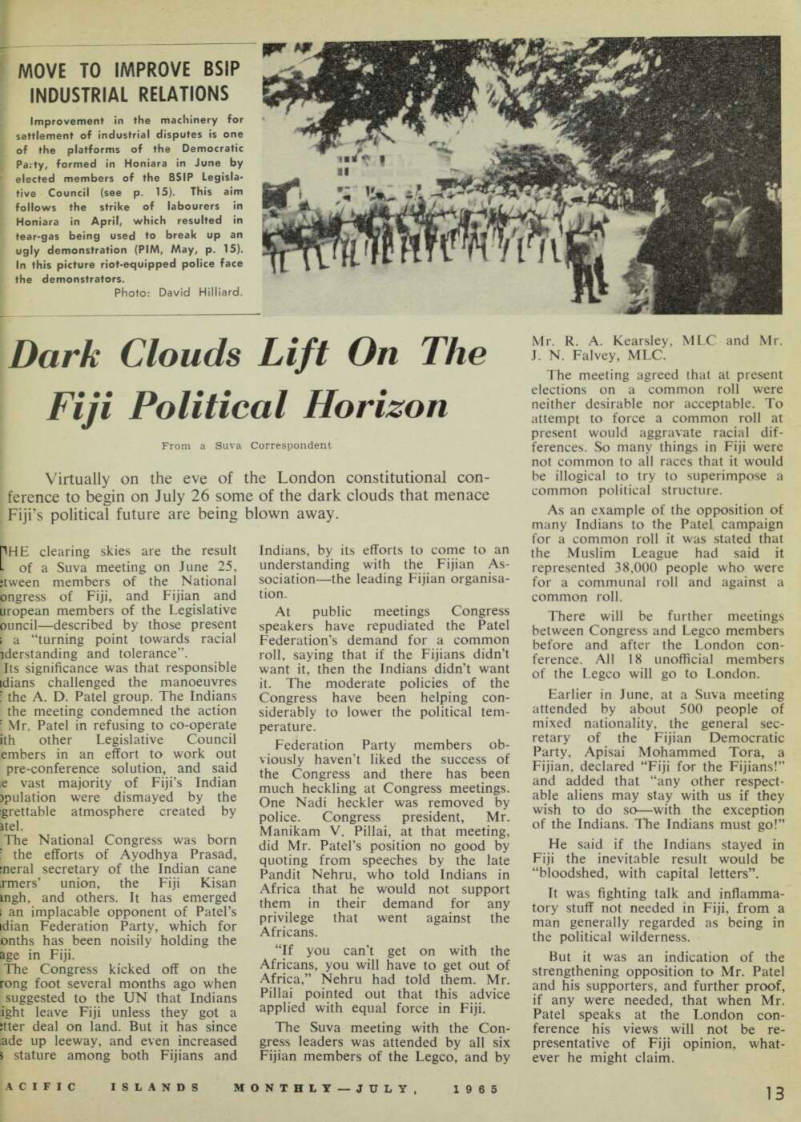
Move To Improve Bsip
Industrial Relations
Improvement in the machinery for settlement of industrial disputes is one of the platforms of the Democratic Party, formed in Honiara in June by elected members of the BSIP Legisla tive Council (see p. 15). This aim follows the strike of labourers in Honiara in April, which resulted in tear-gas being used to break up an ugly demonstration (PIM, May, p. 15).
In this picture riot-equipped police face the demonstrators.
Photo: David Hilliard.