Spectre Of Over-Population
pp. 10-11 · Read in the full issue
With Phosphate Deposits Running Out ...
Looms Over G.E.I.C.
The spectre of a rapidly increasing population with de creasing Ocean Island phosphate resources to support it was a major theme of the fourth meeting of the Gilbert and Ellice Islands Colony’s Advisory Council in Tarawa in May and June.
OPENING the meeting, the Colony’s Resident Commissioner, Mr. V. J. Andersen, said that every thing must be done to limit the growth of population in the Colony, and that the islanders should practise thrift “because of our bleak, long-term financial future”.
“Today,” he said, “with ap proximately 51,000 persons on our small, infertile islands, we can just find enough food and money for a standard of living which is not high and which cannot be compared to that of our neighbours.
“The position will be infinitely worse in 1978 when the population, at its present rate of growth, will be at least 75,500, and employment and revenue prospects on Ocean Island will have disappeared or be disap pearing rapidly.”
Mr. Andersen said that two urgent tasks ahead were the mounting of a full-scale family planning campaign and the need to find more employ ment overseas for the people. It was becoming more difficult to resettle
the islanders in the British Solomons and the New Hebrides, due, in the main, to the increasing interest of these territories in the development of their own resources by and for their own indigenous populations.
“However, at the request of the BSIP Government, the Colonial Development Corporation is in vestigating the feasibility of planned agricultural settlements on Guadal canal and it is hoped some of our people will participate in any schemes which may eventuate,” the Resident Commissioner said.
Mr. Andersen said an investigation was being made into the possibility of setting up a merchant marine training school to teach the skills required by crews of overseas vessels.
Referring to the mining of phosphates on Ocean Island, Mr.
Andersen said that estimated royalties from the British Phosphate Com mission for 1965 were £356,000, based on the export of 310,000 tons at the current royalty rate of 23/a ton.
Higher Royalties
But permission had been given for the extraction rate to be increased to 350,000 tons a year “as a temporary measure, and in anticipation of an improved royalty rate . . . applying to all phosphate exports after February 6, 1965”.
Mr. Andersen said it seemed to be the consensus of opinion that the Colony was ready to take another political step, and consideration was being given to what that step might be.
But “no early results” could be promised as the difficulties of internal communication and the smallness of the Colony’s scattered island com munities had to be taken into account in devising possible constitutions.
Referring to a resolution by the United Nations Committee of 24 last year that progress towards self determination in the GEIC was far
too slow, Mr. Andersen said although United Nations interei the country was welcome, “we dc accept that it has any right to di to us”.
The Government would be fluenced “only by the needs of Colony and the opinions of its pe in determining the rate and typ constitutional development”.
Mr. Andersen also made t points: • Arrangements had been r for a thorough survey of the cultural potential of Christmas Is to be financed by United King Technical Assistance Funds Christmas Island Plantation. It also hoped that the survey t would be able to visit the souti Phoenix Islands to advise on 1 worth as copra producers. • The Cable and Wireless sta on Fanning Island, which was cL down when the COMPAC cable inaugurated, had not been despite a “lengthy sales campaig
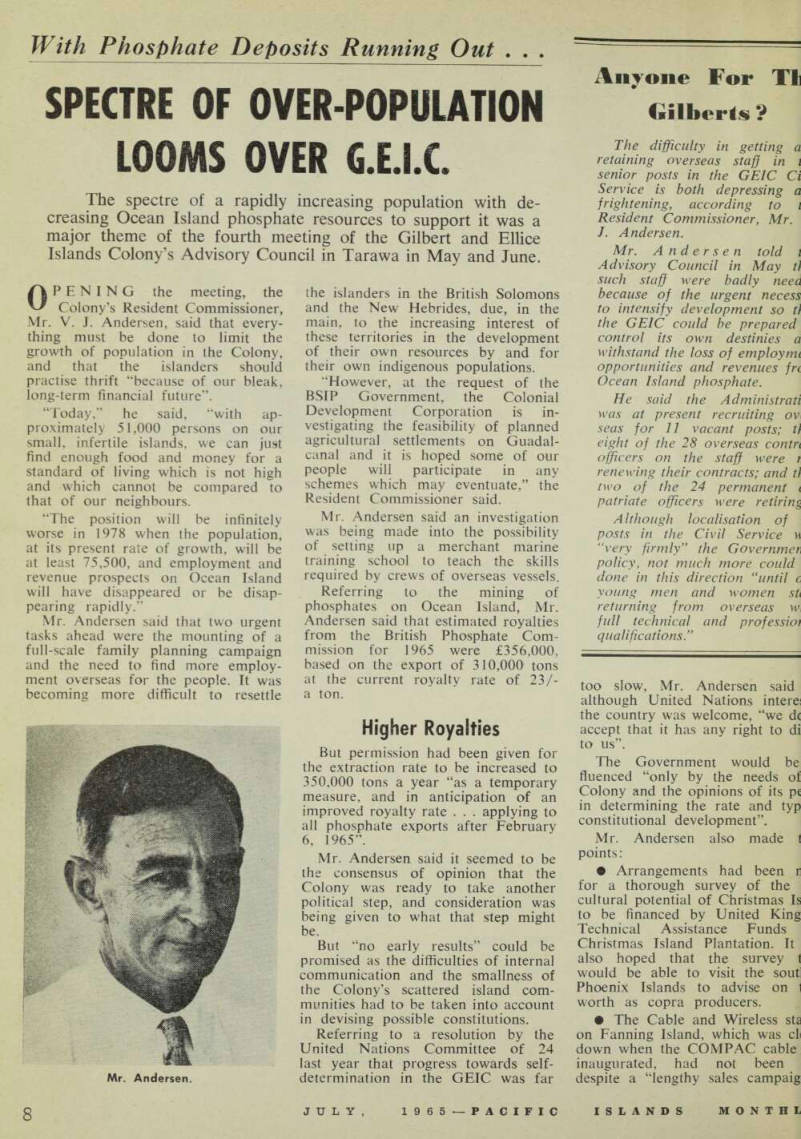
Mr. Andersen.
I Tarawa would soon be linked : radio telephone with Honiara, •an Island and Fiji, and, by the . of COMP AC, with the rest of rworld. n the subsequent debate, Council libers appeared to be divided on of constitutional develop at. tome members seemed to think it t better for things to remain as y were rather than for the Colony be driven into over-hasty advance the Committee of 24 or before sent progress was fully understood t consolidated. hhers thought the Advisory incil was outdated and that it i time for a Legislative Council. )n the question of Ocean Island •sphate, two members, in parti n’. had provocative questions to