Territories TALK-TALK
pp. 105-107 · Read in the full issue
With Tolala
Judging from the number of requests for “more photos of Before Days”, following the publishing of the Kavieng Cricket XI in April PIM, these “B 4 Fix” must be popular.
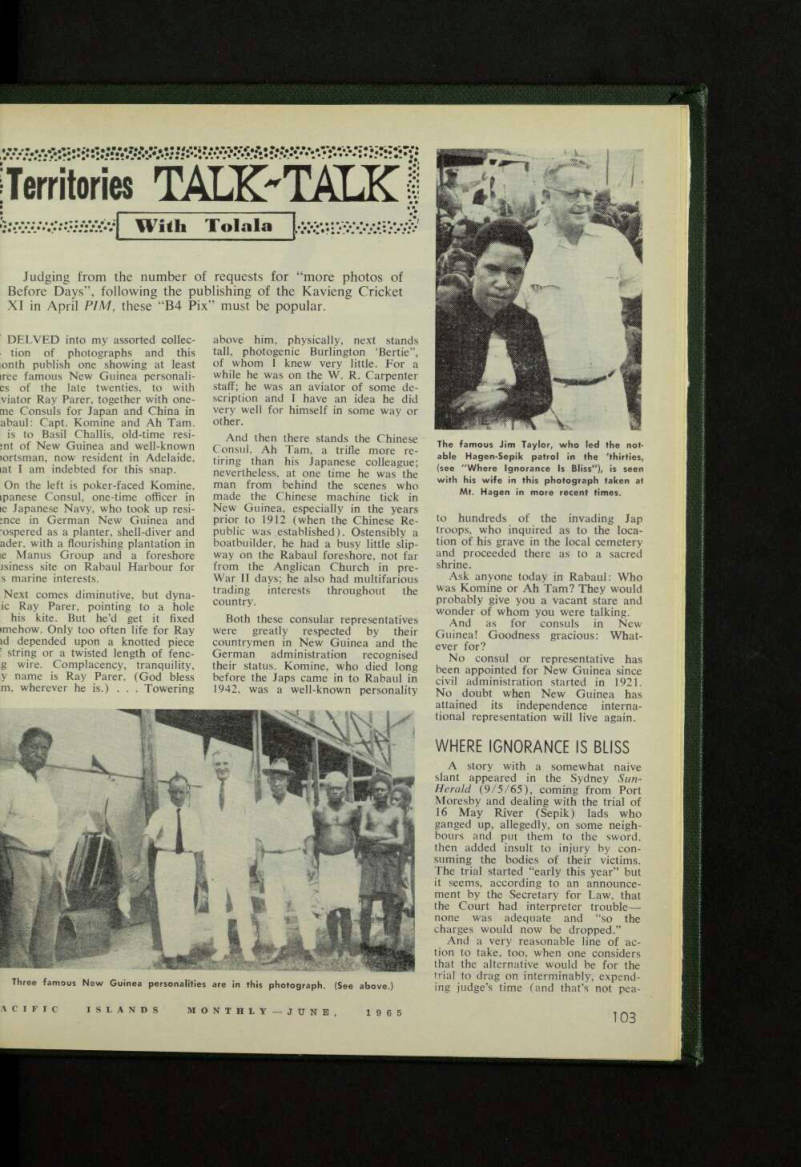
DELVED into my assorted collec tion of photographs and this onth publish one showing at least iree famous New Guinea personali es of the late twenties, to with viator Ray Parer, together with one me Consuls for Japan and China in abaul: Capt. Komine and Ah Tam. is to Basil Challis, old-time resi ;nt of New Guinea and well-known >ortsman, now resident in Adelaide, tat I am indebted for this snap.
On the left is poker-faced Komine, ipanese Consul, one-time officer in te Japanese Navy, who took up resi mce in German New Guinea and •ospered as a planter, shell-diver and ader, with a flourishing plantation in ie Manus Group and a foreshore jsiness site on Rabaul Harbour for s marine interests.
Next comes diminutive, but dyna ic Ray Parer, pointing to a hole his kite. But he’d get it fixed tmehow. Only too often life for Ray id depended upon a knotted piece : string or a twisted length of fenc g wire. Complacency, tranquility, y name is Ray Parer. (God bless m, wherever he is.) . . . Towering
above him, physically, next stands tall, photogenic Burlington ‘Bertie”, of whom I knew very little. For a while he was on the W. R. Carpenter staff; he was an aviator of some de scription and I have an idea he did very well for himself in some way or other.
And then there stands the Chinese Consul. Ah Tam, a trifle more re tiring than his Japanese colleague; nevertheless, at one time he was the man from behind the scenes who made the Chinese machine tick in New Guinea, especially in the years prior to 1912 (when the Chinese Re public was established). Ostensibly a boatbuilder, he had a busy little slip way on the Rabaul foreshore, not far from the Anglican Church in pre- War II days; he also had multifarious trading interests throughout the country.
Both these consular representatives were greatly respected by their countrymen in New Guinea and the German administration recognised their status. Komine, who died long before the Japs came in to Rabaul in 1942, was a well-known personality
to hundreds of the invading Jap troops, who inquired as to the loca tion of his grave in the local cemetery and proceeded there as to a sacred shrine.
Ask anyone today in Rabaul: Who was Komine or Ah Tam? They would probably give you a vacant stare and wonder of whom you were talking.
And as for consuls in New Guinea! Goodness gracious; What ever for?
No consul or representative has been appointed for New Guinea since civil administration started in 1921.
No doubt when New Guinea has attained its independence interna tional representation will live again.
Where Ignorance Is Bliss
A story with a somewhat naive slant appeared in the Sydney Sun- Herald (9/5/65), coming from Port Moresby and dealing with the trial of 16 May River (Sepik) lads who ganged up, allegedly, on some neigh bours and put them to the sword, then added insult to injury by con suming the bodies of their victims.
The trial started “early this year” but it seems, according to an announce ment by the Secretary for Law. that the Court had interpreter trouble— none was adequate and “so the charges would now be dropped.”
And a very reasonable line of ac tion to take, too, when one considers that the alternative would be for the trial to drag on interminably, expend ing judge’s time (and that’s not pea
Three famous New Guinea personalities are in this photograph. (See above.)
The famous Jim Taylor, who led the not able Hagen-Sepik patrol in the 'thirties, (see "Where Ignorance Is Bliss"), is seen with his wife in this photograph taken at Mt. Hagen in more recent times.
nuts in £sd), legal officers’ and court! officials’ costs —with the result that if found guilty and the death sen* tence recorded, the lads would go to a corrective institution for a period! then home again. All this costing oodles of money. For what? To show that justice is not only done, but also! appears to be done? To adhere to an old tradition? . . . Perhaps.
Little wonder that New members in the House of Assembly are urging for a more suitable punish] ment to fit the crime for murderers] instead of the present legal brouhaha which officialdom deems adequate to educate these emerging people in re spect to law and order. (What about that story of the moat being in youf own eye? . . .Tut, tut! Don’t bring that up now.) One thing that I did particularly notice in the Law Secretary’s an nouncement, and which I think is open to question, is “the May River area was first penetrated by ment patrols in 1958. Few people in the area can speak pidgin English.’ 7 ] If the learned Secretary, in refer ring to “government patrols”, confines such patrols to those of the Papua and New Guinea government, then he is quite correct. On the other hand] if he concedes the fact that the gov ernment of the Mandated Territory of New Guinea had recognised patrols, then he must be aware of the Hagen-Sepik patrol under Jim Taylor, with Patrol Officer John Black and lik-lik doctor C. B. Walsh, which travelled through the May area in December, 1938. Taylor in his repon describes the folk in these parts as being unfriendly. Black had told Taylor; “They do not encourage visi tors.”
Well . . . that was twenty years earlier than the Law Secretary’s “first government patrol”. It would not sur prise me if a glance through old Ger man records disclosed that legist Thurnwald and members of the Behrmann’s expedition of 1914 were through that country also.
But, of course, if “government] applies only to the post-merger period ... I give up.
Plain Talk
“Benelong” in his “To The Point’ column in the Sydney Sunday Tele graph (9/5/65) makes a good point when he pleads “Let’s Talk Plainly” after, apparently, reading his first copy of the new quarterly magazine New Guinea.
“Surely,” he writes, “the New Guinea Council isn’t going to foist this word ‘indigene’ on us? In a dozen or so reports from New Guinea j notice that the natives are referred to
indigenes. Come off it, chaps, it’s rench word anyway. What’s wrong ti calling natives natives?” the answer is, of course, hing is wrong. But it would ap r that the New Guinea Council decided, in its wisdom, that a de is not a spade but an agricul d implement. . . . i pity. It is just this particular y floss talk that gives these ido-long-haired integration enthu ts a distorted image with members ;very race in New Guinea, uch adulation earns these experts marks from the majority of New neans who just don’t know what talking about, while the wise s of the isles can arrive at a very r evaluation of this particular id of flattery. ’s so difficult to square Austra thinking with New Guinean. And the slide rules in the world won’t > a little bit.
Mories Of Kew
ir George Taylor, Director of the al Botanic Gardens at Kew (Eng- I), was in Lae middle of April to
i the modern, well-equipped
>arium in that town. Reports of ceremony make no explanation such an important construction not sited in Port Moresby. Cost a mere £lOO,OOO possibly it did come up to the P.M. building dards? (See Tropicalities). r George went a long way into past when he made reference to f Guinea being the source of ir cane. A pity he did not shorten distance a bit and recall some 50years ago when Kew Gardens’ esentative in the BSIP and Bou ville was the late J. H. L. Water >e, who did a worthy collecting for a number of years and after- Is ended up as teacher of the up School, just outside Rabaul. he thirties the school became an bit point for VIPs visiting aul. JHL had a Thing about him young New Guineans and the ty to create in them the urge to i. His classes were wizards at tal arithmetic. Quick as a flash.
Just like that!
ussie journalist, Norman Bartlett,
sd the Nodup school in 1941 and he Australasian (23/8/41) gave tailed cover of his experience. An ict; It is a pity that so many people ho are convinced against the pos bility of educating natives fail to sit the place where education is king place. . . . They should eet, for instance, Mr. J. H. L aterhouse, fat, bullet-headed de nee to native education, who has
given a life in the- tropics and his health to the cause in which he believes.
Asked if he thought pidgin English a necessary form of address, JHL replied it could be in bush villages, but he never used it in his school. One of the pupils mentioned by Bartlett was Towalaka, a name I seem to recognise as one of Rabaul’s postwar town dignitaries at one time. (I remember his handwriting; it was the dead ring of JHL’s neat calligraphy.)
Yes, it would have been a nice touch on Sir George’s part if his delving into Kew records had un earthed JHL and his work, However, i guess there are more than one or two of Rabaul’s elite who were pupils in the Nodup school when JHL was their dominie and they competed one with another in the mental arithmetic classes; some may even be amongst those unique mirror-writers of whom, strangely , there were several in the class.