Reminiscences Of The
pp. 98-99 · Read in the full issue
Australians At War
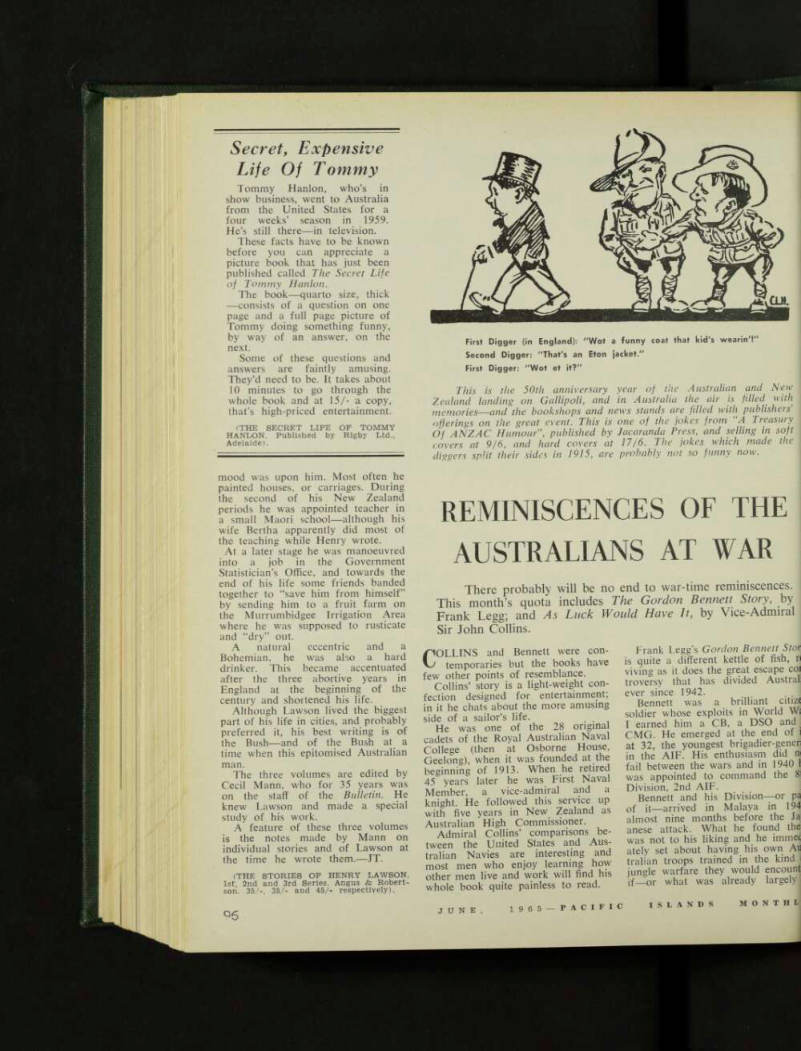
This is the 50th anniversary year of the Australian and New Zealand landing on Gallipoli, and in Australia the air is with memories—and the bookshops and news stands are filled with publishers offerings on the great event. This is one of the jokes from “A Treasury Of ANZAC Humour ”, published by Jacaranda Press, and selling in soft covers at 9/6, and hard covers at 17/6. The jokes which made the diggers split their sides in 1915, are probably not so funny now.
There probably will be no end to war-time reminiscences.
This month’s quota includes The Gordon Bennett Story, by Frank Legg; and As Luck Would Have It, by Vice-Admiral Sir John Collins.
COLLINS and Bennett were con temporaries but the books have few other points of resemblance.
Collins’ story is a light-weight con fection designed for entertainment, in it he chats about the more amusing side of a sailor’s life. , He was one of the 28 original cadets of the Royal Australian Naval College (then at Osborne House, Geelong), when it was founded at the beginning of 1913. When he retired 45 years later he was First Naval Member, a vice-admiral and a knight. He followed this service up with five years in New_ Zealand as Australian High Commissioner.
Admiral Collins’ comparisons be tween the United States and Aus tralian Navies are interesting and most men who enjoy learning how other men live and work will find his whole book quite painless to read.
Frank Legg’s Gordon Bennett Star is quite a different kettle of fish, r( viving as it does the great escape coi troversy that has divided Austral)
ever since 1942. . . i
Bennett was a brilliant citize soldier whose exploits in World Wt I earned him a CB, a DSO and CMG. He emerged at the end of i at 32, the youngest brigadier-generi in the AIF. His enthusiasm did n( fail between the wars and in 1940 I was appointed to command the 81 Division, 2nd AIF.
Bennett and his Division—or pa of it—arrived in Malaya in 194 almost nine months before the Ja] anese attack. What he found thei was not to his liking and he immed ately set about having his own Au tralian troops trained in the kind ] jungle warfare they would encountl if—or what was already largely!
First Digger (in England): "Wot a funny coat that kid's wearin'!"
Second Digger; "That's an Eton jacket."
First Digger: "Wot et it?"
ertainty, when—the Japanese in aded.
Through these months there was ome friction between Bennett and iritish Top Brass as to what should nd should not be done with the Aus ■alians; and some difference of pinion between Bennett and some of is own staff officers who had been tiosen by Bennett’s predecessor. All tese frictions were later blown up ) lend colour to the arguments pro id con the ethics of Bennett’s escape om Singapore.
On December 7, 1941, the Japanese ruck at Pearl Harbour, and simul neously bombed Singapore and nded troops at Kota Bharu, in the irth of the Malayan Peninsula.
The rest is history. On February >, 1942, the British surrendered.
By this time, Bennett’s mind had ready been made up: As soon as e surrender came he would try to cape back to Australia and tell the tailed story of the defeat, passing i the lessons the Australians had irned in recent weeks and “making /self available to help in the ultimate lief of our grand army of brave sn.”
Enthusiastic Welcome Escape he did. He was welcomed thusiastically by the people of Aus- Jia and the Australian Government and sent to Coventry by the Aus lian Military authorities, who saw it that he never again had an :ive command. Their hostility led a Royal Commission at the end 1945 which found that it had been nnett’s duty to “remain in command the AIF until the surrender was nplete”. ‘Until the surrender was complete”, Dears to be the crux of the matter 1 subsequent arguments seem to ige around the fact that although : surrender occurred at 8.30 p.m February 15, 1943 the actual lay down of arms didn’t occur until p.m. It all seems like so much r-splitting 23 years after the event. \s Legg points out, Australia’s neral Blarney and New Zealand’s neral Freyberg had been ordered leave their troops in Greece in U, and a flying-boat was laid on see that they got away, jeneral MacArthur was ordered of the Philippines before his Dps were captured. Why should Bennett get away from Singapore ler his own steam, when he could serve a purpose by stay mrther, it was later revealed that irchill had sent a clear directive General Percival during the final tie for Singapore that, when
matters became hopeless, opportunities should be given for armed parties to escape. The message was never passed on to the Australians.
Legg’s book settles nothing in the Bennett controversy. It simply points once again—if we still need to be re minded of it—to the utter futility of much of Britain’s military planning in this period. It deserved the thrash ing it got in the Malayan campaign.
Frank Legg, a journalist, served with the 9th Australian Division in the Middle East but in 1944 was seconded to the Australian Broad casting Commission as a war corre spondent. He still originates ABC radio and TV shows and documentaries.
(As Luck Would Have It. Angus
& Robertson. 37/6. THE GORDON BENNETT STORY. Angus and Robertson 45/-.