New Caledonian Mining
pp. 87-89 · Read in the full issue
Magnate Fought Duels
To Defend His Honour
By Lew Friday
When the history of mining in the South Pacific comes to be written, space will have to be given to two giants of New Caledonian exploitation, John Fligginson, an Englishman, and Lucien Bernheim, a German Jew.
HIGGINSON was the more spec tacular, but Bernheim was the sounder business man, for Higginson was near bankruptcy when he died in Paris, while Bernheim retired to the same city a few years later with bus fortune intact.
Bernheim was born at Mulhouse, an the Upper Rhine, in 1856, three years before Higginson, aged 19, arrived penniless in New Caledonia, then a struggling French Colony.
Each in his rise to wealth was to exploit to the full the cheapest labour available —convicts from France, New Hebrideans brought in by black birders, Annamite political prisoners [about whose brutal treatm e n t questions were asked in the House of Commons), and Japanese and Jav anese coolies.
Each was accorded French nationality on reaching a dominant position in island affairs. Like the great firm of Ballande, which shipped the Asians in, they were both hard taskmasters.
The Bernheim family, bitterly anti- Serman, escaped to Switzerland at he start of the Franco-Prussian war, md at 14 Lucien crossed the French frontier to join the Legion of Alsace md Lorraine.
After the debacle, he worked his nassage to the Orient, where he ran i lime kiln in Indo-China.
Like Higginson he was drawn to Australia to prospect for gold, but the nickel boom in New Caledonia, so deverly exploited by Higginson, wrought him to Noumea, where he necame a store employee.
Thio Mine By strict economy he saved £2OO, md with this he began to operate a imall mine in the Thio district. He vas the only small miner to hang on it a time when all others, including nany Australian and New Zealanders vere forced to sell out to the Nickel Company, which had a shipping nonopoly.
When, at the height of the slump,
the rich Basse Alpes mine was up for sale, Bernheim somehow scraped to gether enough money to get a grip on it.
Two years later, he left the Basse Alpes mine in the hands of the most capable mining engineer in the Colony, a Comishman named William Nicholls, who had put into operation the first successful nickel venture, the Bel Air at Houailou, even before Higginson took it over.
Bernheim then moved to the West Coast to pioneer the Nepoui River region north of Bourail.
Vast deposits there of chocolate coloured ore had hitherto been neglected in favour of the more at tractive-looking green-coloured garn ierite. The new finds doubled the country’s nickel reserves.
To exploit these finds, the only man Bernheim could turn to for
assistance was Higginson, who struck a hard bargain.
Bernheim would be provided with material and labour on condition that he paid for it monthly, step by step.
He knew that if he failed his enter prise would be swallowed up by his grasping rival.
It was under these conditions that Bernheim built, stretch by stretch, 37 kilometres of tram lines from his main mines, Surprise, Sirius 1 and 2, to haul the ore to the Nepoui jetty. The
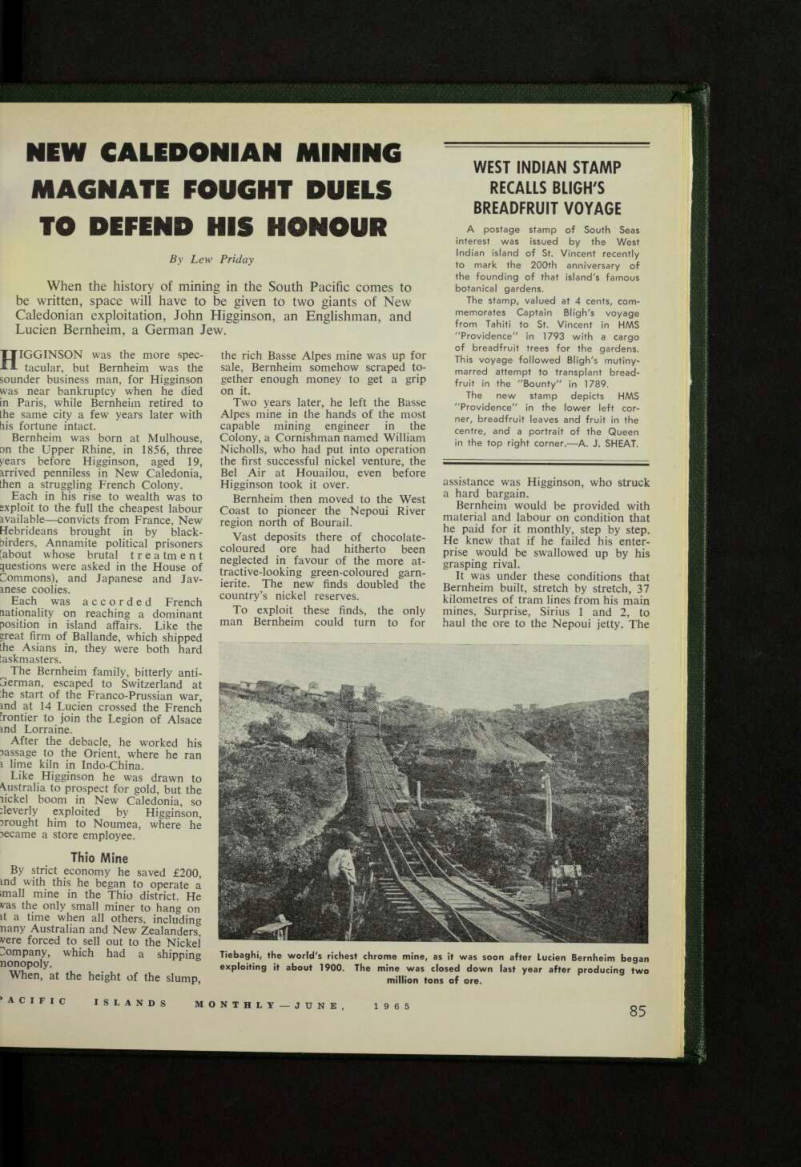
Tiebaghi, the world's richest chrome mine, as it was soon after Lucien Bernheim began exploiting it about 1900. The mine was closed down last year after producing two million tons of ore.
;ost worked out at 30,000 francs a dlometre, but proved economic in he end, for he was the first in the sland to send ore to the wharves un mgged.
On other haulage jobs he employed 00 wagons, 200 oxen, and 60 horses, fhe speed with which his flying fox quipment was erected, bringing ore lown to the river flats, amazed every lody. He was as hard on himself as m his workmen, and stayed on the ob even when a typhoid outbreak Irove other whites away.
With Nepoui in full production, he xtended his operations northwards d the area centred on Pouembout nd Kone—the first a convict settle icnt and the second a free town hip. The tremendously rich Mount [oniambo was in this field.
After some years, these interests /ere bought out by the Nickel Com any, which closed the West Coast 0 exploitation to concentrate pro uction at Thio. (Only last year did le company announce its intention of ringing out French technicians to re pen mining on the West Coast for ickel).
Bernheim next turned to chrome, 1 the exploitation of which he led ic way. Wool ships from Australia greed to call at the island for hromite —an ore which weighs one m to the cubic metre—to take it s ballast to the European markets.
Richest In World Another chrome deposit that Bern eim exploited was that at Tiebaghi, i the north, for which the little port f Pagoumene was built.
This mine, with ore of 56 per cent, lineral content, was long regarded s the richest chrome mine in the orld.
It was accidentally discovered by stockman while searching the great arren Tiebaghi Dom for strayed attle.
He took samples to Bernheim, who eclared the find and formed the Dciete le Chrome, which absorbed a ossible rival, Australian Chrome imited.
Bernheim brought in Adolphus, son f William Nicholls, to manage Tie aghi. Then, about 1900, he arranged >r the British firm of Birch and Co. ) run the mine. This company was ter taken over by a large corpora on which was mining chromite on a rge scale in Rhodesia. (During World War 11, the mine assed from British to American ands, and by 1964, when it was osed down, over two million tons of re had been extracted from it).
Later Bernheim backed another reject, large by local standards,
carried out for him by another of William Nicholls’ sons, Josiah.
This was the harnessing of the Yate River, which drains the Plaine des Lacs in the south, by the construetion of a dam and hydro-electric smelters. This involved the construetion of a large tunnel through the mountain at the side of a picturesque gorge. These smelters, opened in 1913, are now operated by the Nickel Company, Sunnnrtprl Rpfnrmc supported Reforms As he became rich, Bernheim lived down the personal, political and racial envy which marred his years of struggle. By conviction a Republican, he, unlike Higginson, backed Governor Feillet’s far-reaching and expensive reforms, which involved the end of transportation and the replacement of convict labour by Oriental labour as well as the introduction of a few hundred settlers from Northern France and Belgium—the so-called Nordistes. j inese steps made Bernheim un-
popular with the reactionaries, and more than once he was publicly in suited.
On several occasions, under the code of honour then prevailing, Bern heim, or his eldest son, were forced to fight duels on Noumea’s Anse Vata Beach. In one such duel, Bern heim was wounded in one arm.
Eventually, to honour a promise he had made to his wife, a Swiss, Bernheim returned to Europe, and kke man y self-made millionaires, who, with the passage of years became re : spected citizens, he left New Caledonia with the reputation that he had the island’s interests at heart, On one or two brief visits to the country, the colonials welcomed him back as one of themselves, Bernheim’s two sons were born in the Colony. Constant, the elder died in 1910; Gaspard, the younger’ died a captain in the French Army in 1914 of wounds received in action.
Bernheim endowed the Noumea Library and Museum in memory of his younger son.