Fiji's Copra Renaissance
pp. 63-67 · Read in the full issue
May Lead To One Voice
For Pacific Planters
From a Special Correspondent in Suva
The coconut, after being among the depressed things of the world, has taken on a golden sheen in the Island territories of the South Pacific. And Fiji in particular is now thanking its lucky stars that, after years of muddle and strife, the local in dustry has put its house in order just in time for planters to jump on the bandwagon of rising prices.
producers are being paid the i highest prices for years, with ises of £5 a ton for hot air dried opra twice in a couple of weeks, to ring the price (on May 3) to FB2/12/6 a ton.
For helping to put its house in rder at this crucial time, Fiji’s copra rowers and merchants have to thank ,ord Silsoe, saviour of Fiji’s sugar in ustry and now architect of the new iws which will revitalise the coconut idustry.
The copra industry in Fiji has had . history of bedevilment by sickness, y inefficiency, by slipshod methods f production and hit-and-m is s icthods of dealing.
And if these things were not enough 0 stretch the industry on its back, /orld prices have been depressed and tie coconut has more natural enemies tian almost any of the democratic [ations —the rhinoceros beetle, the tick insect, the rat and a dozen other haracters of nature’s underworld.
Almost Lifeless
Wartime prices for copra reached ock bottom, falling to £2 and £3 a on in Fiji. There is little wonder hat producers lost so much heart hat when a price recovery came after he war Fiji found its copra industry Imost lifeless.
Between the growers and the buyers here was antagonism, born of the ilanters’ suspicions that they were >eing short-changed, and the buyers’ mpatience with the quality of copra hey were forced to buy to stay in msiness.
The first real effort to increase pro luction and to turn plantations and ;roves into something approaching he well-tended acres in the Philip )ines came in 1961 at a time when irices were only a little above £4O 1 ton. And the effort was abortive.
It was made with an ill-conceived bill introduced into the Legislative Council by the then Development Commissioner, Mr, Eric Bevington.
The Coconut Palm Development Ordinance, 1961, was more in the way of a doctor administering aspirin to a patient who was in the last throes of blackwater fever, and certainly it was not the answer to the planter’s prayer. The bill provided for payments for improving planta tions and for new planting; but the trouble was the finance had to be found by the industry itself in the form of a levy, with the Government contributing £ for £.
The only chance the planter had of getting his money back was by putting more into his plantation, but with copra prices so low, it seemed to the planter that this was throwing good money after bad. The 25/- a ton levy was more than half the price the planter was getting for his copra.
Certainly if a soothsayer could have given the planter a peep into a genuine crystal ball to reveal the lofty ceiling that copra prices would reach, he might have taken the risk,
but most crystal balls are notoriously unreliable.
The bill had a rough passage through the Legislative Council. Mr.
Bevington was accused of trying to teach the planters how to do their job, and as the planters were still suspicious of the buyers they feared that increased rewards, if any, would go to the merchant.
The bill was steamrollered through but, like steamrollers, it never took to the air. It went on to the Statute Book and remained there, unwanted.
But the efforts made over the bill did create an urge for better things, and the planters approached the Gov ernment, asking that a commission should investigate the copra industry, just as the Sugar Commission headed by Lord Silsoe (who was then Sir Malcolm Trustram Eve) had investi gated and re-created the sugar in dustry.
What better man for this job than Lord Silsoe, some wise man in the Government Buildings thought. So Lord Silsoe arrived in 1963 and using his genius, his keen forensic mind and his experience gained on the Sugar Commission, he blew away the cobwebs, scooped up the rotting foliage and proved to be the steam hammer needed to crack the nut in dustry. His advent was welcomed by both sides.
Lucid Report
On his way to Fiji he had stopped off in Jamaica and had a look at the industry there. He spent some time in Tonga which had grappled with and solved many of the problems of the Fiji industry, and he sent his secretary, Mr. R. T. Sanders —now appropriately enough in the Fiji Office of Natural Resources—to Western Samoa.
He studied all the information he could get from the Gilberts, from the Solomons and from Papua-New Guinea, largest copra producer in the South Pacific. (Fiji comes next).
His lucid final report issued in September, 1963, read in parts like
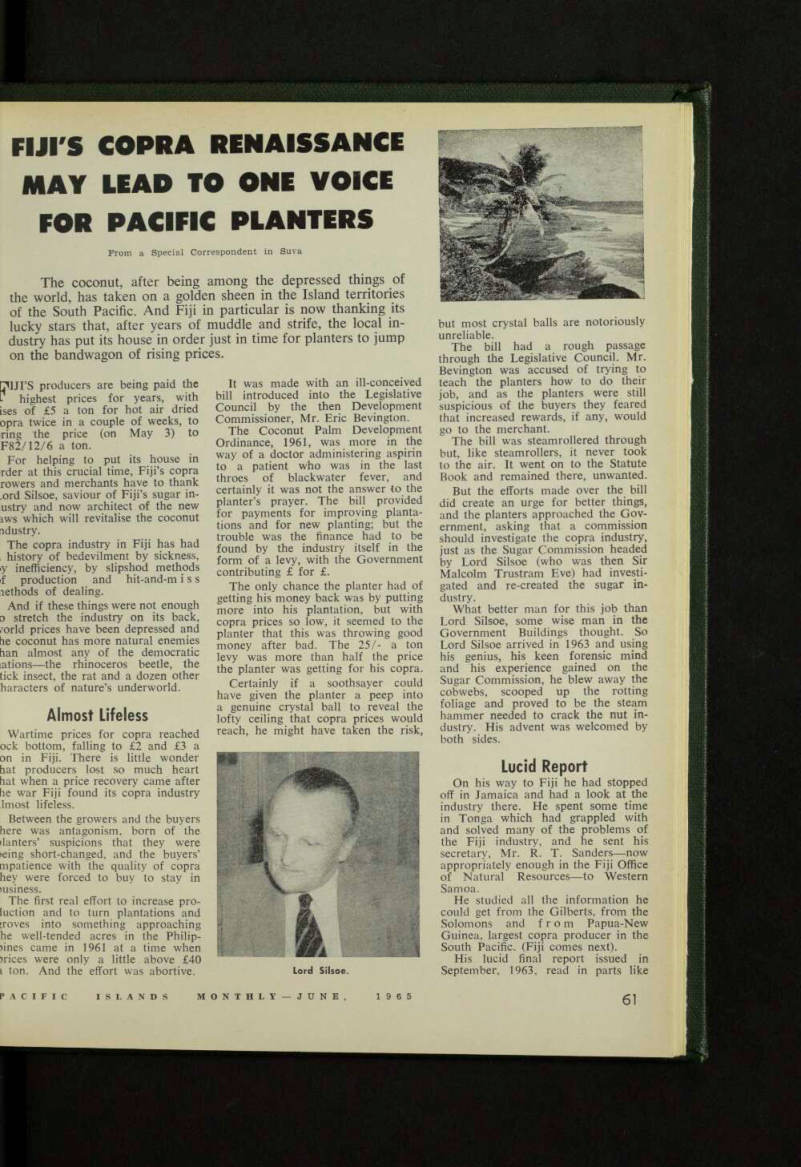
Lord Silsoe.
a school textbook, one chapter ending with a list of “Lessons to be iearnt from other countries”, which was just the thing for the Fijian growers and for some of the better educated planters. There were 16 lessons to be leamt, he said.
He had a blue-print to work from —his own highly-efficient plan for the sugar industry—and he quarried that extensively.
He suggested a Coconut Board and a Coconut Advisory Council, just as he had suggested and created a Board and a Council for the sugar industry.
He laid down rules for procedure, how they should function, how they should be financed, and topped that off with a valuable suggestion which had not as yet found an echo in other copra areas of the South Pacific.
Speak As One
“The production of copra in Fiji is about one per cent, of the present world production,” Lord Silsoe wrote: “The production of New Guinea—the largest producer in the South Pacific —was in 1961 just over 2i per cent.
But the total production of the area covered by the South Pacific Com mission is just above 10 per cent, of that of the world. ‘This total production is larger than that of the whole of Central and South America and nearly three times that of the whole of Africa. One per cent, gives no influence in world affairs but a collective view expressed by 10 per cent, is usually fairly effective.
“The South Pacific, speaking with one voice, would have even more in fluence over their exports of copra or coconut oil.”
Lord Silsoe was thus advocating something on the lines of a South Pacific Copra Commission, and the challenge to action is now being taken up by Ratu K. K. T. Mara, Fiji’s Member for Natural Resources.
Ratu Mara Moves
He told this correspondent that he has already made tentative approaches to the heads of other territories and in June he will see the Western Samoa Government for talks on both copra and bananas.
He also hopes to see Prince Tungi, Premier of Tonga, about the same time, and out of this could come the united voice that Silsoe wanted.
Lord Silsoe himself took a look into the crystal ball and wrote: “After finishing my survey I am not in the least gloomy.
“Increasing populations all over the world and increasing standards of liv ing will surely require more and more edible and non-edible fats.
“I have read everything up to date I can find and it appears to be thought that among its competing oils —soya bean, groundnut, palm, whale and fish—coconut oil should at least keep its place.”
The report was received with relish by both sides of the industry, and hailed on the whole, as a blue-print for the industry.
The Government has since got to work, fashioned legislation on the framework of the report, and produced a “bill relating to the growing of coconuts and the manufacture of copra, coconut oil and coconut products,” which had an easy passage through the recent, March, sitting of the Fiji Legislative Council for two reasons- It was a good bill; and output was rising due to a subsidised scheme for thinning out groves and plantations, replanting and cleaning up.
The subsidy was at Lord Silsoe’s suggestion—a substitute for the levy system. The subsidy was based on half the estimated cost of improving a plantation, and one of the conditions suggested by Lord Silsoe, a psychologist who knows Fijian ternperament, was that payments for clearing and thinning be available for only three years. This was an astute move to produce quick action in the mataqali-owned groves to which the subsidy is confined.
The scheme also encourages the use of cattle. They range freely in the plantations, keep down the weeds and undergrowth which consume
plant food and hide fallen nuts, and are then, after fattening, slaughtered to repair a big deficiency in the Colony’s home-produced food sup plies.
The subsidy has already demon strated to Fijian growers the stupidity of their lackadaisical system of run ning groves. When groves were cleaned and the dense undergrowth cleared away, nut production jumped immediately, in some places by almost 50 per cent,
NutS lost
, , Fijian found that he had for generations allowed almost as many fallen nuts to be buried and l° st * n the undergrowth as he sold to the buyers. It was not the buyer who vas .the big bad wolf, but his own inertia though some prefer the word malua.
The new bill provides for control of the industry in all its phases, with a Board and an Advisory Council, the latter made up of representatives of both sides.
As Ratu K. K. T. Mara said when piloting the measure through in March, it was proposed that the members of the industry should them selves run the industry with the minimum of Government interven tion.
One of the main jobs of the Board is to issue licences for copra makers, coconut oil makers, copra exporters, coconut product makers, exporters of coconut and copra traders. The Board
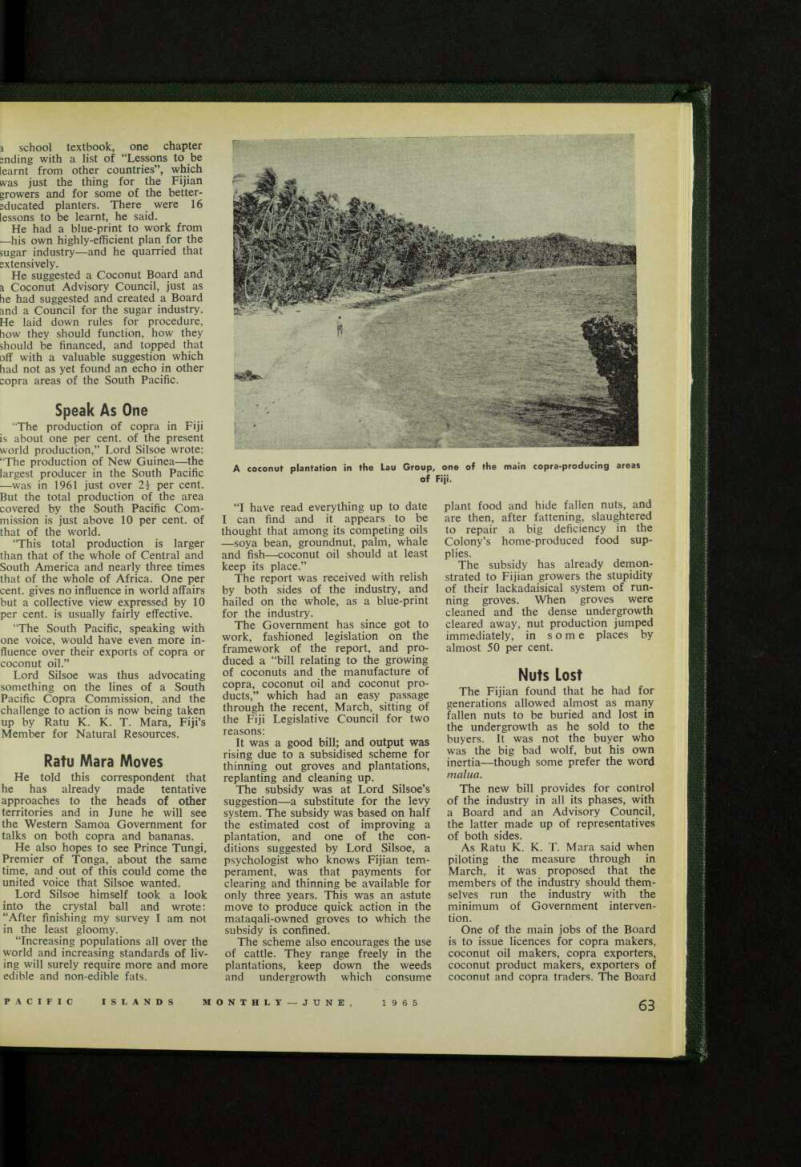
A coconut plantation in the Lau Group, one of the main copra-producing areas of Fiji.
can also, with the approval of the Governor-in-Council, issue a licence to a maker of desiccated coconut.
It can “cause copra driers to be in spected” and can prohibit the “sale or purchase of such varieties of coco nuts as may be specified in such order” and may also prescribe the minimum number of coconuts to be bought at any one time by a copra maker.
The bill provides for punishment in the courts for contraventions of regulations. It is, for instance, an offence for any person without a licence to make copra or coconut oil or any other product or export copra “by way of trade or business”. The penalty is in some cases a fine not exceeding £250 or imprisonment for a period not exceeding 12 months.
Latest figures show how the in dustry, which was a couple of years ago somewhat loosely geared to the Colony’s five-year development plan, is already beginning to enjoy the effects of that plan and of the sub sidised improvements being carried out in plantations and groves.
Fijian copra production alone, from
July 1, 1963, to June 30, 1964, rose by about 5,000 tons, mainly because at long last no coconuts were being left to rot in undergrowth.
Total production (including European) in the years 1963 and 1964 has been about equal but both years showed a big improvement on 1962 production and before. Last year Fiji produed 41,209 tons of copra; exported 7,078 tons of copra, 22,819 tons of coconut oil and 9,519 tons of coconut cake and meal.
In 1962, copra production was only about 30,000 tons.
About 60,000 acres of mataqali groves were cleaned and thinned last year—about 60 per cent, of Fijian holdings.
Last year 1,000 acres were re planted and 3,800 acres of new areas were planted.
Benefits of replanting and new planting will not be reaped for at least five years, and the February hurricane which devastated the Yasawas robbed the Colony of about 1,200 tons of copra for the next five to seven yeas.
Fiji is keeping its fingers crossed and praying that the golden sheen on the coconut will not meanwhile fade. The indications are that, although prices may not remain in the present bracket for long, there will be good prices for some years to come. And in fact there may never be cheap copra again.
DOING COURSE: Mr. Rudolf Off, Deputy Government Printer, Western Samoa, is currently study ing graphic art at Sydney Technical College under a scholarship spon sored by the Australian Govern ment which entitles him to a two year course. But because of pressure of work and a staff short age at home, he may be recalled after completing his first year. —Tele-Photos.