Unique Prehistoric Drawings
pp. 59-61 · Read in the full issue
Found In Caves On Lifou
From Fred Dunn in Noumea
The first prehistoric cave drawings ever found in the islands of New Caledonia were discovered recently in a series of caves on Lifou, one of the Loyalty Islands, by a member of New Caledonia’s meteorological service, Mr. Keller.
PHE Loyalty Islands lie about 50 miles off the east coast of New 'aledonia. Lifou, the largest, with population of 6,000, is 50 miles >ng and about 25 miles across. It i of coral formation and appears to ave been formed by three or four iccessive upheavals.
There are no hills or streams on le island; in fact, no physical ;atures worth noting, except a ridge f rocks 200 ft high, which is full f caves.
The natives of the island, who are now a mixture of Melanesian and Polynesian strains, with a good deal of English sailor blood thrown in, once used the caves as secret burial places, and they were thus tabu to most of the people.
Even now Lifou’s council of elders does not readily grant permission for anyone to visit the caves, and Mr.
Keller, who is the local representative of the meteorological service, had to use all his powers of persuasion to be allowed to enter them.
However, he was not allowed to go in alone—several of the elders accompanied him.
Mr. Keller has reported that to reach the cave where most of the drawings are to be found, he had to crawl and squirm through narrow passages and orifices for about 100 yards. He estimates that this “art gallery” is about 30 yards long by 15 yards wide.
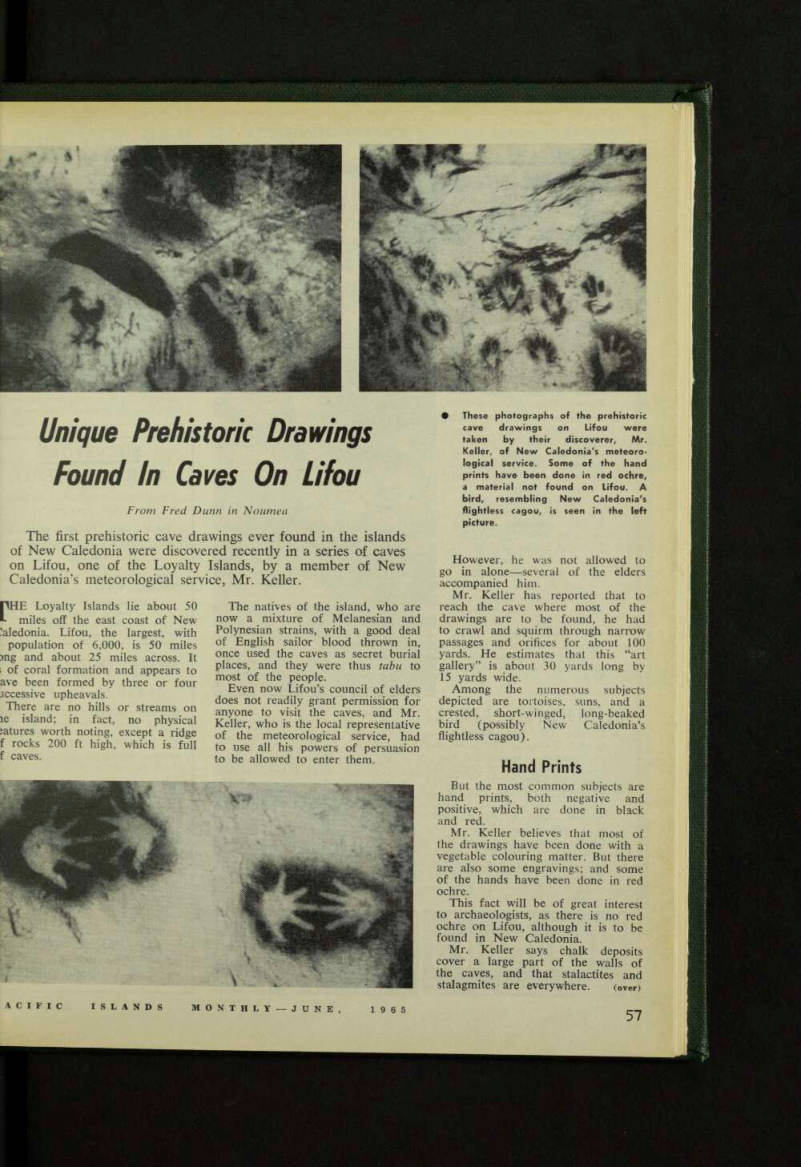
Among the numerous subjects depicted are tortoises, suns, and a crested, short-winged, long-beaked bird (possibly New Caledonia’s flightless cagou).
Hand Prints
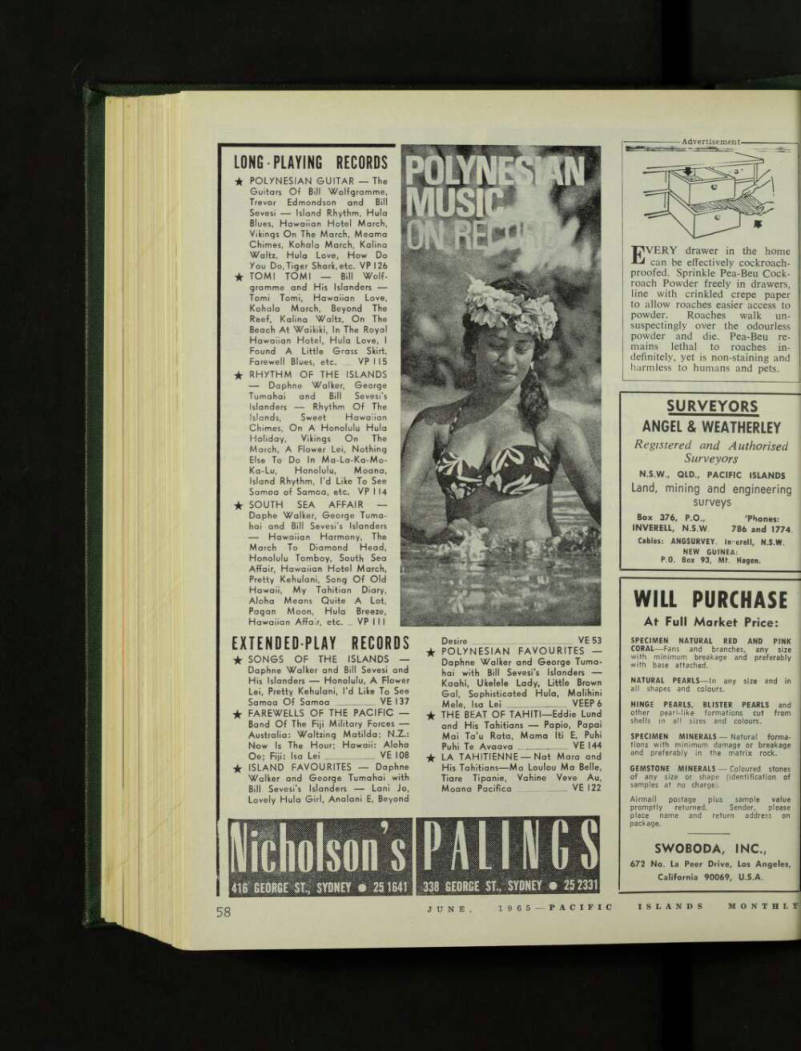
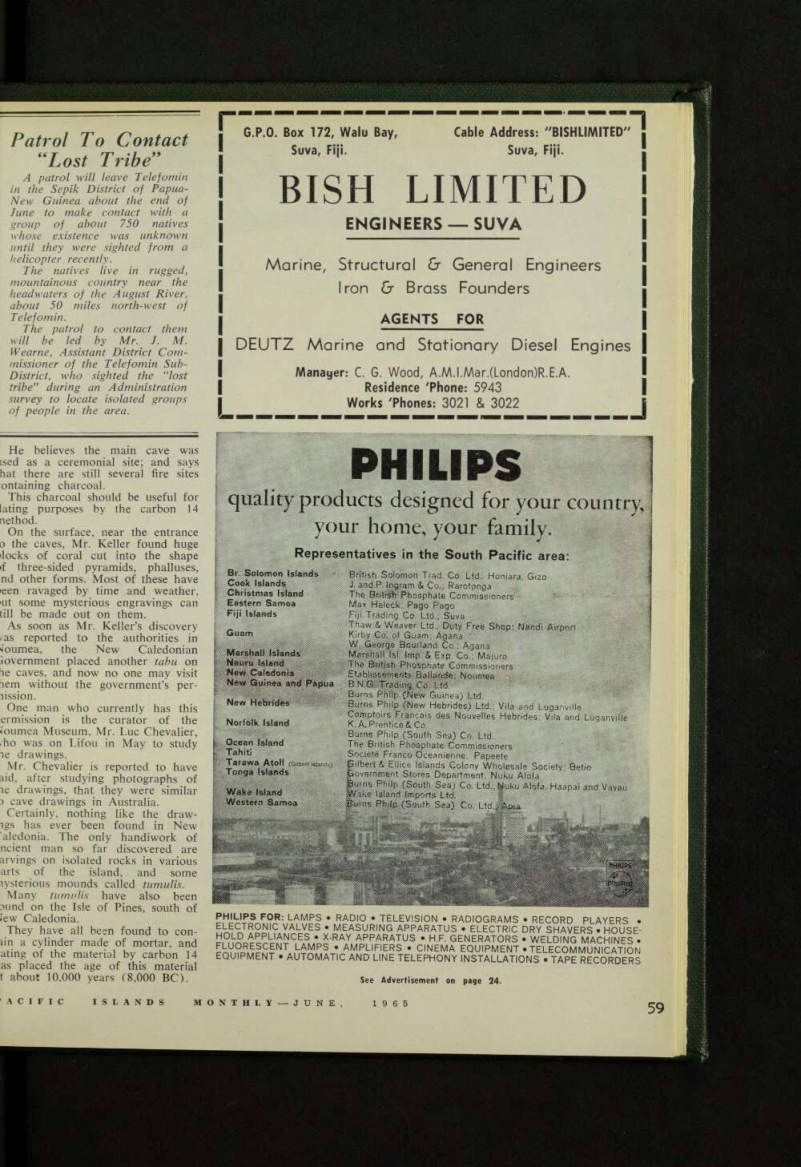
But the most common subjects are hand prints, both negative and positive, which are done in black and red.
Mr. Keller believes that most of the drawings have been done with a vegetable colouring matter. But there are also some engravings; and some of the hands have been done in red ochre.
This fact will be of great interest to archaeologists, as there is no red ochre on Lifou, although it is to be found in New Caledonia.
Mr. Keller says chalk deposits cover a large part of the walls of the caves, and that stalactites and stalagmites are everywhere. (over)
These photographs of the prehistoric cave drawings on Lifou were taken by their discoverer, Mr.
Keller, of New Caledonia's meteoro logical service. Some of the hand prints have been done in red ochre, a material not found on Lifou. A bird, resembling New Caledonia's flightless cagou, is seen in the left picture.
He believes the main cave was ised as a ceremonial site; and says hat there are still several fire sites ontaining charcoal.
This charcoal should be useful for [ating purposes by the carbon 14 nethod.
On the surface, near the entrance o the caves, Mr. Keller found huge 'locks of coral cut into the shape •f three-sided pyramids, phalluses, nd other forms. Most of these have >een ravaged by time and weather, •ut some mysterious engravings can till be made out on them.
As soon as Mr. Keller’s discovery *as reported to the authorities in 'ioumea, the New Caledonian iovemment placed another tabu on le caves, and now no one may visit icm without the government’s per lission.
One man who currently has this ermission is the curator of the loumea Museum, Mr. Luc Chevalier, 'ho was on Lifou in May to study ie drawings.
Mr. Chevalier is reported to have aid, after studying photographs of le drawings, that they were similar a cave drawings in Australia.
Certainly, nothing like the draw igs has ever been found in New aledonia. The only handiwork of ncient man so far discovered are arvings on isolated rocks in various arts of the island, and some lysterious mounds called tumulis.
Many tumulis have also been aund on the Isle of Pines, south of lew Caledonia.
They have all been found to con un a cylinder made of mortar, and ating of the material by carbon 14 as placed the age of this material t about 10,000 years (8,000 BC).