Lae Meeting May Bring Some
pp. 49-53 · Read in the full issue


Get-Up-And-Go To The SPC
By a Staff Writer
The first real steps towards South Seas political unity will be taken at a vital meeting in Lae, New Guinea, in July. The meeting—the Sixth South Pacific Conference —could be a turning point in South Seas politics.
ET, officially, there will be no politics involved, and politics 1 certainly not be encouraged at meeting.
Hie conference has been sponsored the South Pacific Commission, and one of a series of conferences ich have been held every three irs since 1950. Delegates from all ;r the South Seas will attend the etings, which will continue for al ►st a fortnight.
Fhe Lae conference will be like other because there have been im rtant changes within the South :ific Commission itself in the last months.
Fhe changes accompanied the ad ssion last year of Western Samoa a full SPC member—the first inde ident Pacific State to join the mmission. The other members are ; five metropolitan South Seas wers —Australia, Britain, France, iw Zealand and the US.
Not Politics
Collectively they make up a *ional organisation with jurisdic n over 20 per cent, of the earth’s ■face; but the jurisdiction, by agree ;nt, doesn’t involve politics.
The SPC mainly acts as an ad ;ory body on technical and social filers. It is an information ex ange upon which the member gov iments may or may not call, ac rding to whim.
Over the years the SPC has fre ently been the butt of criticism, unly on the ground that its charter s not allowed it to keep pace with ; quick changes in the South Seas.
Some critics have pointed out that litics are so much a part of an lerging Pacific that any organisa >n which is forced to ignore them nply can’t do its job properly.
Another major criticism is that be use headquarters are at Noumea 2 SPC has seemed remote, and that needs to be based in some busy ib, such as Suva or Sydney.
In reply it has been pointed out that despite its charter no organisa tion is any better than the people it employs, and the people who are expected to co-operate with it.
At various times since 1947 the SPC has been badly served on both counts, with personal feuding within the organisation, and outside it an animosity, almost a contempt, by some officials of the Island territories who ought to have been giving their co-operation. Today these criticisms are no longer valid, and the SPC is accepted as a useful and at times valuable body.
Revision
At one stage there was pressure for the whole charter to be thrown open for revision, but this was re jected by the majority, who were apprehensive that a major revision would leave loopholes for develop ment of activities along political lines.
No member government wants the SPC to become a political federation of the South Seas, usurping its own authority (although if this in fact did happen the government which would be least alarmed about it is Britain), Britain has been among those who
have held that the SPC could bring itself up-to-date without any real al teration to the charter—that changes were possible within the existing framework, and that given the oppor tunity the Islanders themselves could give the SPC the teeth it needs with out danger of turning the organisa tion into a political machine.
The matter of a new site for head quarters has now virtually become a dead letter, since most member gov ernments are convinced that if head quarters were removed from Noumea the French would leave the SPC in pique. They do not consider the obvious advantages of the move would be worth this price.
There is no doubt at all that politics do come into the work of the Commission, and the changes that have been made in the last 12 months are in fact an almost unconscious
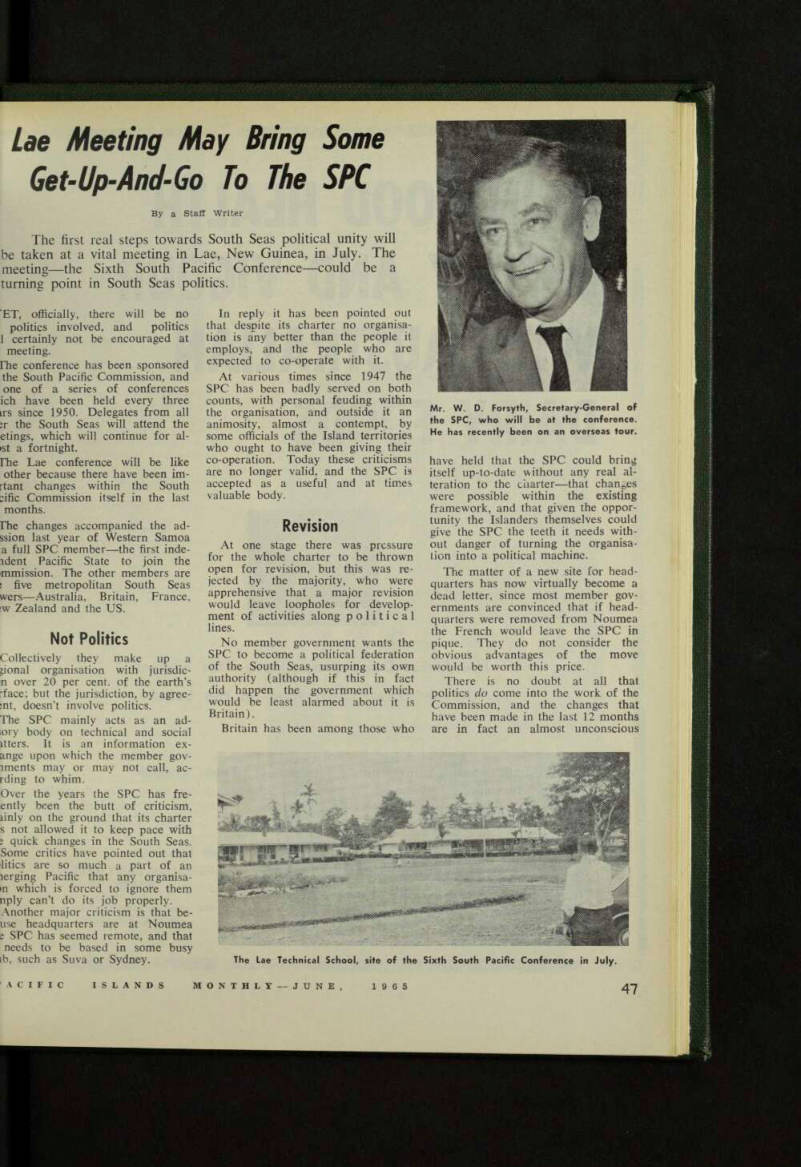
Mr. W. D. Forsyth, Secretary-General of the SPC, who will be at the conference.
He has recently been on an overseas tour.
The Lae Technical School, site of the Sixth South Pacific Conference in July.
recognition of this by the member governments.
Within the Commission meetings themselves reports are altered, or re stricted, because of political con siderations, and the same considera tions affect discussions and decisions of the Commission. This is natural.
The South Pacific Conferences themselves have turned out to be useful political sounding boards for the member governments, both be hind scenes and on the floor of the meeting, for these conferences meet on two levels.
Behind-scenes observers from the metropolitan governments, many of them on a senior diplomatic levei, swap ideas and put forward points of view. Some of it is pure kite flying; at other times it is a serious attempt to convince colleagues on a particular argument.
The changes which were approved in Noumea last year were fore shadowed, behind scenes, at the Fifth South Pacific Conference in Pago Pago in 1962. Observers at that meeting tossed around among them selves a whole series of proposals for improving the work of the Com mission, and there was much lobby ing.
The ideas were taken a step further at a special closed conference in London the following year, but much of the groundwork for unanimity had been laid at Pago.
The Islanders themselves, the people who had come along to speak publicly at the conference, were also doing their own kind of lobbying
at the Pago conference as they got to know each other and began to swap their ideas on where they thought the Pacific was headed.
Much of their conversation was political, and sometimes this boiled over into the conference room.
One notable occasion was when the Netherlands New Guinea delegates attempted to raise the subject of the Indonesian invasion of their country.
This was nipped in the bud by the conference chairman, who pointed out that the agenda had to be followed and that politics weren’t a legitimate subject for discussion anyhow.
This ruling, although correct, caused mutterings of dissent.
There was a similar reaction at the Fourth Conference, at Rabaul in 1959, when delegates finally realised that the agenda had to be followed, even though it had been fixed perhaps 12 months to two years before.
There was a feeling that the con ference did not give them scope to discuss the things that mattered in the way they wanted to discuss them.
At the early post-war conferences the fact that the agenda was so rigid did not matter, for at that stage the Islands people were sltli feeling their way.
They were content to be organised, and even manipulated, by the Euro pean organisers of the conference
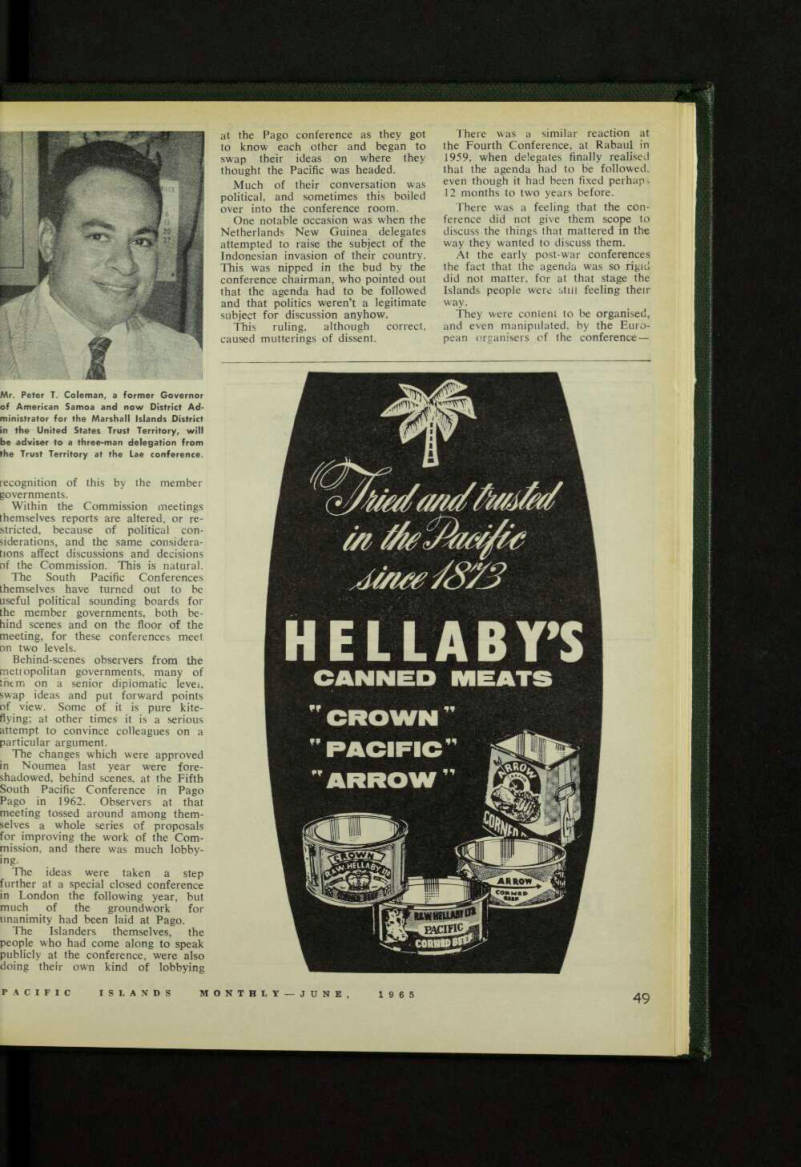
Mr. Peter I. Coleman, a former Governor of American Samoa and now District Ad ministrator for the Marshall Islands District in the United States Trust Territory, will be adviser to a three-man delegation from the Trust Territory at the Lae conference.
by the metropolitan governments which at that time appeared to own diem body and soul.
But the South Pacific today is a Afferent place.
New Guinea elects a majority Assembly on a common roll, Fiji is n the midst of noisy political change, :he Cook Islands are getting self government, Western Samoa is inde pendent—and everybody, just every body, has a point of view which he nsists be heard.
Even the one backward step that las been taken—the step forced on :he West New Guineans by Indonesia, which removes hope now of their becoming their own masters—has lelped speed up developments in bther areas. There is not an Islands ;erritory whose inhabitants have not been aware that what really happened n West New Guinea is that Dutch colonialism was replaced by Indo lesian colonialism of a much nar rower kind—and that it was done Linder false pretences to boot.
Not Before Time
With this South Seas awakening, the changes agreed to by the 26th session of the SPC held in Noumea last October were not before their time.
Under these changes the Sixth Conference at Lae will be invited to plan a work programme for the SPC For the next two years. This will be done by forming a new committee From conference delegates—each Territory being entitled to elect one delegate.
The work proposals made by this committee will go to the full SPC session in Noumea this October and may a result constitute the Com mission’s 1966-67 works programme.
This means that for the first time the Islanders will be able to have some real influence in the SPC.
From this experiment there could lead the development of the three yearly conferences into a kind of regional council, which could meet more frequently than each three years. This would be done by degrees—by arranging, for instance, that the works committee meet more frequently.
This could mean the end of the present SPC Research Council, which in fact is not meeting this year so that the decks may be cleared for the Lae experiment. In the past the Council has been a link between the conferences and the Commission.
The Commission has not yet agreed to make future conference agendas
more fluid, nor has there been any alteration in the charter to make it possible for political subjects to be discussed. But with a greater control by the Islanders themselves these things could follow.
Changes in attitude will obviously take place as more territories seek full membership of the SPC and thus control by the “Old Guard” of metro politan powers is watered down.
Western Samoa is the first new member since the SPC’s inception.
She was admitted under new rules that say any territory may be ad mitted by invitation, if it is an inde pendent state and all its territory is,
immediately prior to its independence, within the territorial scope of the
Spc.
No doubt it will become an in teresting point one day to decide just what degree of independence will be required for membership. Will the Cook Islands, expected soon to have internal self-government, be eligible?
Presumably Tonga is entitled to membership now should she seek it.
But the recent alterations to the charter are not the last word, and the important point is that this Sixth South Pacific Conference at Lae in July may go on record as perhaps the watershed of South Seas politics.