A-Bomb Brings Prosperity
pp. 39-41 · Read in the full issue
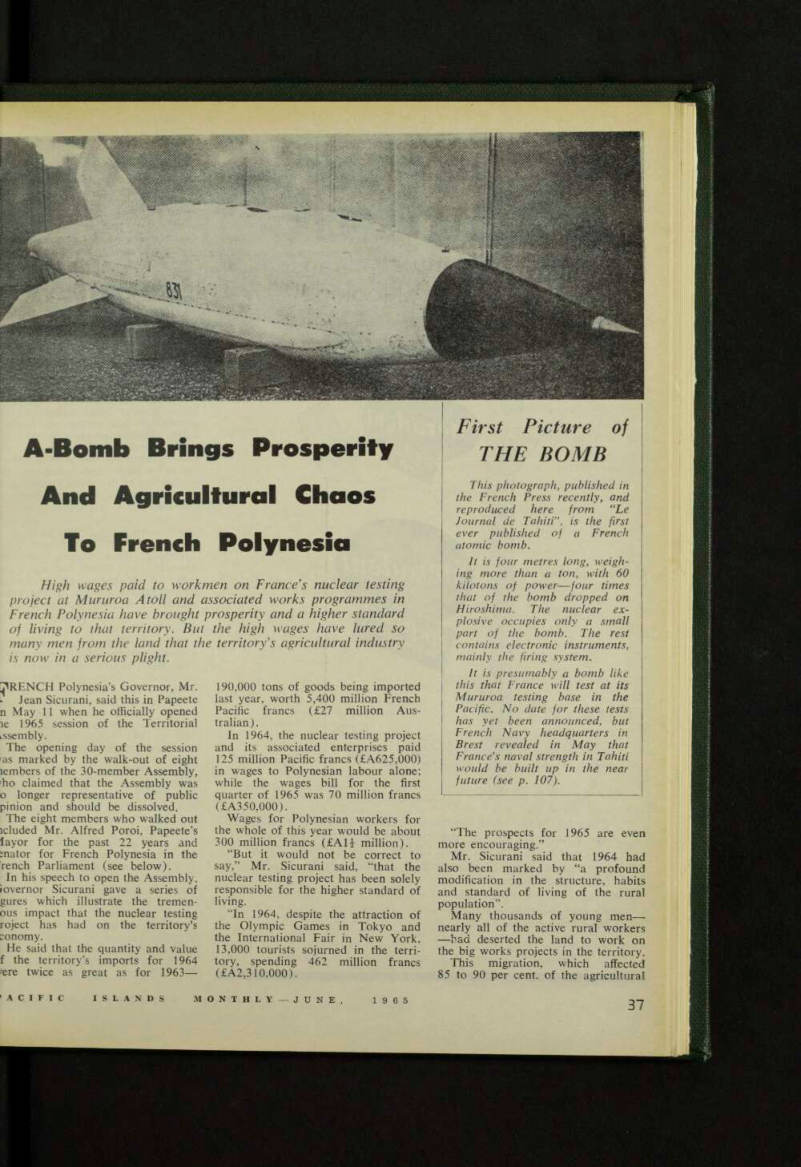

And Agricultural Chaos To French Polynesia
High wages paid to workmen on France’s nuclear testing project at Mururoa Atoll and associated works programmes in French Polynesia have brought prosperity and a higher standard of living to that territory. But the high wages have lured so many men from the land that the territory’s agricultural industry is now in a serious plight.
Polynesia’s Governor, Mr.
Jean Sicurani, said this in Papeete n May 11 when he officially opened le 1965 session of the Territorial assembly.
The opening day of the session 'as marked by the walk-out of eight lembers of the 30-member Assembly, 'ho claimed that the Assembly was o longer representative of public pinion and should be dissolved.
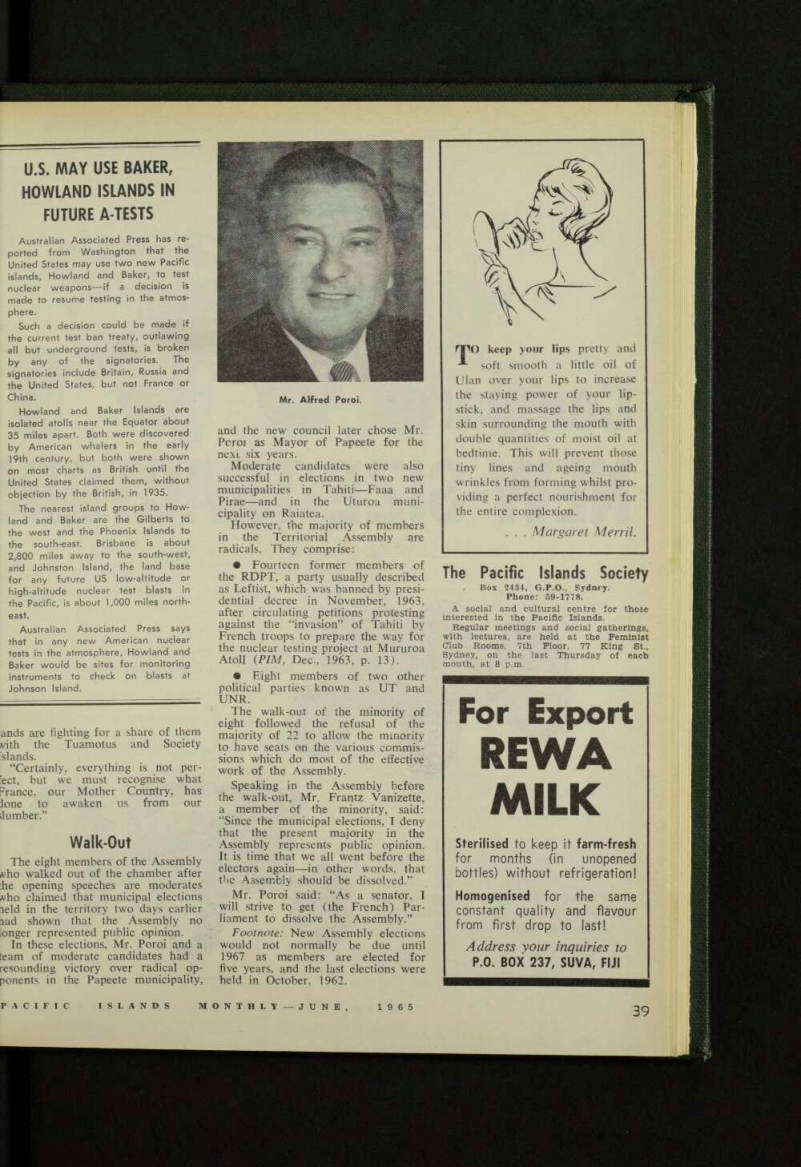
The eight members who walked out icluded Mr. Alfred Poroi, Papeete’s layor for the past 22 years and mator for French Polynesia in the fench Parliament (see below).
In his speech to open the Assembly, rovernor Sicurani gave a series of gures which illustrate the tremen ous impact that the nuclear testing reject has had on the territory’s :onomy.
He said that the quantity and value f the territory’s imports for 1964 rere twice as great as for 1963
190.000 tons of goods being imported last year, worth 5,400 million French Pacific francs (£27 million Aus tralian).
In 1964, the nuclear testing project and its associated enterprises paid 125 million Pacific francs (£A625,000) in wages to Polynesian labour alone; while the wages bill for the first quarter of 1965 was 70 million francs (£A350,000).
Wages for Polynesian workers for the whole of this year would be about 300 million francs (£Ali million).
“But it would not be correct to say,” Mr. Sicurani said, “that the nuclear testing project has been solely responsible for the higher standard of living.
“In 1964, despite the attraction of the Olympic Games in Tokyo and the International Fair in New York, 13.000 tourists sojurned in the terri tory, spending 462 million francs (£A2,310,000).
“The prospects for 1965 are even more encouraging.”
Mr. Sicurani said that 1964 had also been marked by “a profound modification in the structure, habits and standard of living of the rural population”.
Many thousands of young men— nearly all of the active rural workers —had deserted the land to work on the big works projects in the territory.
This migration, which affected 85 to 90 per cent, of the agricultural
population, had had “profound con sequences”.
Mr. Sicurani said that the Govern ment’s first objective—as his pre decessor, Governor Aime Grimald, had said on the same occasion last year—was “to sustain traditional activities so that the rural people would be assured of a constant source of income and so that they would provide more produce for the expand ing local market”.
“But how can one assure the copra producers—the most numerous and the least favoured—a significant but also lasting improvement in their income?”
Mr. Sicurani asked.
“There is no other way, it seems to me, but to establish a coconut pro cessing factory (huilerie), capable of handling the entire production.
“All the conditions are now com bined— natural riches, means of com munication and means of dissemi nating information on a world scale —for developing tourism in the country, and for this it is necessary to re-establish and maintain the equilibrium of the country’s economy.
This is a matter of organisation and investment.”
"Buzzing Hive"
Tevitau Pito, doyen of the Assembly by reason of age, also spoke of the impact of the nuclear testing project on Tahiti and other islands of French Polynesia in a speech at the opening of the Assembly.
He said: “Papeete, peaceful town, sleeping on the edge of an often celebrated lagoon, has become a buzzing hive where it is hard to say what it is that astonishes you most.
“Is it to see boats, ships and tankers swarming in the port while the harmonious islet of Motu Uta (see p. 89) sadly disappears like something grabbed up by a devouring tentacle?
“Is it the disappearance of the wooden houses that have sheltered peaceful households and modest businesses to give place to the proud buildings of cement, built one upon the other?
“I could go on for a long time with this astonishing enumeration . . .
“There is only one reason for this new page in our history—the nuclear testing project, since tourism, alas, is nothing more than a modest artisan in our noisy life . . .
“Full employment of our workmen is assured; prosperity smiles on those who dare; progress is at our door: and the spoils are so great that both the Marquesas and the Austral Is
ands are fighting for a share of them vith the Tuamotus and Society islands.
“Certainly, everything is not per fect, but we must recognise what France, our Mother Country, has lone to awaken us from our ilumber.”
Walk-Out
The eight members of the Assembly vho walked out of the chamber after ;he opening speeches are moderates vho claimed that municipal elections leld in the territory two days earlier lad shown that the Assembly no longer represented public opinion.
In these elections, Mr. Poroi and a team of moderate candidates had a resounding victory over radical op ponents in the Papeete municipality,
and the new council later chose Mr.
Pcroi as Mayor of Papeete for the ncxi six years.
Moderate candidates were also successful in elections in two new municipalities in Tahiti—Faaa and Pirae—and in the Uturoa muni cipality on Raiatea.
However, the majority of members in the Territorial Assembly are radicals. They comprise: • Fourteen former members of the RDPT, a party usually described as Leftist, which was banned by presi dential decree in November, 1963, after circulating petitions protesting against the “invasion” of Tahiti by French troops to prepare the way for the nuclear testing project at Mururoa Atoll (PIM, Dec., 1963, p. 13). • Eight members of two other political parties known as UT and
Unr.
The walk-out of the minority of eight followed the refusal of the majority of 22 to allow the minority to have seats on the various commis sions which do most of the effective work of the Assembly.
Speaking in the Assembly before the walk-out, Mr. Frantz Vanizette, a member of the minority, said: “Since the municipal elections, I deny that the present majority in the Assembly represents public opinion.
It is time that we all went before the electors again—in other words, that the Assembly should be dissolved.”
Mr, Poroi said: “As a senator, I will strive to get (the French) Par liament to dissolve the Assembly.”
Footnote: New Assembly elections would not normally be due until 1967 as members are elected for five years, and the last elections were held in October. 1962.
Mr. Alfred Poroi.