Tropicalities
pp. 23-29 · Read in the full issue


i South Pacific is finally getting around to admitting to itself t it can’t do without the Japanese. But that doesn’t mean that medicine is palatable. There was quite a donneybrook in the stralian Parliament in May as a result of Japanese iness interest in Papua-New Guinea.
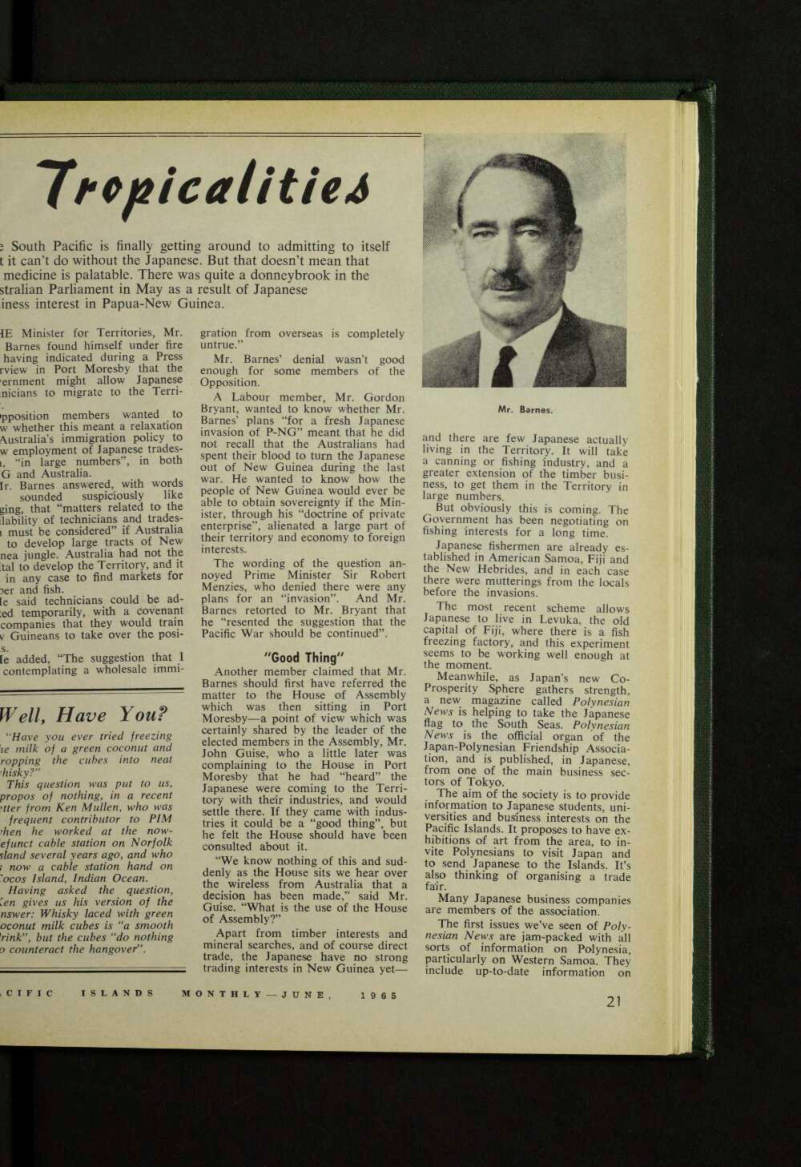
IE Minister for Territories, Mr.
Barnes found himself under fire having indicated during a Press rview in Port Moresby that the 'eminent might allow Japanese nicians to migrate to the Terri ►pposition members wanted to w whether this meant a relaxation Australia’s immigration policy to w employment of Japanese trades i, “in large numbers”, in both G and Australia.
Ir. Barnes answered, with words sounded suspiciously like ging, that “matters related to the lability of technicians and trades i must be considered” if Australia to develop large tracts of New nea jungle. Australia had not the tal to develop the Territory, and it in any case to find markets for 3er and fish. [e said technicians could be ad ;ed temporarily, with a covenant companies that they would train v Guineans to take over the posi s. le added, “The suggestion that I contemplating a wholesale immi
gration from overseas is completely untrue.”
Mr. Barnes’ denial wasn’t good enough for some members of the Opposition.
A Labour member, Mr. Gordon Bryant, wanted to know whether Mr.
Barnes’ plans “for a fresh Japanese invasion of P-NG” meant that he did not recall that the Australians had spent their blood to turn the Japanese out of New Guinea during the last war. He wanted to know how the people of New Guinea would ever be able to obtain sovereignty if the Min ister, through his “doctrine of private enterprise”, alienated a large part of their territory and economy to foreign interests.
The wording of the question an noyed Prime Minister Sir Robert Menzies, who denied there were any plans for an “invasion”. And Mr.
Barnes retorted to Mr. Bryant that he “resented the suggestion that the Pacific War should be continued”.
"Good Thing"
Another member claimed that Mr.
Barnes should first have referred the matter to the House of Assembly which was then sitting in Port Moresby—a point of view which was certainly shared by the leader of the elected members in the Assembly, Mr.
John Guise, who a little later was complaining to the House in Port Moresby that he had “heard” the Japanese were coming to the Terri tory with their industries, and would settle there. If they came with indus tries it could be a “good thing”, but he felt the House should have been consulted about it.
“We know nothing of this and sud denly as the House sits we hear over the wireless from Australia that a decision has been made,” said Mr.
Guise. “What is the use of the House of Assembly?”
Apart from timber interests and mineral searches, and of course direct trade, the Japanese have no strong trading interests in New Guinea yet—
and there are few Japanese actually living in the Territory. It will take a canning or fishing industry, and a greater extension of the timber busi ness, to get them in the Territory in large numbers.
But obviously this is coming. The Government has been negotiating on fishing interests for a long time.
Japanese fishermen are already es tablished in American Samoa, Fiji and the New Hebrides, and in each case there were mutterings from the locals before the invasions.
The most recent scheme allows Japanese to live in Levuka, the old capital of Fiji, where there is a fish freezing factory, and this experiment seems to be working well enough at the moment.
Meanwhile, as Japan’s new Co- Prosperity Sphere gathers strength, a new magazine called Polynesian News is helping to take the Japanese flag to the South Seas. Polynesian News is the official organ of the Japan-Polynesian Friendship Associa tion, and is published, in Japanese, from one of the main business sec tors of Tokyo.
The aim of the society is to provide information to Japanese students, uni versities and business interests on the Pacific Islands. It proposes to have ex hibitions of art from the area, to in vite Polynesians to visit Japan and to send Japanese to the Islands. It’s also thinking of organising a trade fair.
Many Japanese business companies are members of the association.
The first issues we’ve seen of Poly nesian News are jam-packed with all sorts of information on Polynesia, particularly on Western Samoa. They include up-to-date information on
Mr. Barnes.
ideal problems, local customs, and iiness developments, and they in ate trade openings.
Vestern Samoa, says one article, , good timber which could help the ianese furnishing industry, and in urn there are “openings for the j of Japanese bicycles and textiles Samoa”. footnote: When the Australian de ship Sletholm arrived in Lae, w Guinea, in May, stacked with stralian trade goods offered in the rent Australian trade drive in the ' Pacific, those aboard her found was rather hot for the tropics, t they went to buy up some s from the local stores. Unfortu ely all they could see were those de in Japan. Sheepishly they ight them!
oncern Over
>pulation Growth
ONGA’S English-language news paper, the Chronicle, has recently ;n running a series of articles on world’s population problems, in ding birth control, fhe articles suggest that the ngan Government is becoming reasingly concerned over the po ation explosion in its own islands, ere the population has grown m 27,331 in 1926 to about 78,000 v, and where the figure by 1971 expected to exceed 90,000. fhe Chronicle has announced that the end of its current series of ides, the heads of the various urches in Tonga will publish ides on the attitude of their urches to family planning in nga.
lip's Link With
lie German Times
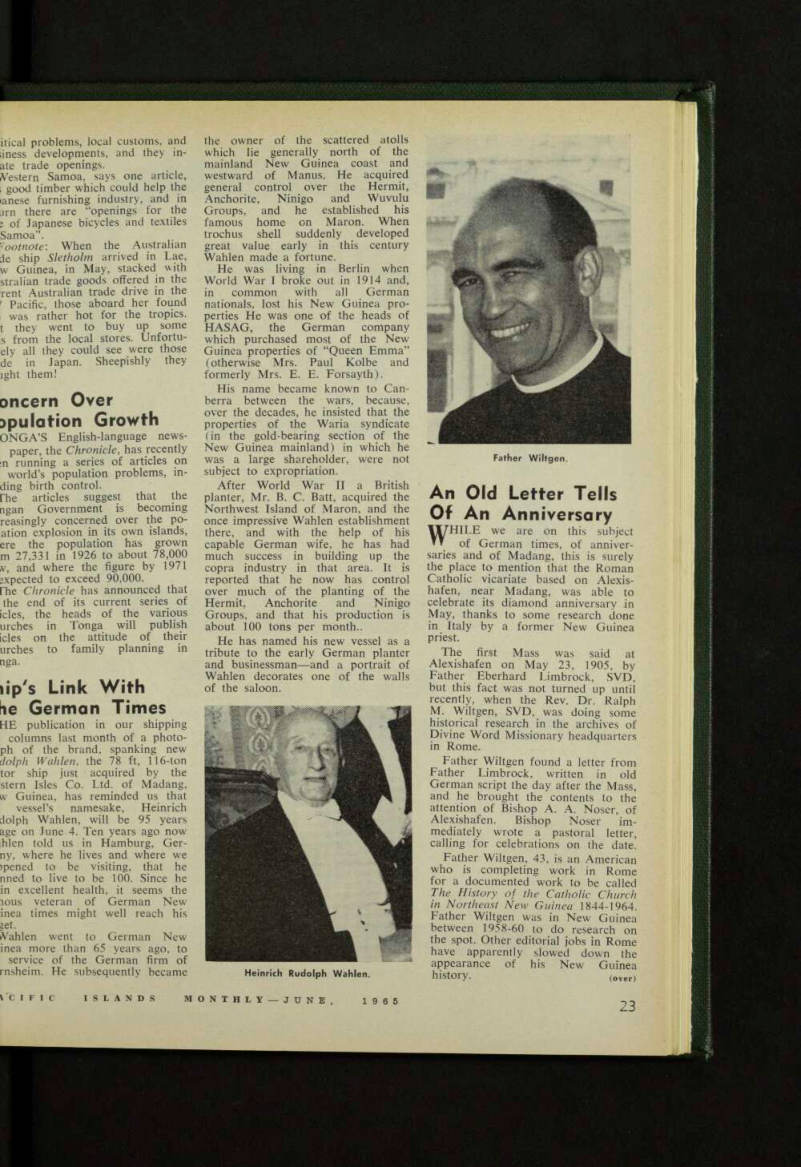
HE publication in our shipping columns last month of a photo ph of the brand, spanking new dolph Wahlen, the 78 ft, 116-ton tor ship just acquired by the stern Isles Co. Ltd. of Madang, w Guinea, has reminded us that vessel’s namesake, Heinrich dolph Wahlen, will be 95 years age on June 4. Ten years ago now hlen told us in Hamburg, Ger ny, where he lives and where we )pened to be visiting, that he nned to live to be 100. Since he in excellent health, it seems the ious veteran of German New inea times might well reach his =et.
Vahlen went to German New inea more than 65 years ago, to service of the German firm of rnsheim. He subsequently became
the owner of the scattered atolls which lie generally north of the mainland New Guinea coast and westward of Manus, He acquired general control over the Hermit, Anchorite, Ninigo and Wuvulu Groups, and he established his famous home on Maron. When trochus shell suddenly developed great value early in this century Wahlen made a fortune.
He was living in Berlin when World War I broke out in 1914 and, in common with all German nationals, lost his New Guinea pro perties He was one of the heads of HASAG, the German company which purchased most of the New Guinea properties of “Queen Emma” (otherwise Mrs. Paul Kolbe and formerly Mrs. E, E. Forsayth).
His name became known to Can berra between the wars, because, over the decades, he insisted that the properties of the Waria syndicate (in the gold-bearing section of the New Guinea mainland) in which he was a large shareholder, were not subject to expropriation.
After World War II a British planter, Mr. B. C. Batt, acquired the Northwest Island of Maron, and the once impressive Wahlen establishment there, and with the help of his capable German wife, he has had much success in building up the copra industry in that area. It is reported that he now has control over much of the planting of the Hermit, Anchorite and Ninigo Groups, and that his production is about 100 tons per month..
He has named his new vessel as a tribute to the early German planter and businessman—and a portrait of Wahlen decorates one of the walls of the saloon.
An Old Letter Tells
Of An Anniversary
WHILE we are on this subject of German times, of anniver saries and of Madang, this is surely the place to mention that the Roman Catholic vicariate based on Alexis hafen, near Madang, was able to celebrate its diamond anniversary in May, thanks to some research done in Italy by a former New Guinea priest.
The first Mass was said at Alexishafen on May 23, 1905, by Father Eberhard Limbrock, SVD, but this fact was not turned up until recently, when the Rev. Dr. Ralph M. Wiltgen, SVD, was doing some historical research in the archives of Divine Word Missionary headquarters in Rome.
Father Wiltgen found a letter from Father Limbrock, written in old German script the day after the Mass, and he brought the contents to the attention of Bishop A. A. Noser, of Alexishafen. Bishop Noser im mediately wrote a pastoral letter, calling for celebrations on the date.
Father Wiltgen, 43, is an American who is completing work in Rome for a documented work to be called The History of the Catholic Church in Northeast New Guinea 1844-1964.
Father Wiltgen was in New Guinea between 1958-60 to do research on the spot. Other editorial jobs in Rome have apparently slowed down the appearance of his New Guinea history. (over)
Heinrich Rudolph Wahlen.
Father Wiltgen.
orfolk's Boom
Mixed Blessing
HE eagerness of various Main landers to cash in on Norfolk nd’s current tourist boom has re ed in what one of the Islanders has :ribed to us as “a lot of unsightly elopment” on the island, le says gimcrack buildings are go up that do not blend in with the •oundings, and that the people who building them will move on in a years when they have made their )ur Islander friend says that efforts e been made from some quarters several years to get the Norfolk nd Council to introduce regulations ing a minimum standard for build -5 on the island. But so far, ough there is some support for h regulations, not enough ncillors are in favour of them.
The regulations will come,” our nder friend says, “but then it will too late.”
Lt present you can build anything ill on private land.
>tanic Riches In
le's Herbarium
EOPLE who are a little staggered at the cost of the handsome crete, steel and glass herbarium opened in Lae, New Guinea l 100,000), have been asking what srbarium does anyhow, he work of the Lae Herbarium ot to provide decorative plants for il front gardens, but to safely e plant collections which will pro ; material for later research. ; will be available for dry plant ections from South-East Asia and South Pacific in addition to ritory collections, and thus it will
be of value to botanists throughout the world.
In fact when officially opening the herbarium, Sir George Taylor, direc tor of the Royal Botanic Gardens at Kew, said Lae deserved the congratu lations of the world’s botanists.
He added that New Guinea’s botanic collections had been of im mense value already, and there were still “many riches” to be found in the Territory, and the herbarium would help reveal these “astonishing riches” to the world. The amount of work to be done was staggering.
Among the visitors at the opening ceremony were 14 botanists from various parts of the world.
A Fish Story To
Beat The Kon-Tiki's
WHEN yachtsman Joe Pachernegg and his wife Benita were sailing in their yacht Okeanos from the Galapagos Islands to Pitcairn re cently ( PIM , May, p. 21), they caught each night for a week what Joe describes in a letter to us as “the strangest fishes ever”.
The fish are Gempylus, or snake mackerel, a variety first seen alive by the members of the Kon-Tiki ex pedition on their famous drift from Peru to the Tuamotus in 1947.
But whereas the Kon-Tiki rafts men appear to have caught only two of these strange fish—and these two came aboard under their own steam —Joe Pachernegg and his wife caught “at least 20” on fishing lines.
The first Gempylus that the Kon- Tiki men saw flew aboard their raft one night and knocked over a paraffin lamp. This seems to in dicate that the fish was attracted from the water by the light.
When caught it gorged up two deep-water fish that had been much torn by its teeth.
Thor Heyerdahl, the leader of the expedition, described the Gempylus in his book as “over three feet long, as slender as a snake, with dull black eyes and a long snout with a greedy jaw full of long sharp teeth. The teeth were as sharp as knives and could be folded back into the roof of the mouth to make way for what it swallowed . . . The snake-fish’s thin skin was bluish violet on the back and steel blue underneath, and it came loose in flakes when we took hold of it.”
When the raftsmen held the fish under the nose of Bengt Danielsson, the Swedish member of the expedi tion, who remained asleep in his sleeping bag during the noise and excitement of catching the fish after it flew aboard, he sat up drowsily and said solemnly: “No, fish like that don’t exist.”
Heyerdahl said in his book: “Bengt was not far wrong. It ap peared later that we six sitting round the lamp in the bamboo cabin were the first men to have seen this fish alive. Only the skeleton of a fish like this one had been found a few times on the coast of South America and the Galapagos Islands; ichthyologists called it Gempylus, or snake mackerel, and thought it lived at the bottom of the sea at a great depth, because no one had ever seen it alive. But if it lived at a great depth, this must at any rate be by day, when the sun blinded the big eyes. For on dark nights Gempylus
Lae's handsome, new £100,000 herbarium
Sir George Taylor in Lae for the opening of the herbarium.
abroad high over the surface of seas; we on the raft had ex ence of that . . .” >e Pachernegg did not give us escription of the Gempylus that and his wife caught, but he sent i picture of one so we could see ourselves. [is only other comment was that npylus did not appear to be as : as they had been made out to be.
ie Sweet Taste
F Success
>COA experts have been saying for 10 or 12 years that cocoa Id become Fiji’s second industry :r sugar. But until the last two or ;e years no really determined irts were made to establish the p on a commercial scale.
'Jow these efforts have been wned with success in the form of encouraging test of 5 cwt of Fiji oa by the well-known Melbourne fectionery firm of Hoadleys. And re seems to be no reason why should not go on to establish valuable cocoa industry (when :es improve!) k good deal of the credit for at has been done so far is due to Fiji Government representative Sydney. Mr. W. B. Rogers, who nt to Fiji as Development Com >sioner in April, 1963. He has crested himself in the prospects the crop, both in Fiji and in stralia. [n Fiji, he came to the conclusion >t it was one of the best crops for
the Colony, and in collaboration with the Colony’s Director of Agriculture, Mr. John Sandys, he saw it establish ed in several parts of Taveuni, west of Savusavu, on Vanua Levu, and along the Wainibuka Valley of the main island of Viti Levu.
After he came to Australia, Mr.
Rogers asked Mr. Gordon Hoadley, managing director of Hoadleys, in Melbourne, to try some of the Fiji cocoa.
Mr. Hoadley agreed to a full scale test with 5 cwt of cocoa sent specially from Fiji.
About the middle of May, Mr.
Rogers received a report from Hoadleys and a few samples of the chocolate, moulded as tablets and wrapped in tin foil.
The report was favourable and constructively critical.
It suggests improvements in hus bandry and fermentation, and says that drying control would produce an excellent cocoa which would be readily marketable in Australia, the west of the United States and Japan.
Mr. Rogers said after trying the chocolate that it was among the best he had tasted; and after he offered some to us, we found our selves expressing the same view.
Mr. Rogers has now arranged for Rowntrees to make a laboratory test of Fiji cocoa in England.
He is confident that the present low prices for cocoa—about £162 a ton c.i.f. London—will not con tinue, and that good times for growers are ahead.
Doubts Over "Total
TV" Education
THERE have been murmurings in American Samoa lately over Governor H. Rex Lee’s plan to educate the children of that territory entirely by TV.
Critics of the plan have been saying that complete education by television is something that has never been tried anywhere in the world, and that it is therefore toying with the lives of American Samoa’s children to subject them to such a system.
Some critics claim, furthermore, that responsible educators have re jected the idea of complete TV education and that such educators believe that TV can never be more than a sophisticated aid in education.
An American visitor to Pago re cently tells us that “classroom super visors” have already reported difficulty in keeping the children’s attention fixed on the TV screen during the lessons now given by television, and that they expect this
problem to grow worse as more TV lessons are introduced.
“Because of their concern over the plan to make TV schooling com plete,” the American says, “the ter ritory’s House of Representatives visited a TV school some time back to see the system in operation. The members came back and recom mended to the Governor that TV should aid teachers, but not replace them.”
However, Governor Lee’s attitude seems to be “complete educational TV or bust,” as three additional channels will be added to the existing educational TV set-up when the new school year begins in October.
There is also expected to be a big turnover of contract teaching per sonnel in July and August, with high school teachers returning to the United States and television teachers (the people who prepare the TV lessons, not those who supervise classrooms during the lessons) arriv ing in Pago to take up new positions.
And the Feleti Memorial Teacher Training School will stop training teachers, and will be converted into the Feleti Memorial Library to serve schools and the public.
Pago’s weekly newspaper, Samoa Times, which is frequently critical of Governor Lee’s actions, said in a recent editorial that total educational TV, if successful in American Samoa, might inspire the creation of similar systems in large underdeveloped countries such as India.
But, the paper said—quoting the director of research and development for the National Association of Educational Broadcasters, which de signed the “total TV” system —the lack of any precedent for the system meant that it would take 12 years to evaluate its potential completely.
“Why, then, hurry to abolish the teacher training and vocational schools?” the Samoa Times asked.
“Would it not be prudent to arrange an impartial evaluation of the new system before giving up conventional methods of teaching entirely?”
“Education is the future of a people. Decisions which would make that future depend so greatly on a previously untested system should, as far as possible, be made after, not before, the evidence is available.”
O The 54-ft motor trawler Jason, owned by John Seeto and Company, of Kavieng, P-NG, sank at Tavui, a few miles from Rabaul at 2 a.m. on May 19 after a collision with the 66-ft trawler Leilani, owned by Buttnall and Jacobsen, of Rabaul.
Witnesses said that Jason was cut in half by the collision; but no casualties were reported.
A Gempylus, from Joe.