Nauruans Make It
pp. 17-18 · Read in the full issue
The "Hard Sell"
By a Staff Writer The new look in Nauruan diplomacy—the ‘‘hard sell ” — was launched in Australia in May, as Nauruan leaders and the Australian Government sat down in Canberra to thrash out the future of the mid-Pacific phosphate island.
FTER years of getting nowhere in their efforts to convince the Aus ilian Government that they had a int of view, the Nauruans finally cided to go to the Australian people. ) help them do it they have a firm economic advisers and another of blic relations consultants on their yroll.
The economic advisers concentrated digging out the facts on the phos ate industry, and presenting them the Government; the public rela ys people made it their business present a Nauruan “image” to the blic.
First shots were fired in Sydney on ay 25, several days before the Can rra conference was due to begin, len Head Chief Hammer Deßoburt t down at a Press conference in his 'tel, surrounded by a battery of ;hts and cameras. With him were mncillors Detudamo and Bemicke, js two economic advisers and two blic relations counsellors.
The PR men had earlier distributed the Press copies of an admirable 22-
page report on Nauru explaining the background of the Nauru situation and the objectives of the Nauruans.
But the real indication of the hard sell approach of the Nauruans and their new helpers was in a letter signed by Hammer Deßoburt, and sent to the Press with the report. Said the letter: “For some considerable time the future of the Island of Nauru has been the subject of discussions and negotia tions between the Nauru Local Gov ernment Council and the Australian Government authorities.
“It has been the policy of the Nauru Local Government Council, and my own personal policy, to conduct these negotiations in the proper place and to avoid engaging in propaganda. In recent months, however, it has be come apparent that those elements who are opposed to, or do not fully comprehend, our objectives have gained considerable Press publicity, the aim of which must be to under mine our case.
“In itself this is regrettable, but by
far the worst aspect of the matter is that our proposals have been distorted to such an extent that the Australian community is confused about them and there is grave misunderstanding generally.
“Clearly, I have a responsibility to my people to put the record straight.
Accordingly, I have caused to be written the accompanying document which sets out clearly the circum stances in which we Nauruans find ourselves, our objectives and our philosophy.
“As you are no doubt aware, the future of our Island will be the sub ject of negotiations with the Aus t r a 1 i a n Department of Territories, commencing in Canberra on May 31.
“It is important, indeed perhaps vital, to those negotiations that our attitude is clearly understood and that the slate should be wiped clean of distorted accounts of what we are seeking.
“I trust, sir, that the statement will clarify our position. The content is available for any use to which you would care to put it.”
Nauruan Arguments
The report added nothing new to the arguments which the Nauruans have been concentrating on for some time—but it did put them in a clearer form, and gave editorial writers a few worthwhile quotes with which to pepper their stories. As a result the Department of Territories, for the first time, found itself having to counter act informed opinion on the Nauru situation.
The report to the Australian Press was in fact an extension of the report given to the UN mission in April, and simplified for popular consumption.
The report said the Nauruans were in Australia to ask for ownership of the phosphate deposits, to request higher phosphate royalties in the
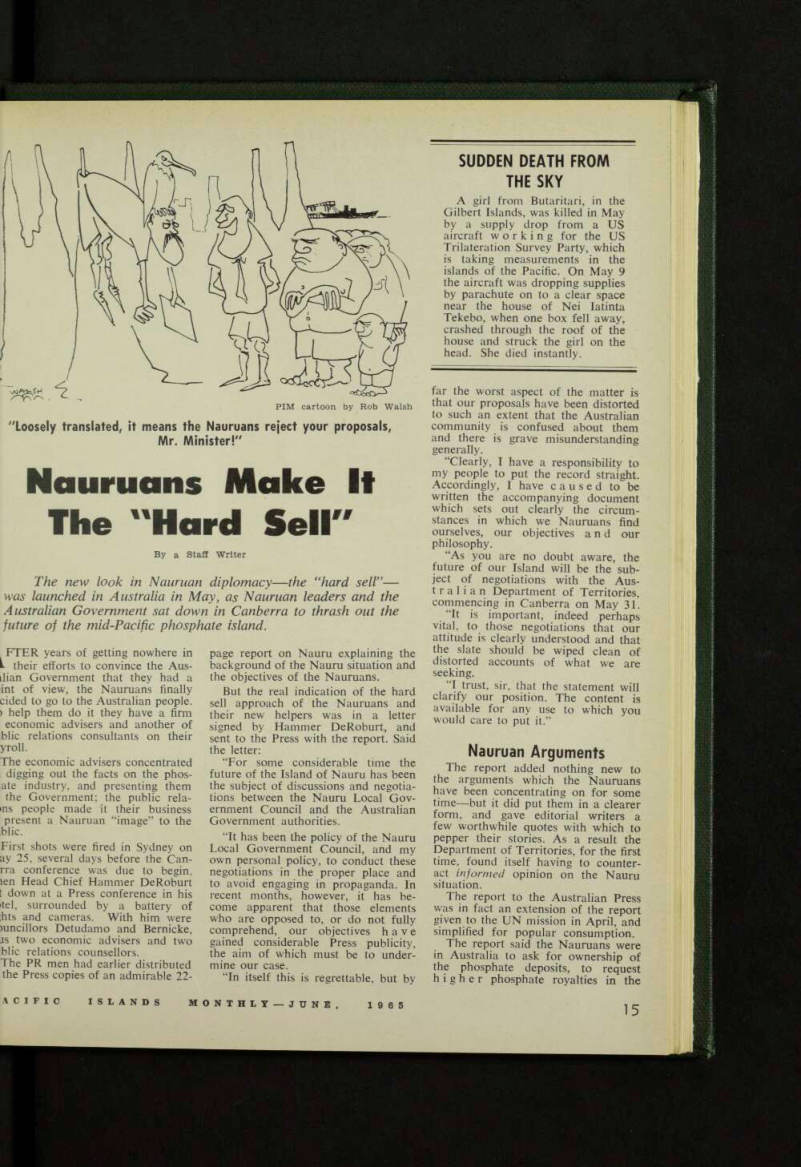
"loosely translated, it means the Nauruans reject your proposals, Mr. Minister!"
meantime, plus a reduction in tl rate at which the phosphate is heir extracted, and to ask for political i dependence.
The royalties were ridiculously i adequate, said the report, which add* that for years the Nauruans h; been “taken for a ride” and treat* like children who are given srm handouts periodically to keep the quiet.
The Nauruans’ basic objectives, said, “are national identity and reasonable standard of 1 i v i n g”. added: “They have never deviat from these aims. . . . They have s& the future not as one problem in isol tion but as a composite problem national survival in a new home wi a reasonable standard of life. Th have also seen that the remainii phosphate on Nauru must becor their bank balance and provide t economic basis for their future. T Nauruans, with no control over t total destruction of their island hor by Britain, Australia and New Ze land, know that right and worl opinion are on their side and th their objectives and claims are jusl The report frequently stressed th all Australians shared the respo sibility of seeing that the problems the Nauruan people were solved ai that they survived as a distinct peop
Not Sovereignty
Hammer DeRoburt faced his Sy ney Press conference with a certa trepidation which did not show in t expert way in which he handled t questions. But he had unhapp memories of an earlier Press conft ance in Canberra in 1964, during whi one or two unsympathetic questione had attempted to bait him w i 1 questions on the plight of the Ai tralian aborigines.
He said in Sydney that the woi “sovereignty” did not adequately d scribe Nauruan aims. They did n want to be cut off from their frienc but they wanted self-government, p( haps rather like the type planned f the Cook Islands, with one differen —they wanted to remain Nauruar Something could be worked out.
DeRoburt declined to give any c tailed information on submissions be made to Canberra, for fear jeopardising the Nauruan position. B presumably the main argument on t economic side will hinge around ; estimate of the true world price f phosphate. The Nauruans will she they are not getting anything like fair share of the true world price, ai that Australian and New Zealai farmers are being subsidised by t Nauruans.