Apprehension
pp. 12-13 · Read in the full issue
Over London Talks On Fiji’s Future
From a Suva Correspondent
With only a little more than a month to go before the 18 unofficial members of Fiji’s Legislative Council meet around the conference table in London to plan the Colony’s destiny, the political cauldron is beginning to simmer, and there is apprehen sion in the Colony.
A RUMOUR which circulated round Suva recently reveals the degree of apprehension which some of the more fanciful souls are beginning to feel.
The red-belted Fijian policemen in their white serrated sulus began to appear on the streets with truncheon hanging in a special holder from their belts.
It took only a couple of days for the word to get around that the police were preparing for riots.
The real explanation was that a supply of specially-made frogs had been received and these enabled the
truncheon to be carried at the belt.
There is no truncheon pocket in a sulu.
People laughed perhaps with relief—when the explanation was published, and so far there is little sign that those truncheons will ever come out en masse in a repetition of the 1959 riots. Although the rift between some sections of the popu lation is widening, the battles are, after all, merely battles of words.
That’s what people keep telling themselves, anyhow.
Wordiest battle of the month followed a speech made at Lautoka by Apisai Mohammed Tora, creator and secretary-general of the Fijian Democratic Party, which boasts a membership of 4,000. Despite his name, Tora is a Fijian.
Lettish in outlook, a trade union organiser with influence concentrated mainly in the North-west of Viti Levu, and regarded by many Fijians as somewhat of a rebel against tradition, Tora threw a political cat among the island doves.
Tora's Surprise
Like the old music hall artist George Robey, it wasn’t what he said but how he said it.
Many had thought for several years that Tora was anti-Fijian and pro-Federation Party. And hadn’t he renounced Christianity for Islam?
When he founded his party it was opposed to Fijian tradition and his incursions into the trade union field had a tinge of the political agitator about them, though recently he has shown all the signs of being a responsible trade unionist.
The very last thing expected ( him was an anti-Indian tirade, b that was what his speech was in tl Kisan Sangh Hall at Lautoka.
It may have been prompted by desire for continued notoriety, ( perhaps it was an indication th blood is thicker than water. Whz ever it was, it brought a more viole reaction than most political speech to date.
The Fijian Democratic Party hi decided to let its voice be heard, 1 said, because as Fijians they we getting fed up with being kick around.
He went on to condemn tl common roll, which is almost tl only thing about which almost all tl Indians in Fiji are united, and whi< is likely to be the reef on whi( the constitutional conference London strikes trouble.
Tora then became very anti-Indk and less than diplomatic. He de cribed them as impertinent—th sentence was not published—ai cried for the creation of a cor mission to make inquiries in oth parts of the world “to see if tho parts could take our rapidly i creasing Indian population”.
Reminding his audience that tl National Congress of Fiji—a new emerged Indian association—had sa that 160,000 Indians wished migrate, Tora commented: “The on thing we should do is help them g°”.
Fortunately, the majority (
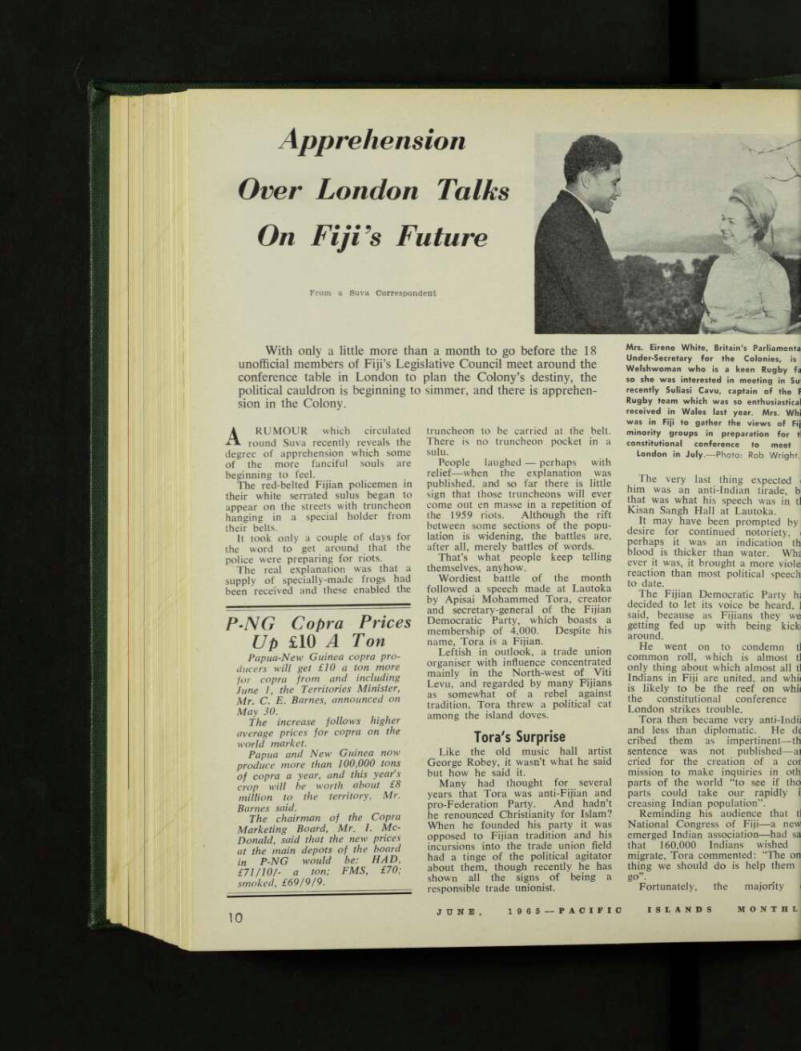
Mrs. Eirene White, Britain's Parliamenta Under-Secretary for the Colonies, is Welshwoman who is a keen Rugby fa[?] so she was interested in meeting in su[?] recently Suliasi Cavu, captain of the [?] Rugby team which was so enthusiastical received in Wales last year. Mrs. Whi was in Fiji to gather the views of Fij minority groups in preparation for t[?] constitutional conference to meet London in July.—Photo: Rob Wright.
nking Indians have laughed at ra’s words, refusing to take him iously. But the Federation Party, leaders of whom have been ponsible with their extremist views Tora’s apparent volte face, have en umbrage and have attacked ra in their propaganda organs.
Ml the heat engendered by the ra views apparently resulted in an ident in Lautoka a few days later en Fijians entered two of the )lic bars and forced all the Indians leave. There were no fights, but this sort of behaviour that breeds germs which could turn those [ squads out.
Meanwhile, what will happen iuld the London conference fail? fhere is a strong belief in some irters that the Federation Party’s r representatives plan to walk of the conference if their demands not met, and that Mr. A, Patel □ld go to Moscow, and then on the United Nations in New York h an appeal to send a party to to supervise elections on a com n roll, with independence to ow. dr. Patel would ask the Soviet its backing on the ground that has always been an anti onialist, and also for a financial nt for the “university tutorial col s’’, which his spiritual adviser, ami Rudrananda, the eminence tind the throne, plans to build Pailevu. The Ramakrishna Mission, Swami says, owns a vast area of d there.
When asked by PIM on June 1 comment on these reports that he ns to visit Moscow and New York, . Patel said: “Cannot a man go where in the world he likes with someone questioning him? Is he free to go anywhere? In any e I have not yet made any angements”.]
Indians In Army
fhe Federation’s Press has been ling loudly for a common roll, I for greater representation in the pslative Council for the Indian nmunity because of its pre iderance of numbers in the colony, iut midst it all there has been one isual article recently, commenting “the complete lack of Indians” the Fiji Miiltary Forces. \n editorial in Jagriti on May 8 ;gested that racial discrimination 5 behind the absence of the iians and asked how, in “such a erse atmosphere”, there could be isfactory constitutional reform in Yas the article, some people are ing, intended for consumption
abroad or for home consumption?
It is well known in Fiji, or ought to be, that there is no racial ban or discrimination in the Fiji Military Forces. Any fit person can join the FMF, be he Fijian, Indian, Rotuman, part-European, Chinese or European or anything else, so long as he is a citizen of Fiji.
Among the United Nations’ Com mittee of 24, however, it may not be known.
In the regular forces there are now no Indians serving, although they have enlisted from time to time, but in the 2nd Battalion, which is the Territorial arm, there are at present 15 Indian soldiers.
But why has the Federation Party now turned its attention to the Fiji Military Forces?
Some close students of political undercurrents hold that the Federa tion Party sees the FMF with its present composition as an obstacle to any extremest Indian attempts to take more control in Fiji. They feel that already some of the arguments being advanced by the Federation Party are remarkably similar to Marxist methods of argument.
At the time of writing, the Great Council of Chiefs is meeting at Suva and from it has come one piece of information which indicates the
present temper of some of the Fijians.
A motion was placed before the council calling for the exclusion of Indians from the constitutional talks in London.
It was defeated by a narrow majortiy.
One can visualise the political whirlwind which would have hit the Colony had the motion been passed by such an exalted body.
Demands for the exclusion of the Indians from the London conference are not new. Letters in Fijian news papers have called for the exclusion of both Indians and Europeans from the conference, on the ground that when Fiji was ceded by King Cakobau to Queen Victoria in 1874 the only partners in the deal were the Fijians and the British Govern ment.
Some Fijians argue that any change in the relationship between Fiji and Great Britain should be the business of no one but the partners to the Deed of Cession.
The Fijian attitude has hardened of late.
Many Fijians are angry at the noise which is daily being made by the Federation Party and its sup porters, at the Patel group’s refusal to take part in the talks between the three racial groups in the Legislative Council and at its announcement that only the common roll will satisfy the group.
The Fijians are not losing sight of the fact that, in 1962, the Fijian members of Legislative Council solemnly declared that if Great Britain abrogated the Deed of Cession then Fiji must be handed back to the Fijians. The Fijians have not altered their stand.
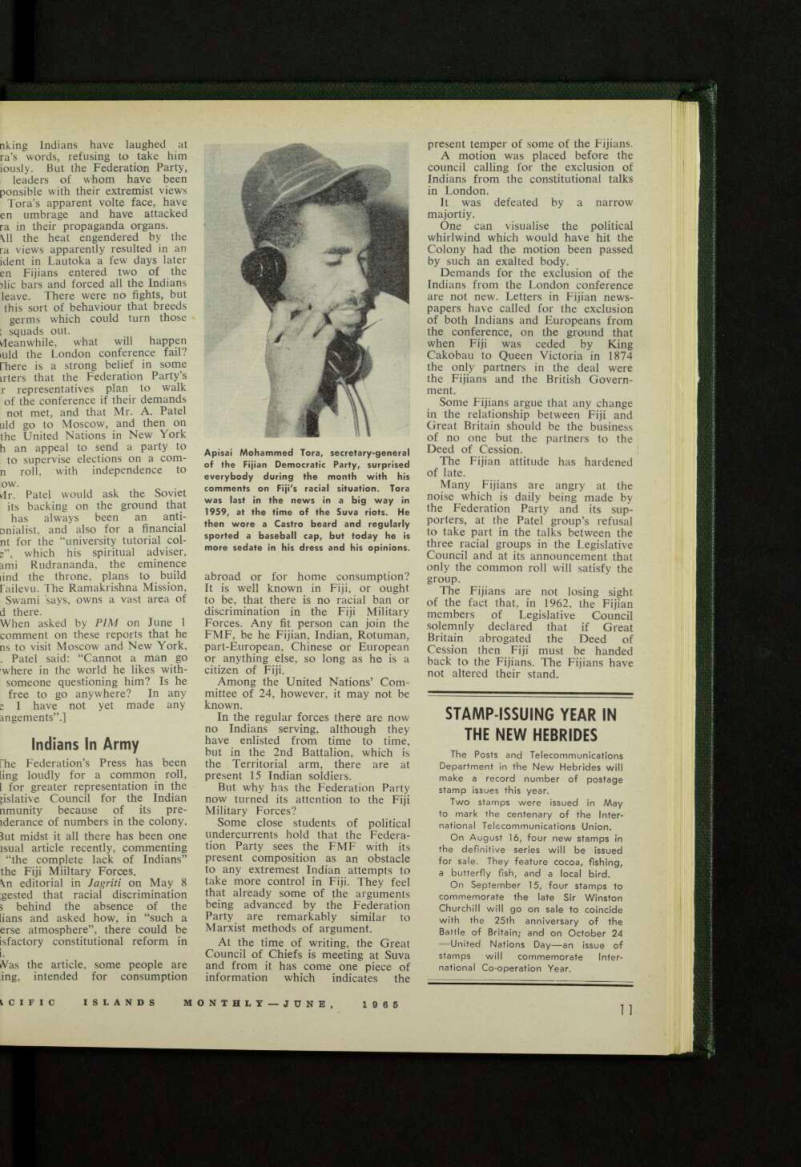
Apisai Mohammed Tora, secretary-general of the Fijian Democratic Party, surprised everybody during the month with his comments on Fiji's racial situation. Tora was last in the news in a big way in 1959, at the time of the Suva riots. He then wore a Castro beard and regularly sported a baseball cap, but today he is more sedate in his dress and his opinions.