Moves Towards
pp. 10-11 · Read in the full issue
Papua-New Guinea
A Constitution
From a Port Moresby Correspondent
The six-day meeting of the House of Assembly of Papua- New Guinea, in May, marked the end of the first year in the life of the junior Parliament of the Territory. In many ways it was six days of reaction, of anti-climax, a legislative tidying-up of major topics such as the University Bill and the World Bank Report, already well talked-out.
OUT in other, important ways, it " marked the further growth in stature and responsibility of a chamber whose members can, as yet, claim only one common interest— and that a vague one—the continued peaceful progress of Papua and New Guinea.
The most significant of these was the appointment of a select com mittee to investigate and draft a constitution for the country. The committee of ten, headed by Mr.
John Guise of Papua, who moved for it in January, is to produce its final proposals for the House to con sider in the second last meeting of its life, probably in May or June, 1967, It has four native members, three Australian members, and three official (Government) members.
There was unanimous support for the idea of drafting a constitution, and it received also the blessing, although not unqualified, of the Government.
Government Warning
The Leader of the House, Dr.
John Gunther, delivering the official view on the move towards a con stitution, said he had been authorised to say that the Government welcomed the proposals for drawing up certain principles which ought to be in corporated in the ultimate constitu tion at the stage of self-government.
He added, as a rider, the warning that the Government believed a balance should be preserved between political and social and economic development. He said: “The soundest result for the Ter ritory will be one which as far pos sible links stages of constitutional development with appropriate stages of social and economic development.”
This little lecture drew sharp replies from both Mr. lan Downs
(Highlands Special) and Mr. John Stuntz (East Papua). They described it as “amazing” and “unnecessary” and “engendered by fear and hyper sensitivity”, and suggested it was the work of the Department of Ter ritories, Canberra, rather than that of Dr, Gunther himself.
This was, in fact, only one of a number of debates in which a rising sense of impatience at the work of the Territories Department could be detected. And there was a strong feeling running through the lobbies and the members’ rooms that if the
Canberra planners did not take more account of the House, they would be made to.
Members are beginning to become jealous of their authority and their responsibility to the country.
So the first year of the new legislature has ended, on the floor
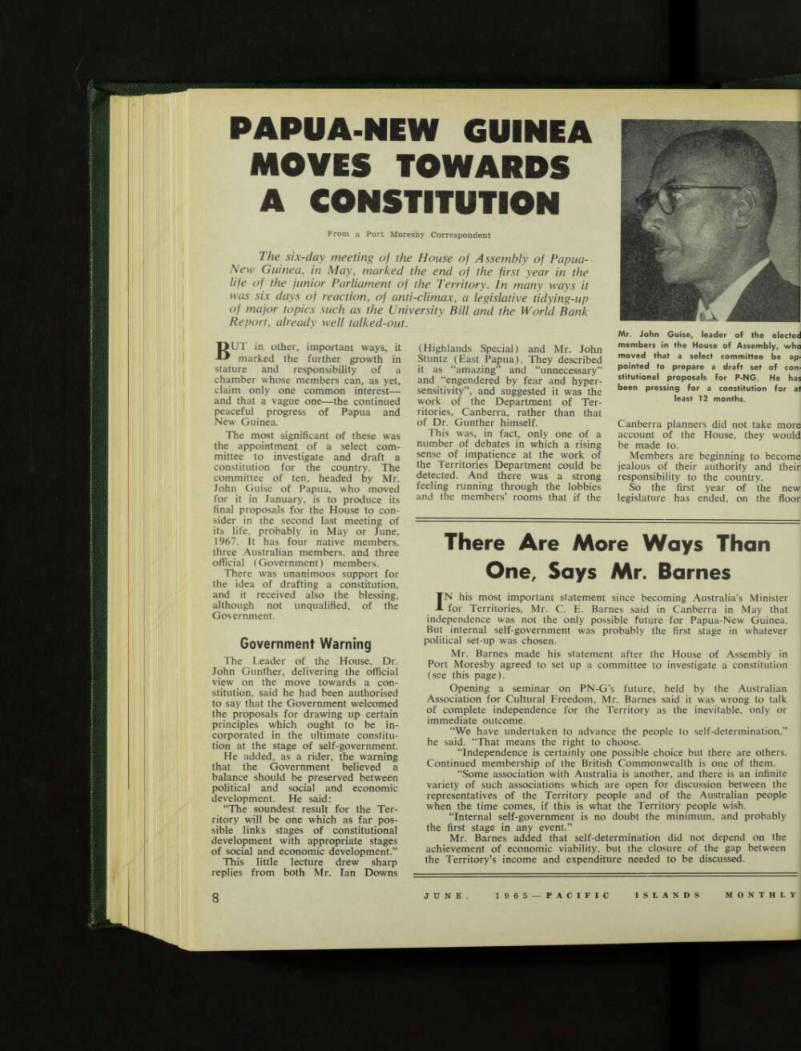
Mr. John Guise, leader of the elected members in the House of Assembly, who moved that a select committee be ap pointed to prepare a draft set of con stitutional proposals for P-NG. He has been pressing for a constitution for at least 12 months.
the House, with a positive move vards defining the sort of state it Papua-New Guinea should be the future.
Fhe newspapers have described the ting up of the Constitutional mmittee as a major step towards lependence, but members of the »use see it as far more than that, is a giant step towards assuring Dd government, freedom and the Section of civil liberties, in ad ice of the clamour and heady otionalism that so often mark iroaching independence in back rd and unevenly-developed coun ts. This, they think, is a great d more important than setting get dates, like mileposts, along an surveyed road.
So much for progress achieved Jer the lights, on the cork-tiled jr of the House.
Outside the chamber, events move ire slowly, but there are signs of expected groping towards logical ►upings that may result in the first ties in Papua-New Guinea, fhe members themselves are wary the party idea, but in the last ir they have become increasingly are of the unwieldy nature of the ected members” group, 54 strong.
From the start, the 54 have met ;ularly throughout the meetings, ting out conflicts, planning tactics, u’eving where possible agreement action on all the most important -ies. This work has paid off. as
was demonstrated earlier this year by the disciplined opposition to government policies, notably the new local pay scales. Where disagreement was unavoidable, no attempt was made to force unanimity of views.
But now, members realise, more is needed.
No issue over the last twelve months has produced violent division of opinion that would serve as a focus for party development, and the danger of trying to create artificial, or regional groupings, is recognised.
A Highlands bloc, predicted in some quarters over a year ago, has never developed. This was proved con clusively in the debate on the Univer sity Bill, when expected Highlands opposition to Port Moresby as the university site failed to materialise in a significant form.
However, in the Secretariat build ing, next to the House of Assembly, and in private homes, the talks go on, often late into the night, in the hope of finding common ground on which to found party groups.
One such group is gathering around Zure Zurecnuoc, member for Finsch hafen and Under-Secretary for the Treasury. Zure is emerging as one of the strongest figures among the New Guineans, but so far he cannot command loyalty for his leadership from any sizeable number.
Other moves are taking place among Islands members, led by Mr.
Roy Ashton, New Britain Special electorate, and among representatives from the Morobe, Madang, Eastern Highlands, and Western Papua areas.
All are conscious that a party or bloc would need to command between 15 and 20 votes to be a significant force.
The leader of the elected members, Mr. John Guise, is in a curious position.
John Guise's Position
Ostensibly the most powerful man of the 54, he is reported to be feeling his personal position weakened by his need to provide real leadership of a shapeless group. Some members say he is compromising himself out of existence, and may not be able to continue in this way much longer.
Behind all the busy clatter of debate, the stream of political life is starting to run more strongly.
There is an air of expectancy as members wait and search for the issue that could crystallise opinion and spark the parties. But there is caution. The 54, or most of them, know already that the winning policies will arise from the needs of the people, and cannot be imposed from the top.