Pacific Commerce and Produce
pp. 125-128 · Read in the full issue
W. R. Carpenter's
Remarkable
Growth Continues
W. R. Carpenter Holdings
d.’s -emarkable growth con
ues. The latest consolidated
t profit, for the period ended
tie 30, was £2,054,371, which
s an increase of £318,771, or .4 per cent, on the result for
■ year ended September 30,
63.
DR the latest balance, the date has been advanced from September to June 30, the date on which st of the subsidiaries balance, n the six years since the holding ipany was formed the group profit almost quadrupled from 7,907 in 1957-58, to the latest fit. he earning rate on capital in 7- was 19.8 per cent. There a sharp jump to 29 per cent, in 8- and since then it has been: 9- 36.9; 1960-61, 36.9; 1-62, 35.25; 1962-63, 36.25; 3-64, 36.5. he dividend for the latest year 5 per cent., including a final of ?er cent., and is a reduction from per cent. The directors last year cast a dividend of 15 per cent, on eased capital after a one-for-four us issue. he 15 per cent, dividend requires 5,750. he latest profit was Carpenter’s successive profit increase, he chairman, Mr. R. B. Car er, said in the report that income i investments increased consider he merchandise turnover gained übsidiaries in the Pacific Islands shown a substantial improve t,” he said. “Australian-based idiaries earned enhanced net ts during the period.” ic group’s investment income by £98,854 to £531,428. This ides £431,260 (up £96,518) from 1 shares and debentures, sted investments with a book s (cost or valuation) of
£8,209,518 had a market value of £11,890,243 at June 30.
A year previously, listed invest ments with a book value of £7,912,823, had a market value of £10,938,096.
A summary of recent results in the accounts shows that W. R. Carpenter earns about half its profits in Aus tralia.
A proportion of the group’s profits earned in Australia fell slightly from 50.84 to 49.2 per cent, in the latest year.
Misima Agreement
Ratified
Pacific Islands Mines Ltd.
shareholders at a special meet ing in Sydney on September 14 rati fied an agreement which had been signed with Cultus Explorations Ltd., Canada, to develop the Misima gold mine in Papua ( PIM , Sept., p. 125).
The agreement provides for Cultus to spend £400,000, which will entitle it to a 60 per cent, interest in the mine. Share prices increased slightly following ratification.
Rich Chrome Mine
Closes Down
of the richest chrome mines in the world closed down at the end of August because its pro duct could not be mined at a com petitive price. It is the Tiebaghi mine at Paagoumene in north-west New Caledonia.
The mine was opened in 1903.
It was worked continually for the next 59 years, during which 2,100,000 tons of chrome ore were extracted.
In March, 1962, the staff of over 300 was reduced to less than 30, and last year only 15 were retained for security purposes. The remaining 15 were dismissed at the end of August.
The village of Tiebaghi on the
coast from which the ore was shipped after being brought down from the mine high in the mountains once had a population of 600 people.
It will now become a ghost town.
Investment Invited
In SPSM Ltd.
chief manager in Fiji, Mr.
A. S. Hermes, who is also managing director of South Pacific Sugar Mills Ltd., CSR subsidiary, announced on September 9 that the Fiji public would have the op portunity to share in the ownership of SPSM. Five million shares of 5/- each will be offered, which will represent £1,250,000 of the present total issued capital of £9,250,000.
At present the capital is in £1 shares, but each £1 share will be divided into four shares of 5/- each.
Mr. Hermes said that should ap plications be received for more than 5 million shares of 5/- the CSR proposed to reserve the right to accept applications for the excess over 5 million. The right would also be reserved not to proceed with the sale if the response fell below an acceptable minimum number of shares.
The shares to be transferred from the ownership of CSR would carry the right to all dividends declared in future by SPSM Ltd.
Companies would be considered as buyers of the shares, but there would be some limitations on com panies not predominantly owned or controlled by persons resident in Fiji.
Mr. Hermes’ announcement is a sequel to the 1961 inquiry into the Fiji sugar industry by a commission headed by Sir Malcolm Trustram Eve. The Commission recommended among other things that a CSR subsidiary be set up in Fiji and that at a later date shares in the sub sidiary company be released.
Turtle Trade Appeal
FIJI curio vendors have asked the Government to ban the export of raw turtle shells. They claim that the tortoiseshell souvenir trade is gradually being strangled because traders have been exporting turtle shell in bulk. (Over)
Fiji Wants FOB
Duty Assessment
FIJI may soon revert to assessme of Customs duty on the f.o, value of goods. The Colony’s 19' Fiscal Review Committee made tl recommendation in its report.
The c.i.f. system (cost, insuram freight) was adopted about 18 ye£ ago, and became more and more n popular because of the time a paper work involved.
Commerce has been pressing 1 several years for a reversion to t f.o.b. method. Businessmen agi that duty rates must rise to off! the loss of revenue, and have si gested that this could be done on selective basis.
Pacific Trade
Move
THE New Zealand Government 1 given qualified approval to a p posal to set up a Pacific trade ■ ganisation of Australia, Jap; Canada, the US and New Zealand The proposal, which is long ter and known as “The Pacific Bas: plan, was raised in September wl a Japanese Chamber of Comma and Industry goodwill mission visii Australia and New Zealand.
The move would appear to be natural sequel to the Comm Market and a tendency for so areas of the world to set up th own “common market” or trad blocs.
A Pacific basin trading area woi naturally involve many island grou which are now trying to bolster th economy with increased trade.
Banana Disease No
Serious Fiji Threat
FIJI’S banana producers—ab( 95 per cent. Fijians—w severely jolted on September and the jolt is likely to be felt la in other banana producing islai of the South Pacific, and further.
The banana industry was told t the black leaf streak, the horri disfiguring disease wich kills leaves and bares the fruit to killing rays of the sun, is winn the fight.
The expert, Mr. Robert Lea brought from Britain about a y ago when the disease first laid blight on the plantations, had b< optimistic when he first tackled but his latest announcement coi not have been gloomier.
Mr. Leach, a plant patholog
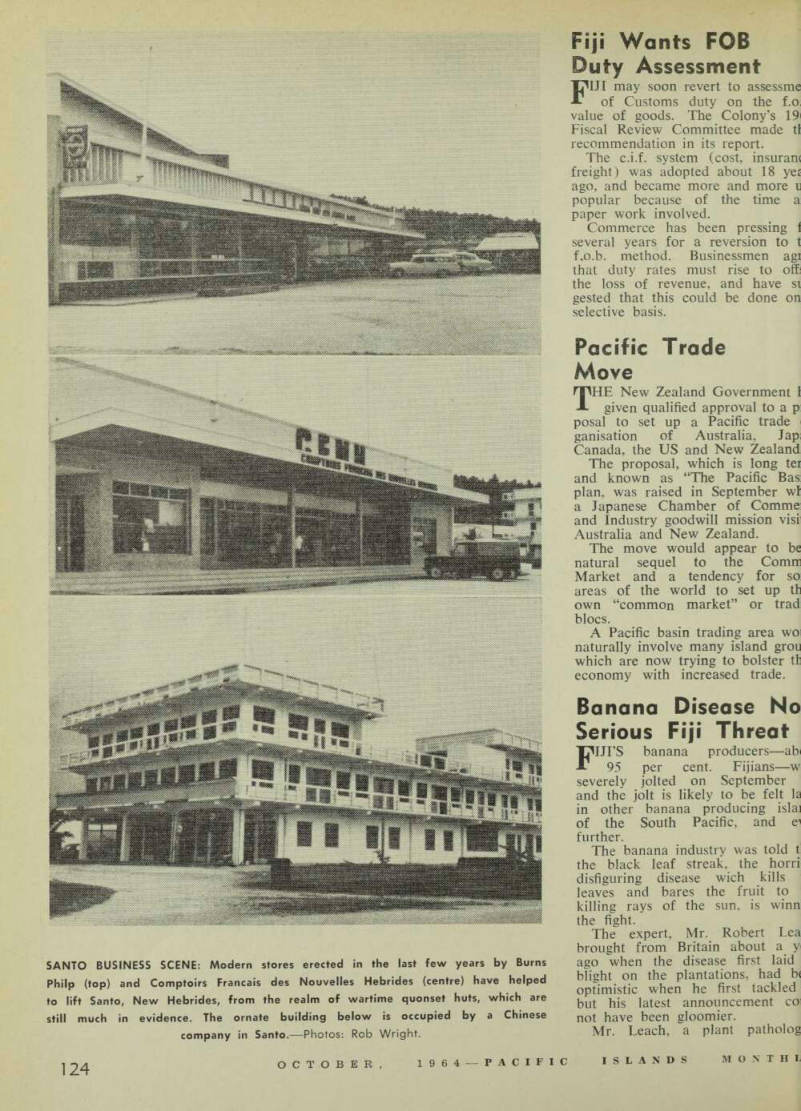
SANTO BUSINESS SCENE: Modern stores erected in the last few years by Burns Philp (top) and Comptoirs Francais des Nouvelles Hebrides (centre) have helped to lift Santo, New Hebrides, from the realm of wartime quonset huts, which are still much in evidence. The ornate building below is occupied by a Chinese company in Santo. — Photos: Rob Wright.
ivho gave the disease its name—it las been found nowhere else but in "iji—has admitted that control is r ery difficult.
“It is a fungus disease carried by urborne organisms and is gradually preading from the south-eastern •art of Viti Levu.
“It has already reached Viti Levu tay, Korovisilu and Namosi on Viti .evu and signs have been found on aveuni.
The disease is likely to continue > spread and it could spread iroughout the world.”
And that is bad news for Samoa nd other South Pacific producers, has already decimated crops in the ewa Delta area on Viti Levu, and ie disease, together with the depre ations of the March floods, has ade such inroads that Fiji’s banana divenes to New Zealand, her one id only overseas customer, are )wn to 45 per cent, of the quota.
Ihe only effective treatment is gular oil spraying which is ex snsive and only practicable under ose management in organised and cessible plantations—which is what e biggest part of Fiji’s plantations e not.
The cost of spraying, says Mr. ;ach, winch may range from out j/- a case in plantation areas perhaps double in scattered oves, and that may make pro ction uneconomical.
The statement from the Agri- Jture Department contains a hint at suggests the disease may be en more serious than has been mitted.
It advises the growers to look to ier crops, to cocoa and coffee, a says the department will advise a help growers with those crops.
Cocoa and coffee have been tried -ore in Fiji without much success t ne w er and improved methods y make another attempt at finding sfui tes for bananas more suc- Hiere is one gleam of hope A'ever, f or the banana industry. i rt i r °? the fact that some better thod of beating the black death y be discovered, the Lomaivuna cme, begun for the purpose of widmg bananas for the now mdoned Japanese market, may be e m time to supply sufficient lanas. -omaivuna, where 100 families e now been settled, each with acres, has complete supervision 1 the bananas grown in well inged groves so that controlling disease will be easier than in other plantation in Fiji Tie report adds that it is not posed at present to use the
bananas from Lomaivuna for the New Zealand market at the expense of traditional growers who can meet their quotas. But, with only 45 per cent, of the quota being met, it hardly looks as if anyone is meeting his quota.
Lomaivuna is being geared to produce rubber as well as market produce, but bananas were number one on the plan.
It is obvious, however, that Fiji has missed the banana boat to Japan.
Interest In
Islands Fruit
A DEMAND is growing in New Zealand for fruit and vegetables from the Islands. The demand is par ticularly for off-season fruit.
A TEAL Electra one day in August flew half a ton of fruit and vegetables from Nadi to Auckland.
There is a growing demand for such delicacies as water melon and egg plant, which cannot be grown in New Zealand i n the colder months.
Auckland produce dealers say it is becoming profitable to handle lines from the Islands because air freights are becoming cheaper.
There is apparently little worry about the demand suddenly evaporat ing, because of the growing popula tion of Islanders and Indians in Auckland, which has been buying most of the produce.
interest In Fiji
Pineapples
Melbourne businessman and former Victorian Cabinet Minister, Sir Arthur Warner, has interested himself in the Fiji pineapple venture launched last year by a Nadi sur veyor, Mr. E. C. Ewins, and his son, Mr. G. S. Ewins.
A company, Fiji Pineapples Ltd., was recently registered in the Colony, and has its headquatrers at Raiwai, Waqadra, Nadi.
Sir Arthur last year proposed to
establish television in Fiji and also to manufacture television sets and parts, but had to abandon the plan, temporarily at least, when the Fiji Government decided the time was not ripe to set up television in the Colony.
Fiji Plan For A
Provident Scheme
SAVING for a rainy day is some thing Islands people generally give little thought to, but, if the Fiji Government adopts a provident scheme exhaustively prepared by a social security adviser from London, they will be forced to give both thought and cash to it.
The expert is Mr. J. E. Ashford, of the British Ministry of Employ ment and Pensions, who has now made his report after investigations in Fiji lasting almost a year.
His scheme is simply one of compulsory saving with all employ ers and employees paying a sug gested amount equal to 5 per cent, of the employees’ wages.
The sum accumulated to a member’s credit, would be payable
under the following conditions: As an age benefit, payable at 60; with drawal benefit, payable at 56 where the member has not worked as a wage-earner for one year; invalid benefit, where a member is medic ally certified as unfit for further employment; survivor’s benefit, on the death of a member; special death benefit, to a deceased member’s widow, to bring up his accumulated credit to £lOO where it is below that amount; marriage benefit, where the member is a woman who marries; and emigration benefit, where the member is about to leave Fiji for good.
The Government, suggests Mr.
Ashford in his lengthy report, would administer the fund but would not contribute to it, although he calculates the Inland Revenue Department would be short of between £70,000 and £90,000 for income tax relief on contributions from wages and profits.
The scheme would apply to all persons over 16 employed for wages under contract of service. It could be extended later to take in self employed.
Since it was at the Government’s request that Mr. Ashford made his survey and no doubt the Govern ment, is “sold” on the idea, but Mr.
Ashford will have a host of doubters to win over, mainly those whose motto is “I’m all right Jack”. These people would not be prepared to concede that saving was to Fiji’s economic advantage.
All a large section will consider is the fact that they will be asked to contribute to a fund for someone else’s benefit.
And, when one considers that the Government had to introduce legislation to force dishonest employers to pay the meagre wages that many of them try to avoid paying, the Fiji Provident Fund has several reefs to negotiate before it gets into safe harbour.
Mr. Ashford fears one possible bad effect. “On the introduction of the fund, employers might seek to add the cost of contributions to their prices, and employees might base a demand for higher wages on their obligation to contribute, both moves inflationary in tendency,” he says.