A Trap For Young Authors
p. 91 · Read in the full issue
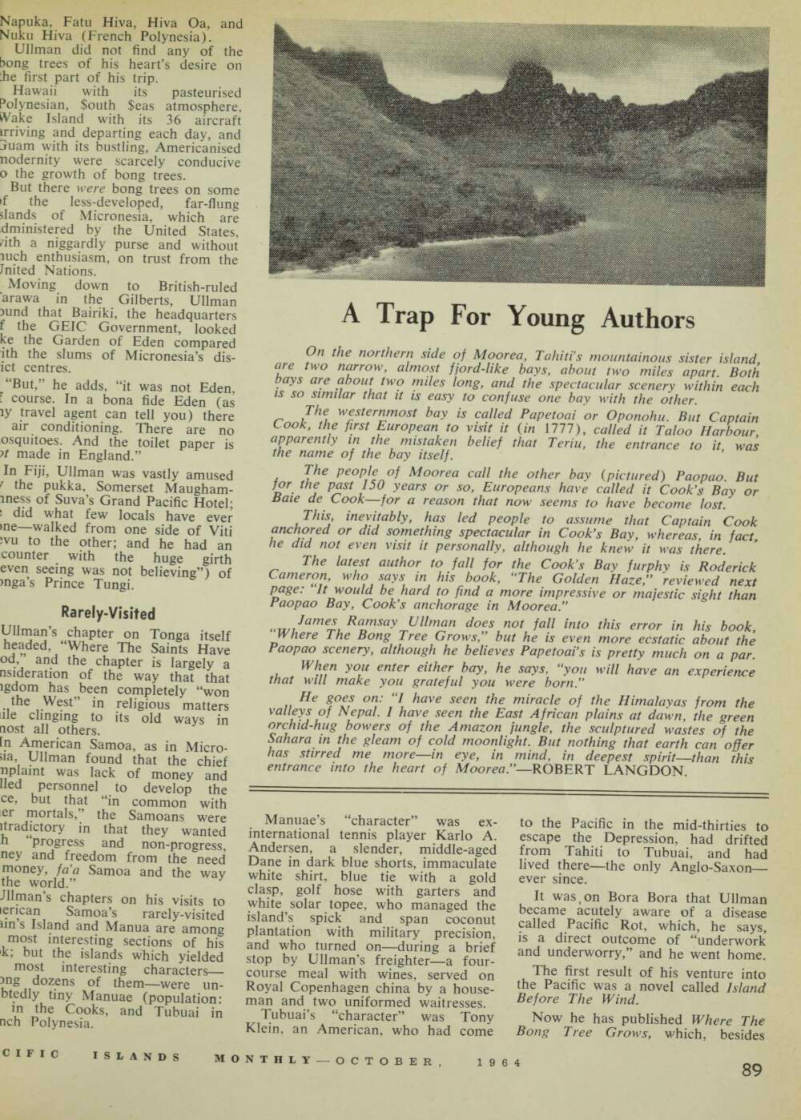
On the northern side of Moorea, Tahiti’s mountainous sister island are two narrow, almost fjord-like bays, about two miles apart. Both bays are about two miles long, and the spectacular scenery within each is so similar that it is easy to confuse one bay with the other. „ , Th f, westernmost bay is called Papetoai or Oponohu. But Captain Cook, the first European to visit it (in 1777), called it Taloo Harbour, apparently in the mistaken belief that Teriu, the entrance to it was the name of the bay itself. , Jif 16 P eo P}e°f Moorea call the other bay ( pictured) Paopao. But for the past 150 years or so, Europeans have called it Cook’s Bay or iiaie de Cook for a reason that now seems to have become lost.
This, inevitably, has led people to assume that Captain Cook anchored or did something spectacular in Cook’s Bay, whereas, in fact he did not even visit it personally, although he knew it was there.
The latest author to fall for the Cook’s Bay furphy is Roderick Cameron, who says in his book, “The Golden Haze,” reviewed next page: It would be hard to find a more impressive or majestic sight than Paopao Bay, Cook’s anchorage in Moorea.”
Rc L msa y u llman does not fall into this error in his book, Where The Bong Tree Grows, ’ but he is even more ecstatic about the Paopao scenery, although he believes Papetoai’s is pretty much on a par.
When you enter either bay, he says. “you will have an experience that will make you grateful you were born.”
He goes on: “I have seen the miracle of the Himalayas from the valleys of Nepal. I have seen the East African plains at dawn, the green orchid-hug bowers of the Amazon jungle, the sculptured wastes of the Sahara in the gleam of cold moonlight. But nothing that earth can offer has stirred me more—in eye, in mind, in deepest spirit—than this
entrance into the heart of Moorea.”-