Paliau Seen
p. 89 · Read in the full issue
The Month's New Reading
As Another
Roosevelt
Nothing fascinates man like lan, and for those who want to
sive deeply into this fascinating
ibject, Continuities in Cultural
volution, by Margaret Mead,
ill fill the bill. 3HE book is published through the • Dwight Harrington Terry Found ion Lectures and deserts straight ithropology.
The author seeks, instead, (says e dust jacket) to “provide a new ntext for considering both im rsonal processes in the develop ;nt of civilisation and the role of iividual genius in cultural innova n. The analysis focuses on cultural cro-evolution: the development of m’s specific psychobiological capa ies and the continuity of cultural msmission through the sense . .
If the reader understands that, ’s in, or at any rate, at first base, ’ll find, though, that Dr. Mead ’t nearly as bad as her dust jacket.
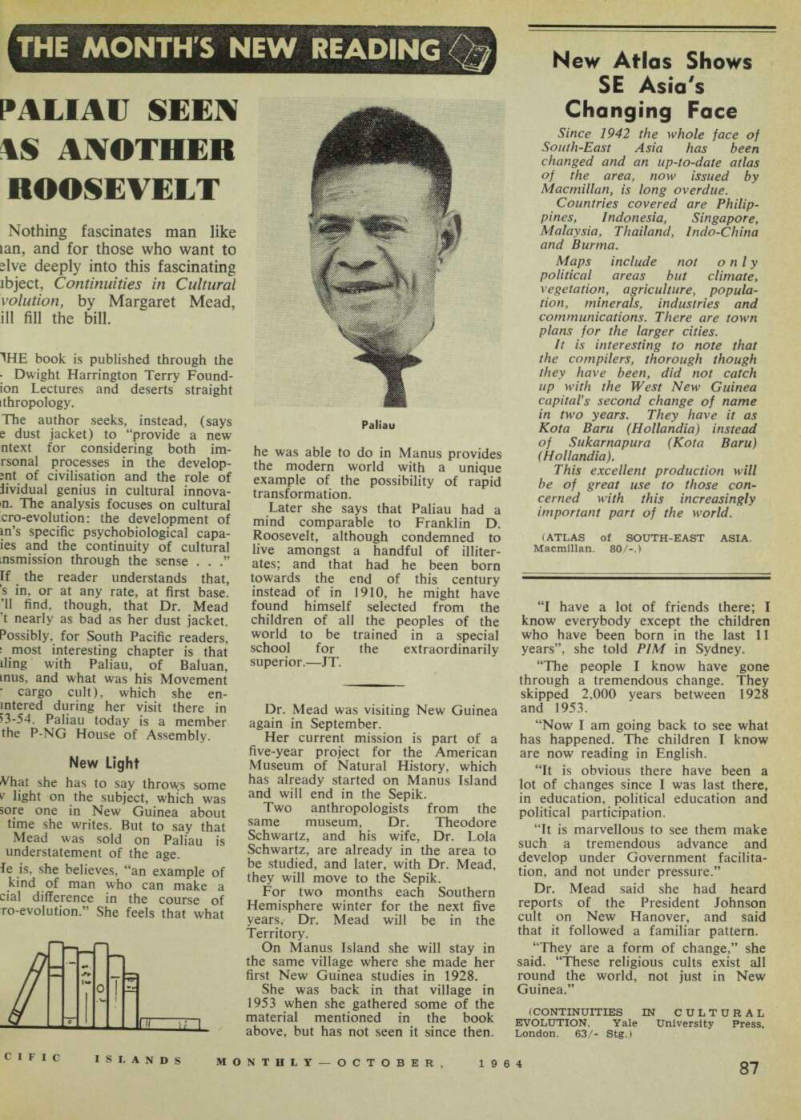
Possibly, for South Pacific readers, ' most interesting chapter is that ding with Paliau, of Baluan, inus, and what was his Movement • cargo cult), which she en mtered during her visit there in 53-54. Paliau today is a member the P-NG House of Assembly.
New Light
iVhat she has to say throws some v light on the subject, which was sore one in New Guinea about time she writes. But to say that Mead was sold on Paliau is understatement of the age.
Ie is, she believes, “an example of kind of man who can make a cial difference in the course of ro-evolution.” She feels that what
he was able to do in Manus provides the modern world with a unique example of the possibility of rapid transformation.
Later she says that Paliau had a mind comparable to Franklin D.
Roosevelt, although condemned to live amongst a handful of illiter ates; and that had he been born towards the end of this century instead of in 1910, he might have found himself selected from the children of all the peoples of the world to be trained in a special school for the extraordinarily superior.—JT.
Dr. Mead was visiting New Guinea again in September.
Her current mission is part of a five-year project for the American Museum of Natural History, which has already started on Manus Island and will end in the Sepik.
Two anthropologists from the same museum, Dr. Theodore Schwartz, and his wife, Dr. Lola Schwartz, are already in the area to be studied, and later, with Dr. Mead, they will move to the Sepik.
For two months each Southern Hemisphere winter for the next five years, Dr. Mead will be in the Territory.
On Manus Island she will stay in the same village where she made her first New Guinea studies in 1928.
She was back in that village in 1953 when she gathered some of the material mentioned in the book above, but has not seen it since then.
“I have a lot of friends there; I know everybody except the children who have been born in the last 11 years”, she told PIM in Sydney.
“The people I know have gone through a tremendous change. They skipped 2,000 years between 1928 and 1953.
“Now I am going back to see what has happened. The children I know are now reading in English.
“It is obvious there have been a lot of changes since I was last there, in education, political education and political participation.
“It is marvellous to see them make such a tremendous advance and develop under Government facilita tion, and not under pressure.”
Dr. Mead said she had heard reports of the President Johnson cult on New Hanover, and said that it followed a familiar pattern.
“They are a form of change,” she said, “These religious cults exist all round the world, not just in New Guinea.”
(Continuities In Cultural
EVOLUTION. Yale University Press, London. 63/- Stg.)
Paliau