Tahiti's Nature Man Did
pp. 79-81 · Read in the full issue

NOT Want A Wife For His Garden Off Eden
By Thomas H. Darling, the Nature Man’s Half-Brother
My father Tom Darling, who was also the father of my half-brother Ernest W. Darling, was only 16 when he married his first wife. He was born in Sparta, Ontario, Canada, and moved to Kansas, US, not far from Topeka, after his first
marriage.
IN KANSAS, Tom Darling got a small farm; raised broom corn, strawberries and bees; and made brooms. It was in my father’s 16 ft by 20 ft log cabin that Ernest, his brother Charles and their sister Edith were born.
One day when my father was 35, he got tired of ploughing, left the plough in the field, took the horses to the barn, went into the village nearby and asked the local doctor if he thought he could yet become a doctor.
The doctor said he believed he could; and since Ernest, Charles and Edith were beyond the infant stage, they and their mother were left on the farm while my father studied at the Detroit College of Medicine with the help of his Uncle Sam in Canada.
He graduated near the head of his class.
After graduation and internship, my father took his family to Port land, Oregon, and established practice there in the downtown section.
In Oregon, with its rainy, cold winters, Ernest caught cold after cold, until he was nothing but a cage of bones. Tuberculosis followed.
Medicine Ineffectual The medicine of that period could do little for TB, and Ernest, now in his twenties, became discouraged and sick, and lost his faith in medicine. (I still have our father’s medical books and frequently have to smile at the treatment recom mended.) Ernest, at this time, was at Stanford University the same university that Jack London went to, where they both had hot and heavy words with Dr. David Starr Jordan, the renowned educator and head of the university.
In an effort to cure him of his disease, my father sent Ernest to Arizona for a brief period. He then went into the forests of Southern
Oregon to live the life of a “Wild Man”, as my father called it.
By this time, our father had become divorced from his first wife and had married my mother—he being 52 and my mother 28 or 29.
Ernest was much taken with my mother and she defended him in the many bickerings he had with our father.
I have nothing but the fondest memories of Ernest, who was a great personal hero. I still have a few relics of him.
Among these is a piece of white cedar he picked up at Stanford and sent to my father. On it is written: “White cedar I picked up in the U.
Buildings where I have been working.
Am going 2 make a strong effort, 2 re-enter on my course next month.
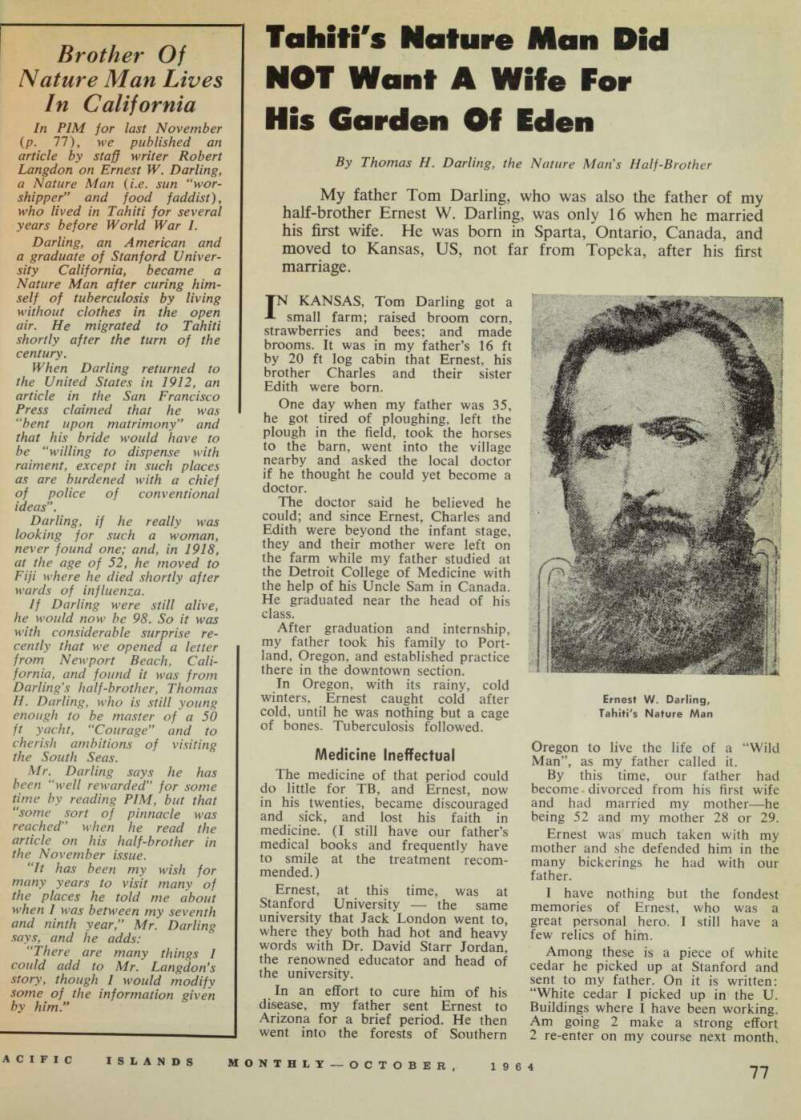
Ernest W. Darling, Tahiti's Nature Man
With love to all. Ernest.” On the address side is: “From E. W. Darling, Stanford.” The postmark is 3. p.m., August 4, 1902.
The package was addressed to our father, Dr. T. Darling, Cor. 30th & E. Salmon, Portland, Oregon.
I also have a few postcards that Ernest sent from Tahiti. They show some of the scenes of that day, such as the old bandstand and native scenes; and there are a couple of his little “plantation” with messages giving his hopes and dreams for it.
Among my memories of Ernest are the wonderful cigar boxes he sent me, carefully packed and full of dried bananas, for which “delicious” is but a mild word. I am sure that if people in the Islands could dry and ship bananas like he did, they would make a fortune.
There was magic in the way Ernest did everything—like showing me the correct island way of extracting coconut milk. This was when he visited us in California, to where my father retired in 1911.
I also remember asking Ernest about cannibalism, and he told me that they didn’t eat people in the South Seas any more, but that he had met people there who had enjoyed the delights of “long pig” in the past.
Critical Ernest had a critical attitude towards the prevailing faiths of his day, and his trouble with the French in Tahiti was caused by missionaries.
Ernest used to advise the native people to dress as they had always dressed, eat what they had always saten and resist the use of clothes unnatural to them—above all the disease-provoking muumuu or Mother Hubbard.
As a result, the French mis sionaries forbade him to cross certain property to get to his plantation, and it was for this reason that he had ;o scramble up a steep path.
Ernest always wore what was necessary to protect him—either :rom the weather or the law. When le came to see us, he wore enough o avoid an argument with Dad.
He liked the tropics because he iked to get plenty of fresh air to ceep him comfortable in the heat.
Fhere are many people now who nave found it sufficient to wear as ittle, and probably less than he lid, in public.
Now let’s dispose of the “Eve n the Garden of Eden” bit that Mr.
Langdon referred to in his story.
On his return to the US in 1911, Ernest gave out a story about wanting
a wife to avoid complications with European women who got silly ideas and wanted to be overly friendly.
Remember, he was a big, strong, well-formed and intelligent man. I have heard from good friends in Tahiti that I have relatives there. 1 am sure his bed was not cold.
I remember visiting Ernest once at the San Diego International Exposition in 1915. He had a Nature Man booth there.
He didn’t care much what people
called him, so long as he could get over his idea of good clean health. I never saw him do anything like “muscle beach” stuff, When I saw Ernest at the ex position, I was with my (and Ernest’s) uncle, James V. Teetzel, Justice of the King’s Bench in Ottawa, Canada, Ernest, by the way, never tried to drag any of his family down by using their names to get out of something.