Sensational Legal
pp. 55-57 · Read in the full issue

Important Ruling Or US Constitution
Sensational Legal Case In American Samoa
From D. C. "Mike" Kneubuhl in Pago Pago One of the most colourful, comical nd eventful criminal cases ever to ome before the court in American amoa was heard in Pago Pago in [ugust. During the case, the High 'ourt ruled for the first time in 4 years of US rule in American amoa that the US Constitution oplies in this territory. >EFORE the court was a con -3 struction worker, William C. rown, of Seattle, who arrived in ago Pago recently as an employee f the Government.
He was charged with (1) inter ring with civil rights and (2) isorderly conduct after allegedly ireatening, during his wedding night inner on June 24, that he would hoot American Samoa’s Governor, Ir. H. Rex Lee.
Eleven days after the threat was llegedly made, Brown, who is nown to his Samoan friends as Puka Sill, was thrown into solitary con nement and placed under a $B,OOO ond.
The basis for the first charge was lat Brown had violated a civil ights statute of American Samoa diich made it a criminal offence to eprive anyone of his rights secured y law. This offence carried a laximum penalty of three years’ aol and a fine of $1,500.
The prosecution reasoned that if ie threat was made and carried out, ; would deprive Governor Lee not nly of his life but also of his rights d liberty and property.
Crowded Courtroom When Brown’s trial began at .05 a.m. on August 20, about 100 lamoans and 20 Europeans had ammed into the courtroom under tie Governor’s office in Pago Pago’s lain Administration building. Most if the area around the courthouse /as also filled.
Judge Arthur Morrow, a 71-year ild lowan, who has been a judge in American Samoa for 28 years, (resided. Two associate Samoan □dges, who are not educated in law, at on the bench as consultants,
primarily on Samoan customs and traditions.
The prosecutor was American Samoa’s Attorney-General, Mr.
Alfred J. Gergely, who was assisted by Mr. Donald Tindal.
Brown’s lawyer was Mr. George Wray, who had come from Washington for the case.
Mr. Wray was soon on his feet arguing for the dismissal of the first charge against Brown. He demanded that the court find that the civil rights statute in question was itself a violation of the due process clause of the Fifth Amendment of the US Constitution.
Mr. Wray pointed out dramatically that if the statute were valid, every stolen coconut would deprive a man of his constitutional rights to property, and the thief would become liable to three years’ imprisonment.
“It is shocking,” Mr. Wray went
on, “that an attorney has to come 8,000 miles to remonstrate with the Attorney-General (of American Samoa) that such an application of law is beyond the ken of any known jurisprudence.”
In his arguments, Mr. Wray used other strong words such as “dis graceful” and “shameful”, and as the Samoans in the courtroom had never heard a case presented so forcefully against the Government, they felt sure something would happen to Mr.
Wray.
But Mr. Wray came out on top.
After consulting the Samoan judges, Judge Morrow made the historic announcement that the civil rights statute was contrary to the US Constitution and was therefore null and void. . . , “We are of the opinion,’ Judge Morrow said, “that the due process clause in the Fifth Amendment of
tie Constitution of the United States s in force in American Samoa, and tiat it protects the fundamental luman rights of all inhabitants of American Samoa and is binding upon bis court.”
The first charge against Brown was berefore dismissed—to the obvious mazement but satisfaction of the iamoan spectators.
The trial then proceeded on the isorderly conduct charge. The pro ecution presented three witnesses, a lan named Atafau, of Leone village, iis wife, and his daughter. All laimed that they heard Brown breaten to shoot Governor Lee.
Both Brown and his wife denied hat this threat was made, but the ndges found the charge proved and mtenced Brown to 55 days’ im prisonment.
At this stage, it seemed that the ase was all over. But then Mr. Wray Iropped the biggest bombshell in American Samoa’s legal history by equesting and obtaining a summons or the arrest of the Attorney jeneral, Mr. Gergely, for failing o get a warrant after Brown was xrested within the 24 hours allow ible.
Mr. Gergely, who faced a penalty >f up to one year’s imprisonment, ippeared before American Samoa’s iigh Court on this charge on August H.
Meanwhile, Brown had been eleased—the Government having : reed him the day after his trial vhen he had served 49 days’ im msonment.
Another big crowd attended the rearing of the charge against Mr.
Tergely, who was found not guilty.
During the hearing it was stated that Mr. Gergely was taken ill the evening following the arrest of Brown, that he was given sedatives and was under a doctor’s care, and that when he contacted his assistant, Mr. Tmdal, about Brown, he told him the warrant was overdue.
Judge Morrow dismissed the charge, saying no criminal intent had been revealed.
Mr. Reginald Philips, of Western Samoa, appeared for the prosecution, and Mr. Tindal represented Mr.
Gergely.
The Brown-Gergely case has there-
fore ended, but the implications of the judges’ decision on the con stitutional aspect of it are expected to manifest themselves in the months ahead in demands for rights from the Sa moan people, Although the case does not present itself as dramatically to the outside world as Governor Lee’s programme of educational television, paved roads, an auditorium, and the Samoan Development Corporation^ hotel, it will have an effect that is fundamental to the Territory’s pro gress.
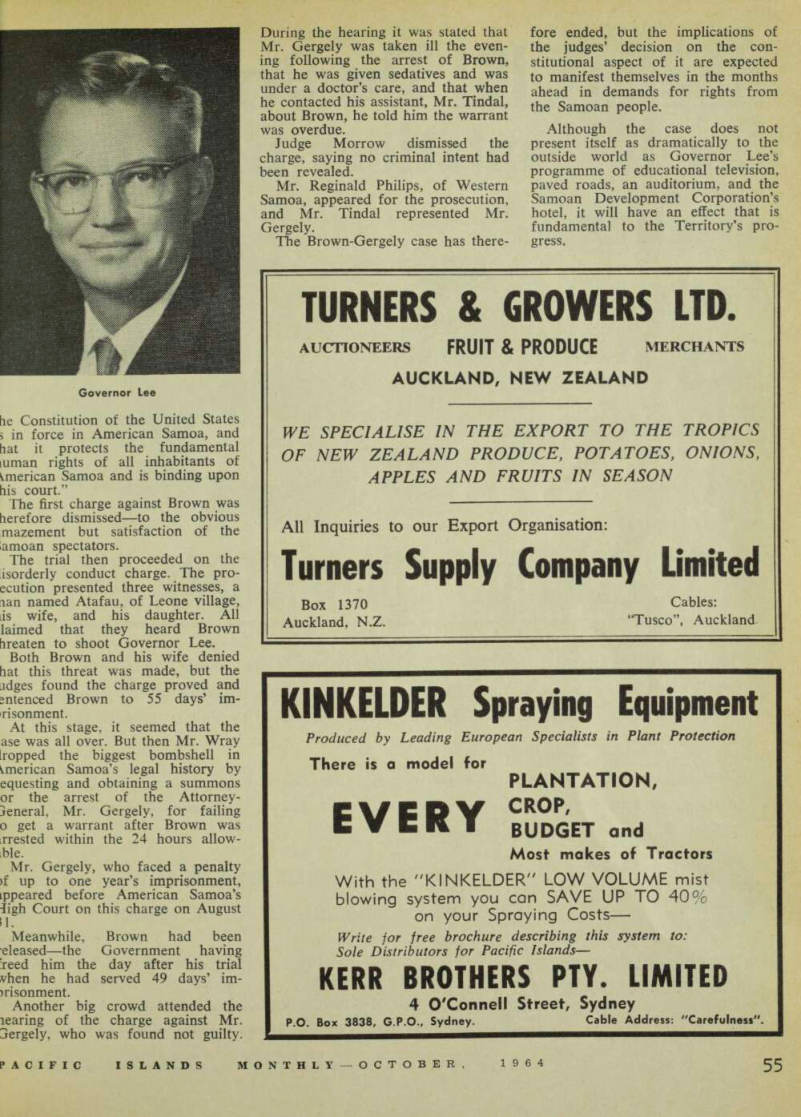
Governor Lee