Your Own, Sir Guy Says
pp. 31-33 · Read in the full issue
The Month In Western Samoa
Its A Cold, Hard World On Your Own, Sir Guy Says
From R. F. Rankin, in Apia Since independence in 1962, Western Samoa has, by the good graces of Commonwealth members, been regarded as an “as if” member until she can make up hef mind one way or the other. After nearly three years Samoan leaders still seem reluctant to make a final decision.
|N his return from the Common wealth Education Conference d in Ottawa during August, the noan delegate, Minister of ucation Papalii Poumau, an imced that Samoa had asked at the iference, and been accepted mimously, for membership of the mmonwealth Educational Scheme with all its perks for under 'eloped countries. [n correspondence to the local :ss, and through remarks by mer High Commissioner Sir Guy wles, who was holidaying in Samoa early September, the question of noa joininp the Commonwealth once more come to the fore. rolourfully mixing his metaphors, Guy said that the ship of state independent Samoa has been nched and during the early years its journey the seas had been y smooth. But it was a very dl ship, and it could do with all help it could get when the chill ds started blowing in the not too ant future.
Cold Hard World It can be a cold hard world for nail country trying to go it alone,” said. ir Guy saw the help Samoa ded coming from broader and ;er association with the outside Id, and particularly with the nmonwealth.
Samoa’s judicial and parlia itary system and general outlook >ased on that of Britain. Closer )ciation with Britain and other nmonwealth countries can do ling but strengthen these in itions and society,” he said.
Opinion in Samoa, as far as one make out, is generally favourable ards Commonwealth membership.
I think the advantages from ing the Commonwealth would outweigh the disadvantages, if
any,” said leading politician Afoa fouvale Misimoa.
“I think their programme of assis tance to developing countries is probably more effective than that of the United Nations.”
But there is a fear among some Samoans that if Samoa joins the Commonwealth, her special relation ship with New Zealand would be weakened and New Zealand would no longer be so obliged to play her hole of guide and provider.
For the same reason some New Zealand politicians would be happy to see Samoa in the Commonwealth where the growing burden of Samoa’s economic problems may be shared.
In the meantime it looks as though Samoa is content to take the best of two worlds as long as it is able. ☆ ☆ ☆ AMIDST a convincing show of apparent sincerity in offering their all for the country, Samoa’s MPs almost did themselves out of a comparatively lucrative living in September.
It all started with a private member’s motion, by Amituana’i Vili, that ordinary members’ salaries should be fixed at £650 plus allow ances. At the moment ordinary members receive between £4OO-£5OO a year and Cabinet Ministers £1,400.
In what was either a masterly political move aimed against any in crease, or an astonishing display of patriotism, Prime Minister Mataafa moved an amendment that salaries for all members of Parliament, in cluding Cabinet Ministers, should be fixed at £l2 a year.
He claimed eloquently that mem bers should be willing to work for the development of their country without thought of financial compensation.
“If members have as their main objective the salary for the office they
hold, then I don’t think they are rendering genuine service to the Government and our beloved country,” he said.
From speeches made on the amendment it appeared the House was fairly evenly divided. But at times exchanges became heated, especially when Asiata Lagolago accused the Prime Minister of having an ulterior motive in moving the amendment.
The Speaker called the House to order, and after a long explanation on the rules of debate, declared the motion and amendment had lapsed because time had expired.
At present members have no power to fix their salaries, which are decided by an independent com mission of inquiry.
The commission sat last year and its report recommending no increase was rejected by Parliament.
The commission sat again and completed its new findings early this
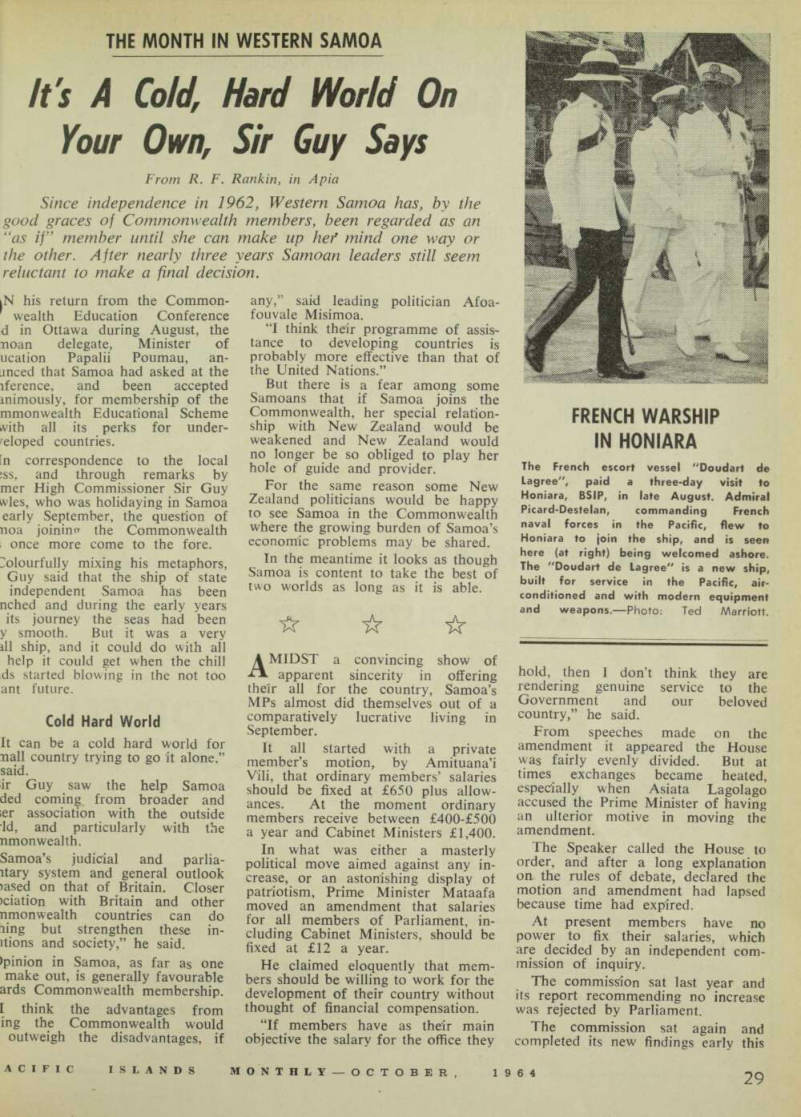
French Warship
In Honiara
The French escort vessel "Doudart de Lagree", paid a three-day visit to Honiara, BSIP, in late August. Admiral Picard-Destelan, commanding French naval forces in the Pacific, flew to Honiara to join the ship, and is seen here (at right) being welcomed ashore.
The "Doudart de Lagree" is a new ship, built for service in the Pacific, air conditioned and with modern equipment and weapons.— Photo: Ted /Marriott.
ar but they have not yet been eased. It is generally believed it the commission has again recom ;nded no increase. ☆ ☆ ☆ FTER reading the annual report L for 1963 of Controller and lief Auditor R. I. Campagnolo, an erseas visitor asked (in all serious ss), “Tell me confidentially, how ig do you think they can go on fore it all blows up?”
The report spotlighted deficien s in financial control in practically jry department, uncovering some ;ctacular shortages such as 140 lons of ethyl alcohol, 1,548 ounces tincture of opium and 20 lb of icentrated opium liquor un :ounted for in the Health Depart nt; strange procedures in the arding of contracts in the Agri ture and Public Works Depart nts; and assertions of maladminis tion in the Marine and other partments and Western Samoa jst Estates Corporation. ‘Although expenditure of moneys ?ropriated by Parliament increased m £1,371,740 in 1960 to 233,203 in 1963, the administra q of finance in some departments 1 not keep pace with the increase,” ted Mr. Campagnolo. ‘The number of suitable staff lilable for senior positions was
limited, and when such persons were transferred, the benefit to one department left a problem in another department . . . lack of control and supervision led to errors, waste, extravagance, and irregularities; and the people’s funds were not adequately protected. As the scope of State activities widens, a strong audit service becomes increasingly necessary.”
In his introduction to the report, Mr. Campagnolo stated that the purpose of the audit was to provide a
guard against autocratic dealings and administrative excesses in matters of finance.
“Its place in a country’s adminis tration reflects generally the extent to which democratic principles have been developed,” he said, Which to some extent reassured the worried visitor. Although the audit department may need strengthening, the fact that it can and does speak out so freely is surely some guarantee that the place is not about to “blow up”.
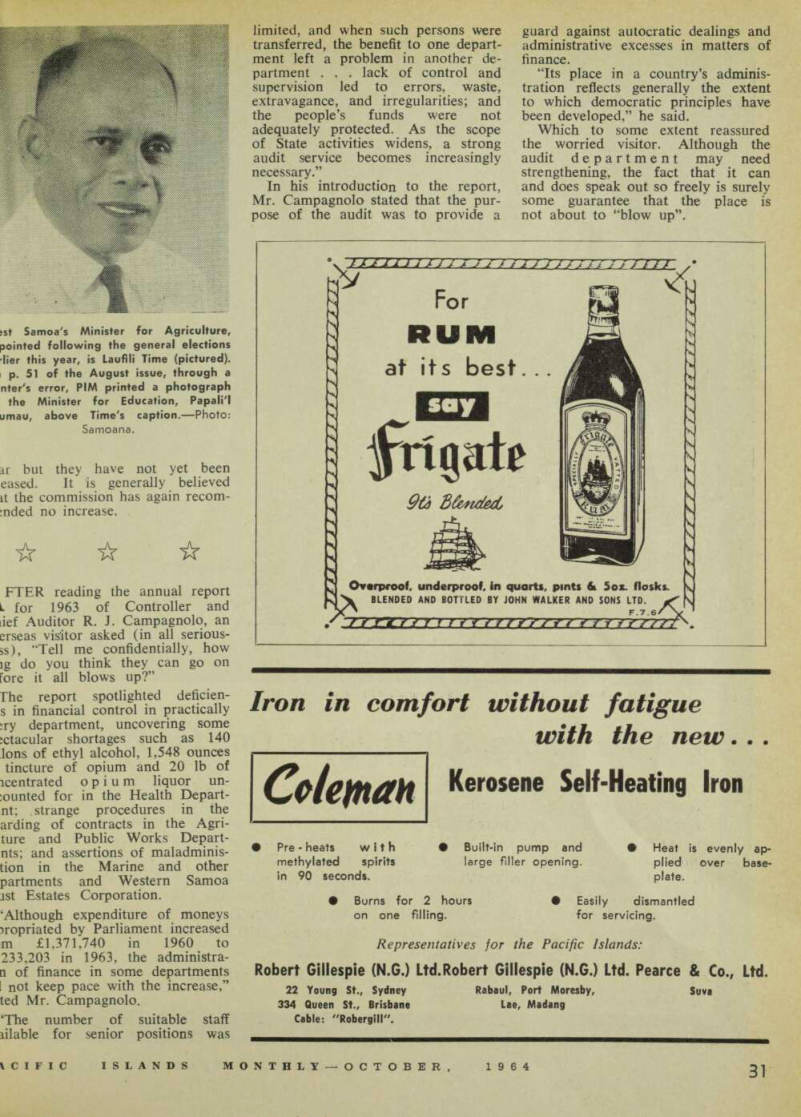
est Samoa's Minister for Agriculture, pointed following the general elections [?]lier this year, is Laufili Time (pictured). p. 51 of the August issue, through a [?]nter's error, PIM printed a photograph the Minister for Education, Papali'l [?]mau, above Time's caption.—Photo: Samoana.