Service Reorganisation
p. 22 · Read in the full issue
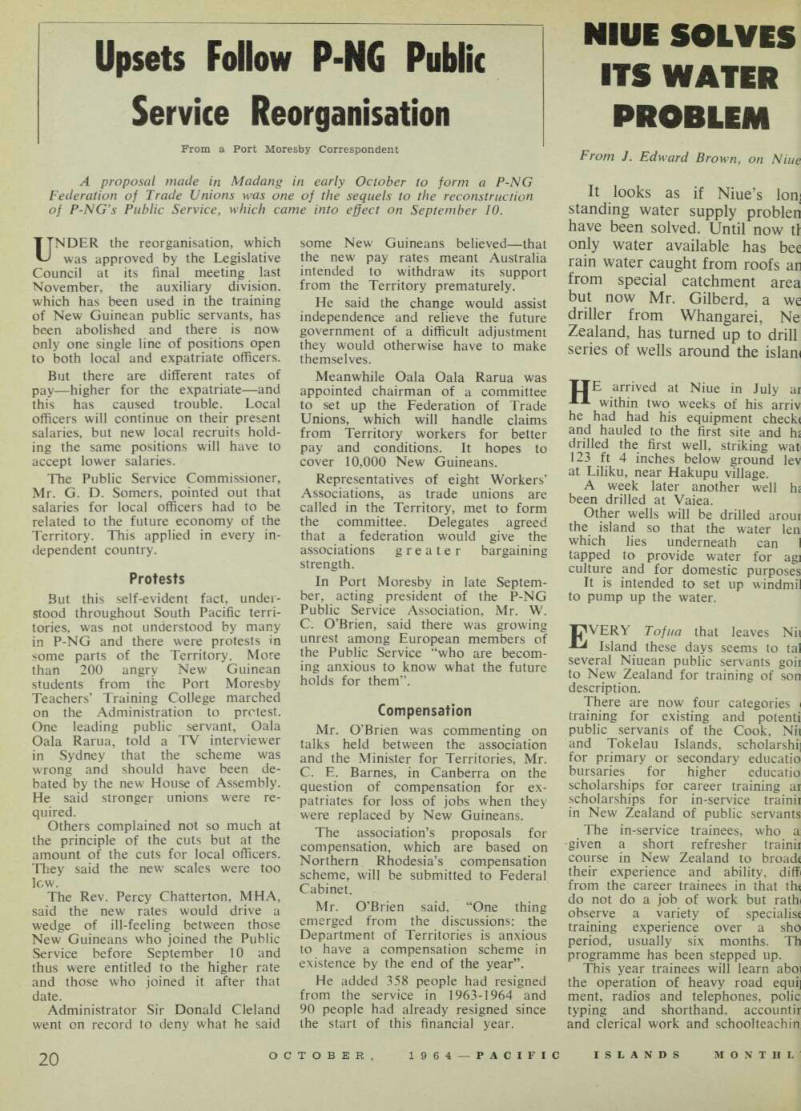
Upsets Follow P-NG Public Service Reorganisation
From a Port Moresby Correspondent A proposal made in Madang in early October to form a P-NG Federation of Trade Unions was one of the sequels to the reconstruction of P-NG’s Public Service, which came into effect on September 10.
UNDER the reorganisation, which was approved by the Legislative Council at its final meeting last November, the auxiliary division, which has been used in the training of New Guinean public servants, has been abolished and there is now only one single line of positions open to both local and expatriate officers.
But there are different rates of pay—higher for the expatriate—and this has caused trouble. Local officers will continue on their present salaries, but new local recruits hold ing the same positions will have to accept lower salaries.
The Public Service Commissioner, Mr. G. D. Somers, pointed out that salaries for local officers had to be related to the future economy of the Territory. This applied in every in dependent country.
Protests But this self-evident fact, under stood throughout South Pacific terri tories, was not understood by many in P-NG and there were protests in some parts of the Territory. More than 200 angry New Guinean students from the Port Moresby Teachers’ Training College marched on the Administration to pretest.
One leading public servant, Gala Gala Rarua, told a TV interviewer in Sydney that the scheme was wrong and should have been de bated by the new House of Assembly.
He said stronger unions were re quired.
Others complained not so much at the principle of the cuts but at the amount of the cuts for local officers.
They said the new scales were too low.
The Rev. Percy Chatterton, MHA, said the new rates would drive a wedge of ill-feeling between those New Guineans who joined the Public Service before September 10 and thus were entitled to the higher rate and those who joined it after that date.
Administrator Sir Donald Cleland went on record to deny what he said
some New Guineans believed—that the new pay rates meant Australia intended to withdraw its support from the Territory prematurely.
He said the change would assist independence and relieve the future government of a difficult adjustment they would otherwise have to make themselves.
Meanwhile Gala Gala Rarua was appointed chairman of a committee to set up the Federation of Trade Unions, which will handle claims from Territory workers for better pay and conditions. It hopes to cover 10,000 New Guineans.
Representatives of eight Workers’
Associations, as trade unions are called in the Territory, met to form the committee. Delegates agreed that a federation would give the associations greater bargaining strength.
In Port Moresby in late Septem ber, acting president of the P-NG Public Service Association, Mr. W.
C. O’Brien, said there was growing unrest among European members of the Public Service “who are becom ing anxious to know what the future holds for them”.
Compensation
Mr, O’Brien was commenting on talks held between the association and the Minister for Territories, Mr.
C. E. Barnes, in Canberra on the question of compensation for ex patriates for loss of jobs when they were replaced by New Guineans.
The association’s proposals for compensation, which are based on Northern Rhodesia’s compensation scheme, will be submitted to Federal Cabinet.
Mr. O’Brien said, “One thing emerged from the discussions: the Department of Territories is anxious to have a compensation scheme in existence by the end of the year”.
He added 358 people had resigned from the service in 1963-1964 and 90 people had already resigned since the start of this financial year.