tropicalities
pp. 19-21 · Read in the full issue

After 40 years in the police force, 32 of them in the Territory, Papua-New Guinea Police Commissioner Mr. Chris Normoyle retired on September 30.
There was no immediate announcement about his successor but there was quite a lot of activity going on behind the scenes.
FR. NORMOYLE retired a little L earlier than he had anticipated iccause he was more interested in ig a good policeman than in owing a straight political policy . He made several plans for im vement, to little avail, ligh authority has been seeking eplacement who will perhaps be e malleable. >ne authority would like to see •etired Pacific Islands Regiment mel or major fill the post. )ther authority leans towards eone with academic qualifications, compromise might be reached i a District Officer or District imissioner. But an ordinary pro ional cop is apparently not ted. [eanwhile the Department of itories is still dealing with a plan eorganisation for the Police De ment, presented to it more than months ago by Policeman Nor le.
e Smell Of
al Money
FORTUNE may be waiting for lucky finders on the coasts of fic Islands between the Cooks New Guinea. It is represented by -fgris, a secretion from the tine of the Cachalot whale, big piece, weighing about 100 found on one of the islands itly, was bought by Sydney jfacturing chemists, Lockwood rath Pty. Ltd. lat piece was worth £1,500 to )0 to the finder, at current prices om £15 to £20 a lb. nbergris is used by the world’s ng perfumers. It is built up ie whale’s intestines through an tion caused by the “beaks” of plankton on which the whale e secretion is in a mass which be up to 100 lb, and more, eight. It is dark to start, but
after years in the ocean it becomes lighter.
It is in the final stage, when the whole mass is very light in colour that it is most prized, and very high in value.
It is not found only on islands close to the traditional routes whales follow on their annual migrations. It is believed that it is generally caught up in the Humbolt current which sweeps across the Pacific from east to west before it gets into another drift to be washed up on an island beach.
A Sydney perfume manufacturer said that ambergris looked some thing like a clay subsoil, and had a sort of pungent odour.
“The worse it smells the better it is,” he told us.
A Fijian With A
Difference
THE Fijian custom of kerekere, which allows a relative to ask the owner of something for all or part of that something, is, in the words of Sir Alan Burns, “a serious handi cap to the progress of the Fijian people, as it is a powerful disincentive to individual effort and thrift”.
But not every Fijian is deterred from individual effort by kerekere— a notable exception being Ratu Meli Loki, chief of Tamavua Village, just outside Suva.
On a hill at Tamavua that com mands a fine view of Suva Harbour, Meli has constructed the bigge t bure in the whole of Fiji to put on pro grammes of Fijian entertainment for anyone who wants to be so enter tained, but particularly tourists.
Construction of the bure began in August, 1963, and it was finished in January. The building is 90 ft long, 30 ft wide and 40 ft high. Shows are held there every Saturday night, and on request from travel organisa tions and cruise ships.
Loki says that the idea of the entertainment is to give tourists “as much traditional atmosphere as we can during the short time they spend in Fiji”.
Visitors are greeted with salusalus (the Fijian equivalent of Polynesian leis), and after they have seated themselves on the floor, there is a yaqona (kava) ceremony of welcome.
A group of dancers perform dances with spears, fans, clubs, etc. and also sing folk songs, and a string band plays soft music between items.
This entertainment is followed by
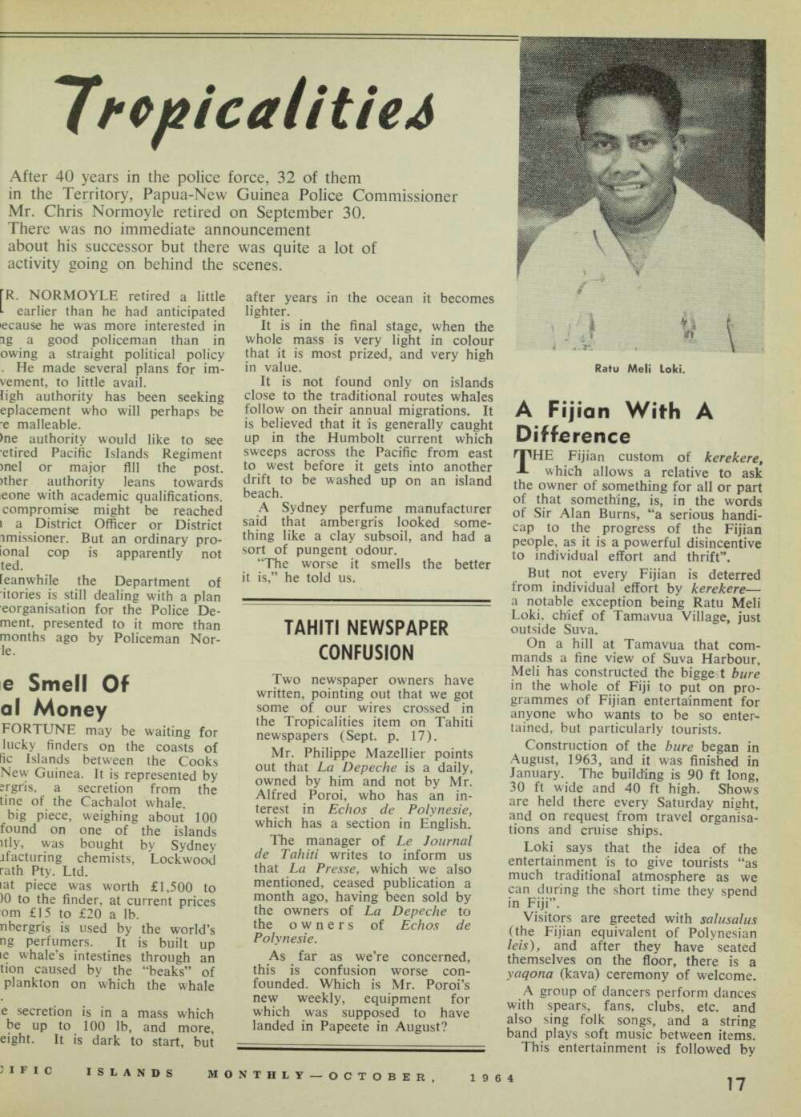
Ratu Meli Loki.
a Fijian feast, in which fingers are used as knives and forks; and somewhere along the line, the visitors are invited to participate in dancing side by side, Fijian fashion, rather than face to face.
Loki says: “It takes patience and push to develop a business like this, but things are progressing satisfactorily and our Saturday night shows are proving popular even with the local people”.
Loki, who speaks enviable English, was the first Fijian announcer on the Fiji Broadcasting Commission.
Everybody's
Doing It
AN EXHIBIT at New Guinea's Goroka Show indicated that the now sophisticated New Guineans of the New Guinea Highlands mine for themselves gold each year worth £20,000 to £30,000. An official told us that most New Guinean miners sell the gold to the Administration or the banks, and get silver currency in exchange.
“Yes, and then they put it back
in the ground,” somebody remark “There are thousands of pou: in silver currency buried arm the villages.”
“Quite so,” replied the offic “But so what? Don’t we sell the g to the United States, and don’t Americans put it back in the groi —in the vaults at Fort Knox?”
Well Met By
Chance In Tahiti
TAHITI is full of surprises, m of them pleasant. One day cently we were sitting on a beach Tautira, watching some 1c youngsters sail model outrig canoes with red and blue pareu sa when we were accosted by an eldc gentleman (see photo) wearing 1c costume. He was probably wonc ing what we were doing on prope that turned out to be private.
He was Henrik G. Levinsen, Dane, who has spent 40 years Tahiti, give or take one or two wl
tried unsuccessfully to settle NZ or Fiji. Tahiti has always awn him back and now, at 80, he mds his time writing poetry, read y (favourite author; Bertrand issell), and caretaking the Robert ►uis Stevenson Lodge, which is ned by the Bambridge family.
Tautira is the largest village on hiti-iti and is the place where RLS ed for some months during the vels that eventually brought him “Vailima”, in Apia, Western tnoa. The present Lodge is sup sed to have been built on the spot ere Stevenson lived. The Lodge >vides probably the cheapest ac nmodation in Tahiti—rooms cost : equivalent of a few pounds per ek and you do for yourself.
An even more exhilarating en inter was with Mrs. Manuel bson, who turned up at the Hotel biti in the middle of luncheon the lowing day and to the interest of er diners, and the amazement of :ific Islands Monthly* s R. W. bson, claimed him as her family’s n.
Arrangements were made to visit Tahiti Robsons at “23 kilometres” m Papeete, in the Paea district, dix heures”, the following rning.
Clan Assembled Vhen we arrived at the appointed e the whole clan was assembled, 1 although it is possibly an ggeration to say that there are idreds of Tahiti Robsons, there tainly are dozens and dozens of m, from babes of a few months , to Tante, who is probably well > her 70’s.
Vhere their six words of English our half dozen words of French dapped we gathered that mdpere Algernon Robson had ved in Tahiti about 100-125 years from England and had married fahitian. About the same time, grandfather of R. W. Robson ved in Otago, New Zealand, and an the production of the NZ >sons —but other than that no ct connection could be proved, lost Robson families have their Is going back to Northumber 1, around Hexham, where some of last remnants of Hadrian’s Wall still be seen. According to RWR, ' originally made an honest liv as border raiders. ut in spite of the missing links be -n the Tahitian and the New land Robsons, by the end of an rious morning and stirrup-cups of and Scotch whisky, everyone was )ared to settle for the name of sin. It was one of the pleasantest hunters we’ve had in the South
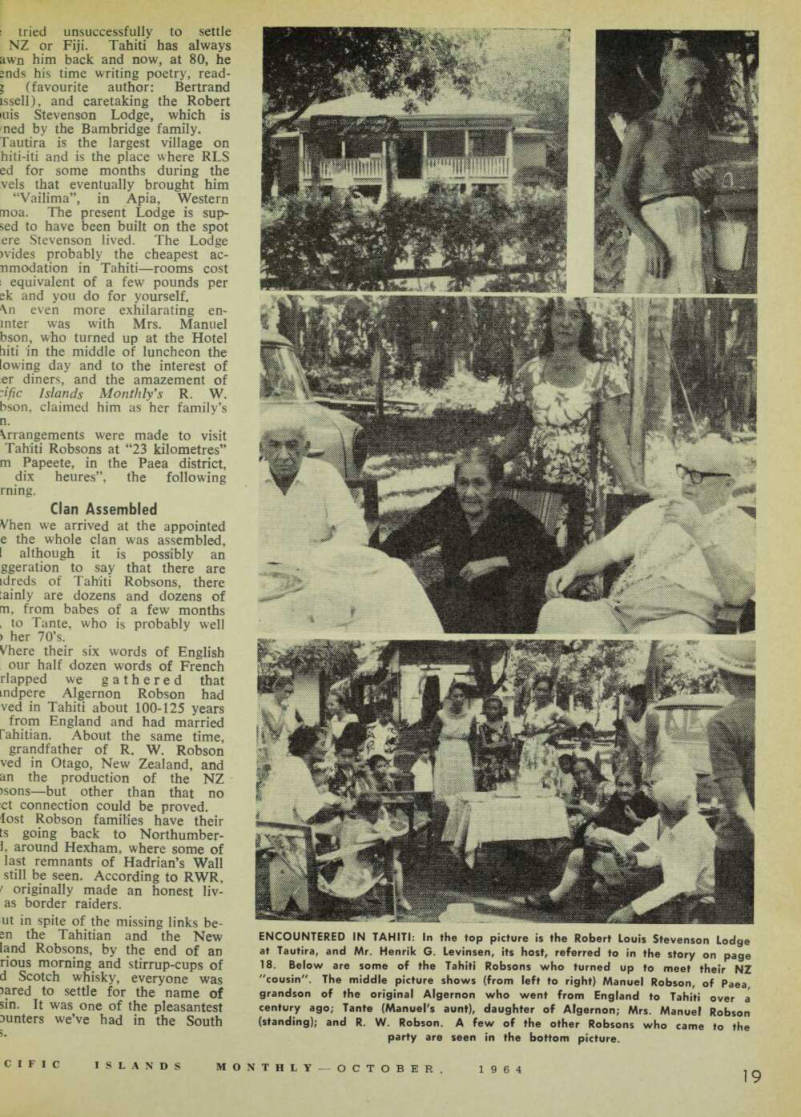
ENCOUNTERED IN TAHITI: In the top picture is the Robert Louis Stevenson Lodge at Tautira, and Mr. Henrik G. Levinsen, its host, referred to in the story on page 18. Below are some of the Tahiti Robsons who turned up to meet their NZ "cousin". The middle picture shows (from left to right) Manuel Robson, of Paea, grandson of the original Algernon who went from England to Tahiti over a century ago; Tante (Manuel's aunt), daughter of Algernon; Mrs. Manuel Robson (standing); and R. W. Robson. A few of the other Robsons who came to the party are seen in the bottom picture.