UN Mission
pp. 16-17 · Read in the full issue
NG Visit
From a Rabaul Correspondent Two United Nations truth
seekers, who obviously couldn’
find the sort of truth they wer seeking, cut short their visit t( Papua-New Guinea last month.
THEY left the Territory two day ahead of schedule, pausing lon enough in Australia to tell th Minister for Territories, Mr. Barnei that they had not said the cor troversial things claimed in som sections of the Press.
Since their return they have pn sented a report to the United Natior Committee of 24 on De-colonisatioi The report is reasonably generoi towards Australia’s policies in P-NC although it haggles over a numbe of specific points.
The two men who made the tor are Mr. Natwar Singh (India) an Dr. Mohied-Din Nabavi (Iran' They are members of the Committe of 24 but their P-NG tour was personal one at the invitation of th Australian Commonwealth.
The Committee of 24 is an Afr< Asian-sponsored group within th UN. Its stated aims are to ensui the independence and freedom c choice of what it calls colonial terr tories, although on its record it
First Officers
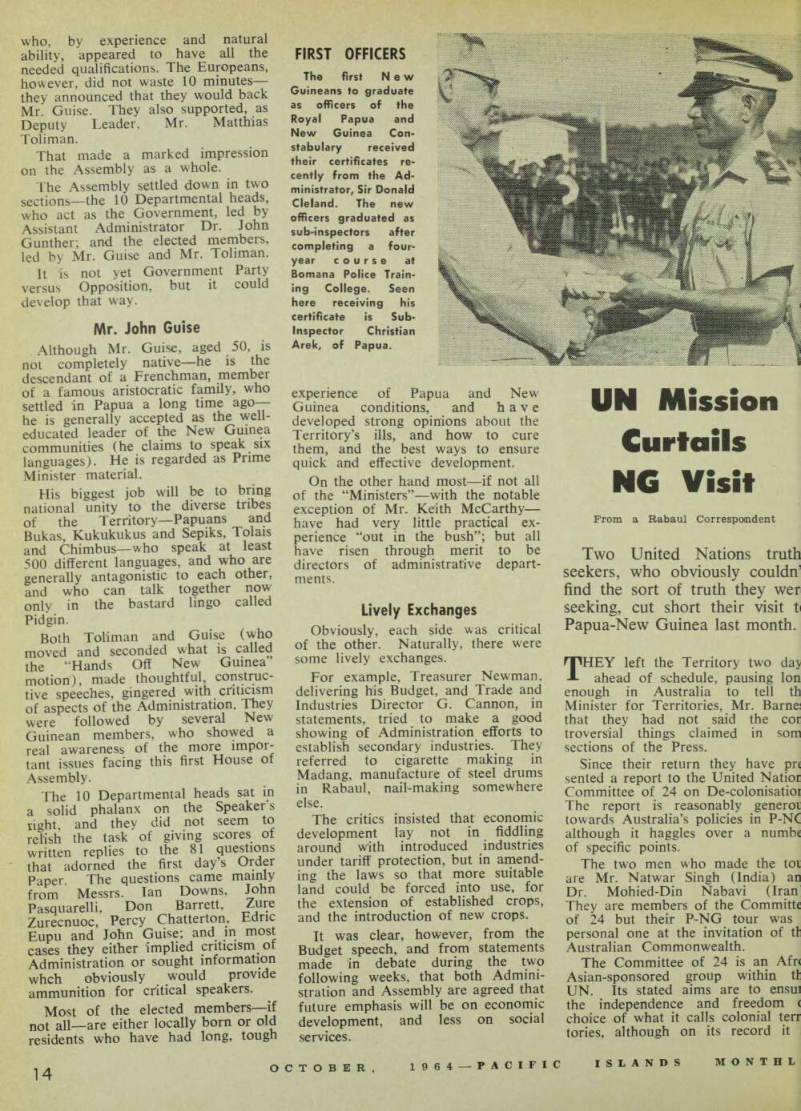
The first New Guineans to graduate as officers of the Royal Papua and New Guinea Con stabulary received their certificates re cently from the Ad ministrator, Sir Donald Cleland. The new officers graduated as sub-inspectors after completing a four year course at Bomana Police Train ing College. Seen here receiving his certificate is Sub- Inspector Christian Arek, of Papua.
ore interested in rapid wholesale dependence rather than soundly ised self-determination.
The two men started their tour in )rt Moresby and after talks with astralian officials there they were imched into a solid round of in ections which lasted for eight days.
It was on the eighth day that ings started coming unstuck. Fog Goroka caused the men to miss aircraft connection and they took o days to get to Rabaul instead the scheduled one day. Australian mmercial representatives and gov iment officers take this sort of ing in their stride, but the UN mble-shooters were a sorry pair icn they finally reached Rabaul.
Dr. Nabavi was sauve and polite, t claimed that the two days which took to get to Rabaul represented sry hard work”, and he was viously not in a benevolent mood, r. Natwar Singh, on the other hand, wned and lolled around with little ■e for what anyone thought. Un
shaven and unworried he cancelled the day’s itinerary and went to bed.
Later he cancelled another tour in the Rabaul area—and then grabbed the official transport to make a tourist trip to nearby Matupit volcano.
The two men abandoned altogether an important conference with leaders of the Gazelle Peninsula Local Gov ernment Council—the biggest council in P-NG and a recognised group with growing political power.
They left P-NG two days ahead of schedule after fussing at officials in Rabaul to change their aircraft bookings.
What was achieved?
In Press interviews and a radio interview it was obvious that the two men had preconceived ideas. They were interested in pushing in dependence at any price for the New Guineans and they seemed annoyed rather than surprised when NG leaders indicated a preference for studied rather than hasty develop ment.
The impression arose from their visit that they were not so much in terested in what the people wanted but rather in what they felt the people should have. Such an attitude may well end in independence, but it can hardly be described as self determination.
Avoided Reply
A Rabaul broadcaster, Mr. Bob Roberts, asked the two men in an interview if it would be better to educate the people to the standards of democracy rather than to grant early independence which could cause anarchy.
Mr. Natwar Singh’s answer was: “I will not go into the controversial part of your question”.
Said Mr. Natwar Singh: “The position is quite clear. Papua-New Guinea is no different from any other colonial territory, and the aims of our committee are quite basic—all territories which have not yet gained independence should be granted in dependence without delay. There is a process by which this can be done, and it should be done”.
Since the return of the two men to United Nations headquarters, the main criticism which they have made concerns the presence in the P-NG House of Assembly of Government nominated members and of Euro peans from special electorates.
The fact that the New Guineans themselves asked for this type of situation during the present interim years is ignored. The Gazelle Peninsula Council—which the two men were supposed to meet —was prepared to provide the reasons.