Mischief Makers
pp. 15-16 · Read in the full issue
P-NG Snub For UN Mischief Makers
From R. W. Robson, in Port Moresby Out of the welter of undefined political ideas and con fusing commentaries which attended the Foot Report on P-NG —and the attempted implementation of the report in the hurried establishment of a House of Assembly—there has come a fairly clear indication of where P-NG is going, and how it is going to be shaped.
TP to the end of August, it was J an uncertain picture.
There was an Assembly of 64 — ] New Guineans and 16 Europeans, us 10 officials—but no one knew hether there was racial harmony the Assembly; whether the appoint ed of 10 New Guineans as Under ;cretaries, to integrate the Assembly th the Administration, was working it; whether the vague policies out led by Administration were voured generally by Assemblymen.
But before the' second session of s Assembly in September was three ys old, the picture had changed mpletely.
It was obvious there was a remark able degree of harmony between the New Guinean and the European members. All sections appeared to have similar ideas of where the Territory is going, and how it is to be prepared for eventual self government.
Spontaneous
Probably the most startling development was a spontaneous declaration by the New Guineans, insisting that the people of P-NG should be allowed to go forward towards self-government in associa tion with Australia, and that the emissaries of UN should keep their mischief-making noses out of it.
That declaration, introduced in the opening hour of the session on September 1, set the note for all future debate.
In my opinion, this concerted move by New Guinean leaders was brought about by: • The friendly and helpful attitude of the elected European members of the Assembly towards the New Guinean members. • The irritating comments of peripatetic, irresponsible observers from India, Africa, and other "emerging” countries who, although their own governmental set-ups represent everything undesirable from anarchy to dictatorship, think they have a UN-given right to lecture Australia about her performances in New Guinea. P-NG, in August, had to suffer silly criticism by emissaries from Persia, Kenya, Pakistan, Nigeria and elsewhere, and this was resented.
O A clear perception by the New Guineans of the implicit threat to their future in the activities of Indo nesia against Malaysia and of Red China against the free countries of South-East Asia. They shrewdly decided they were safer with Aus tralia.
The first indication that something
unexpected was afoot came the day before the assembly opened, as the New Guinean MHA’s gathered in Port Moresby and went into private conference.
The Europeans soon knew that some concerted move was planned; but they did not know its nature,' and some of them were pessimistic.
The Hands-Off Motion Their pleasure was marked when
Assembly met’
Matthias Tollman, a teacher from Rabaul who is also Under-Secretary for the Administrator’s Department gave notice that he would move: * “We, the elected representatives of the people of Papua and New Guinea, desire to convey to the Parliament of the Commonwealth of Australia the Trusteeship Council and the General Assembly of the United Nations Organisation, the expressed wish of the people that they, the people, and they alone, be allowed to decide when the time is ripe for self-government in Papua and New Guinea, and the form that such gov ernment will take; and the people’s further firm conviction that the road to self-government can best be travelled with one guide, and that guide the Administering Authority; and that undue pressure from with out can lead only to that disruption, chaos and bloodshed which the people have observed with great alarm in certain newly independent countries.”
The 38 New Guinean members already had agreed, outside the As sembly, that they should nominate John Guise as leader of the elected members.
But what would the 16 elected Europeans do? It had been expected that they would nominate as their leader a European—Mr. lan Downs
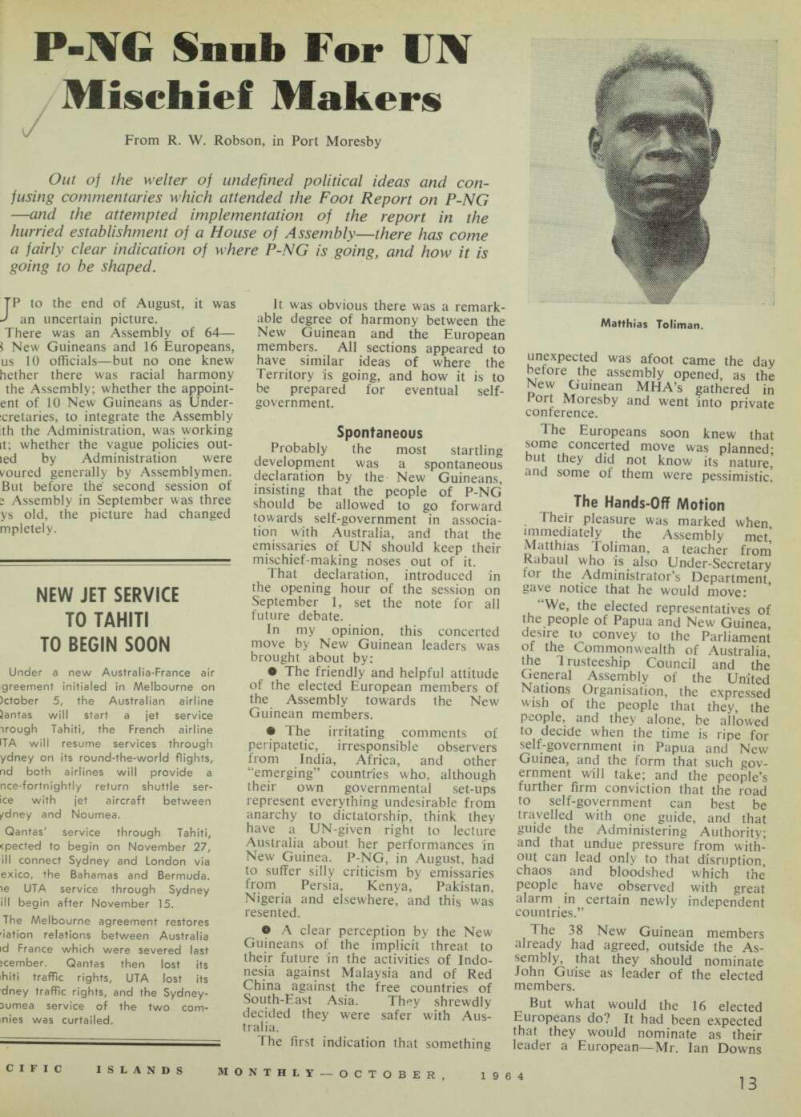
Matthias Toliman.
who, by experience and natural ability, appeared to have all the needed qualifications. The Europeans, however, did not waste 10 minutes — they announced that they would back Mr. Guise. They also supported, as Deputy Leader, Mr. Matthias Tollman.
That made a marked impression on the Assembly as a whole.
The Assembly settled down in two sections—the 10 Departmental heads, who act as the Government, led by Assistant Administrator Dr. John Gunther; and the elected members, led by Mr. Guise and Mr. Toliman.
It is not yet Government Party versus Opposition, but it could develop that way.
Mr. John Guise Although Mr. Guise, aged 50, is not completely native—he is the descendant of a Frenchman, member of a famous aristocratic family, who settled in Papua a long time ago— he is generally accepted as the well educated leader of the New Guinea communities (he claims to speak six languages). He is regarded as Prime Minister material.
His biggest job will be to bring national unity to the diverse tribes of the Territory—Papuans and Bukas, Kukukukus and Sepiks, Tolais and Chimbus —who speak at least 500 different languages, and who are generally antagonistic to each other, and who can talk together now only in the bastard lingo called Pidgin.
Both Toliman and Guise (who moved and seconded what is called the “Hands Off New Guinea” motion), made thoughtful, construc tive speeches, gingered with criticism of aspects of the Administration. They were followed by several New Guinean members, who showed a real awareness of the more impor tant issues facing this first House of Assembly.
The 10 Departmental heads sat in a solid phalanx on the Speaker’s light, and they did not seem to relish the task of giving scores of written replies to the 81 questions that adorned the first day s Order Paper. The questions came mainly from Messrs. lan Downs, John Pasquarelli, Don Barrett, Zure Zurecnuoc, Percy Chatterton, Ednc Eupu and John Guise; and in most cases they either implied criticism of Administration or sought information whch obviously would provide ammunition for critical speakers.
Most of the elected members —if not all—are either locally born or old residents who have had long, tough
experience of Papua and New Guinea conditions, and have developed strong opinions about the Territory’s ills, and how to cure them, and the best ways to ensure quick and effective development.
On the other hand most—if not all of the “Ministers” —with the notable exception of Mr. Keith McCarthy— have had very little practical ex perience “out in the bush”; but all have risen through merit to be directors of administrative depart ments.
Lively Exchanges
Obviously, each side was critical of the other. Naturally, there were some lively exchanges.
For example, Treasurer Newman, delivering Ms Budget, and Trade and Industries Director G. Cannon, in statements, tried to make a good showing of Administration efforts to establish secondary industries. They referred to cigarette making in Madang, manufacture of steel drums in Rabaul, nail-making somewhere else.
The critics insisted that economic development lay not in fiddling around with introduced industries under tariff protection, but in amend ing the laws so that more suitable land could be forced into use, for the extension of established crops, and the introduction of new crops.
It was clear, however, from the Budget speech, and from statements made in debate during the two following weeks, that both Admini stration and Assembly are agreed that future emphasis will be on economic development, and less on social services.