But The Philatelists Won't
pp. 13-14 · Read in the full issue
Willis May Make His Fortune, But The Philatelists Won't
By a Staff Writer.
If there’s any money in floating 10,000 miles across the South Pacific from Peru to Australia, it hasn’t gone into the pockets of the newspaper magnates, the radio barons, the tele vision tycoons, or the cinema moguls.
WILLIAM WILLIS, the 71-year old American raftman, who, on September 9, became the first person to complete such a trip, made sure of that by saying nothing about his lone trip to anyone, and by keeping almost completely out of every cameraman’s way.
And if there’s anyone, who, like me, got one of the 421 letters that Willis carried on his raft, he’d better give up the idea of selling it for a fortune because the Western Samoa Post Office seems to have ensured that the raft-borne letters have no more value as collectors’ items than those conveyed by con ventional means.
Willis’ letters were posted in Apia, Western Samoa, the only place he stopped at on his unique trans pacific voyage, which took 205 days.
The voyage began at Callao, Peru, on July 4 last year when Willis’ 10-ton steel raft, called Age Unlimited, was towed 45 miles off the Peruvian coast and cast adrift
in the Humboldt Current. Willis’ aim was to drift non-stop to Aus tralia to show that a man of his age could do such a thing and as a protest against arbitrary retiring ages.
On November 12, 1963, with a distress flag flying, Willis made an unscheduled landing at Puipa’a, six miles from Apia, where his raft was repaired while he flew home to New York for medical attention.
He resumed his voyage on June 26, slipping out of Apia in darkness to avoid being trailed by a yacht carrying photographers, who, report edly, were hoping to cash in with a film on his exploits.
The only time that Willis was sighted during the 2\ months it took him to reach Australia from Samoa was on August 18 when the freighter Baron Jedburgh reported seeing him near Willis Island (of all places!), 250 miles east of Cairns.
Three weeks later, after somehow
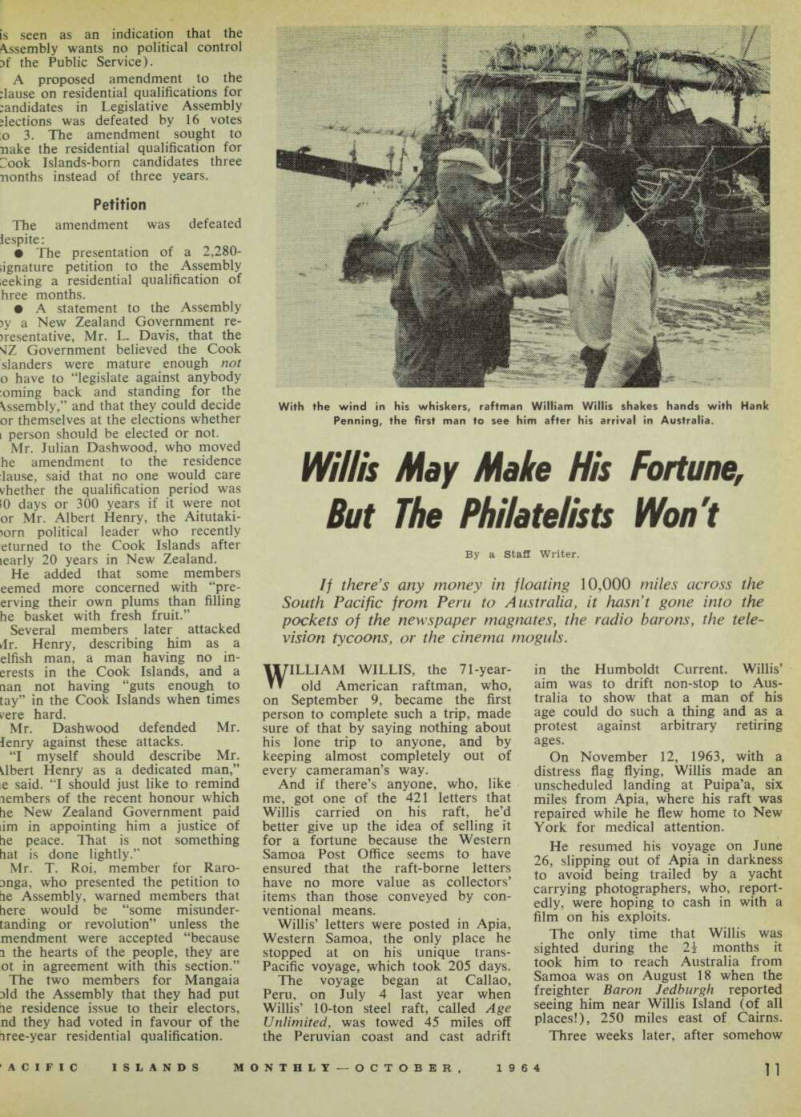
With the wind in his whiskers, raftman William Willis shakes hands with Hank Penning, the first man to see him after his arrival in Australia.
finding a gap in Queensland’s formid able Great Barrier Reef, Willis beached his raft near the mouth of the Tully River, fired off some rockets, and brought a local school teacher, Mr. Hank Penning, to his aid.
When asked who he was, Willis replied with Stanley-meets-Living stone succinctness: “I’m Willis, of New York,” adding after a pause, “But I’ve just come from Samoa.”
Needless to say, it was not long before the Press had swarmed to the spot, seeking stories from this extraordinary adventurer. But although Willis was affable, he was as tight-lipped about his adventures as he was when he completed a similar voyage from Callao to Pago Pago 10 years ago in his raft Seven Little Sisters.
About all the reporters learned was that, following an accident on board, Willis had been paralysed from the waist down for six days when he was still hundreds of miles aff the Australian coast.
If they wanted to know more, Willis said, it would cost $25,000, which was what he was paid for a story on his previous voyage. He offered the raft itself at the same figure—with no takers.
Lecture Tour He planned later to ship the raft to Sydney, where he will probably begin a lecture tour.
The circumstances of Willis’ arrival brought this reaction from a columnist in the Apia weekly Samoana : “It looks as though raftsman William Willis found the formula for success when he came ashore at Puipa’a last November. His landing in Australia followed almost exactly the same pattern—rough seas, injury, radio silence, sailing through a reef, distress flag flying, and a call home to his wife. He should pack ’em in at New York where he is to lecture at the World’s Fair!”
Meanwhile, Willis handed over his bag of Apia mail to the postal authorities at Tully for dispatch to the Sydney GPO, where he had hoped to deliver it personally.
The Sydney authorities had been advised by telegram from the Apia Post Office that Willis was carrying this mail. But as Apia did not request special philatelic treatment, they had no authority to stamp it to indicate that it had come by raft.
However, the Sydney authorities did take it on themselves to back stamp the letters, which is not normal practice.
The back stamp, which is rectan gular, bears the words, “SYDNEY/
28 Sep./1964/N.S.W. Aust.”. The
cancellation on the front (on all the envelopes I have seen) is a round one with the words, “APIA/20 JE
64 1/Western Samoa”. Post
cards had the same stamps, but both on the address side. The postcard stamps were circular, A Sydney GPO official told me that of the 421 letters in Willis’ bag, 295 were for return to Samoa, and most of the rest were for Sydney addressees. In almost all cases, the senders had either written or type
written such words as “Per Willis raft ‘Age Unlimited’ ” on the envelopes or cards.
The official said he had asked a stamp dealer his opinion of an envelope as a collector’s item. The dealer had replied: “If I was to offer that to a collector in Europe, he would be sceptical. There’s nothing official on it to prove it came by raft.”
He added: “There’s no means of putting a value on these things. It’s a question of supply and demand, So as far as I’m concerned, the demand is nil.”