Schoolboy Jocularities, But
pp. 11-12 · Read in the full issue
Fiji's Member System Inaugurated
Schoolboy Jocularities, But No Fanfare Of Trumpets
From a Suva Correspondent History is not always made with a bang and a flourish of trumpets, it seems. At any rate, there was nothing spectacular about the beginning of the latest chapter in Fiji’s history—the inauguration of the new Member system in the Legislative Council on September 14.
UNDER the new system, six unofficial members, three with portfolios and three without, took their seats on the Government side of the House, bolstering the Govern ment team.
There were, therefore, 16 members on the Government benches (against 19 previously), and 12 unofficial members on the opposite side.
The six “borrowed” unofficial members looked somewhat uneasy and a little embarrassed as they rubbed shoulders with the official members.
The “borrowed” six are Mr, John Falvey, Member for Communications and Works; Ratu K. K. T. Mara, Member for Natural Resources; Mr.
A. D. Patel, Member for Social Services; Messrs, Ron Kermode and James Madhavan, and Ratu Penaia Ganilau.
There was a first-day-at-school after-the-hols. air in the chamber before the bewigged, begowned Speaker, Mr. Maurice Scott, took his seat.
Crossed Floor The unofficials shook the hands and pulled the legs of their erstwhile colleagues who had crossed the floor, muttering schoolboyish jocularities such as, “And how’s the Govern ment?” and “What’s it feel like to be one of the ruling class?” while the erstwhiles countered with, “Ah, the Opposition!”
Then, after, a few harmless questions to Mr. Patel, as Member for Social Services, the Council settled down quietly to the business before it.
Some bills were soon approved, as a result of which no one can be forced to accept vaccination for smallpox and repairers of goods can sell them if the owners don’t claim them within a certain time.
Next, the House considered the report of a Salaries Commission which, after five months hard work
in the Colony, recently issued find ings particularly favourable to civil servants in the lower grades.
Little was said about the report on the first day, because the Colonial Secretary proposed that a select com mittee should consider it and report to the Council after an adjournment.
Somebody wanted to know who would appoint the select committee —the Government, which might pack it with its own members, or the Speaker, who might bring in un official members with their own ideas on who should get salary increases?
Voice Of Jacob The Colonial Secretary replied that the Speaker picked the committee members. But the Speaker said that he announced them from a list recommended by the Government.
So when the list was announced, it was the voice of Jacob but the hands of Esau.
When it resumed its session on the evening of September 17, the Council had quite an audience. Not surprisingly, it was made up largely of civil servants.
Almost everybody on the unofficial side had a dig that evening at the salaries report, and some expressed disgust that the magistracy had not been elevated to the top salary bracket.
The debate was carried over to the following morning when the Gov ernment said it wouldn’t give another penny to the magistrates, as, in the end, they came off better than most because promotion was rapid.
This argument did not entirely convince everyone, and it was probably not coincidence that the members who waxed wrathful about injustices to magistrates were lawyers.
Eventually, the salary proposals were approved without many changes, back-dated to New Year’s Day.
The Council then considered
another matter, which, in its implica tions, is much more important than civil servants’ salaries.
It was brought up by an Indian nominated member, Mr. C. A. Shah, who moved that the Government obtain a direct vote from sugar cane farmers and South Pacific Sugar Mills Ltd. on the future of the Sugar Price Stabilisation Fund.
Distribution The motion also asked that “pro vision be made for the winding up of the Sugar Price Stabilisation Fund and the Capital Development Fund and their distribution to the cane growers and the millers according to their respective shares”.
On the surface, it seemed harmless enough except that the mover and seconder, Mr. C. A. Shah and Mr.
S. M. Koya respectively, are mem bers of the “Federation”, an organisa tion born during the 1960 cane field troubles and nurtured afterwards.
The unofficials who spoke on the motion—Mr. F. G. Archibald, Mr.
A. I. N. Deoki, Mr. C. P. Singh, and Mr. J. A. Moore—favoured the motion, or most of it, and Mr. Deoki suggested what appeared to be an admirable idea.
This was that the money accruing to farmers—about £5O a head, he reckoned—should be used to buy shares in the SPSM, which, the previous week, had announced that five million 5/- shares in the com pany would be offered to the people of Fiji (see p. 123).
Mr. Deoki’s idea did not seem so good after the Financial Secretary, Mr. Harry Ritchie, had a go.
He explained that Britain had agreed to pay more than the world price for sugar from Commonwealth producers, provided those producers put some of the extra money in a fund to be used when sugar was not fetching so much. If Fiji monkeyed
with the fund, Britain was likely to cut its price for Fiji sugar.
The result would be a new record low in the price for sugar and nothing in the “kitty” to bolster up the price.
Mr. Ritchie added that, with a world shortage of sugar recently, Fiji had been riding on the crest of a wave and selling for high prices in the world’s free market.
But those prices were tumbling, so price fluctuations would affect Fiji more than in the past. This meant that Fiji would need her Sugar Stabilisation Fund.
Despite this logical argument, Mr.
Koya persisted. He complained that no one listened to the cane farmers, and he said that these men believed that if they were not coloured, but were Europeans, they would “not have this treatment from the Govern ment”.
Rebuked The Speaker rebuked Mr. Koya for this remark and ruled him out of order.
The “baby” of the House, Josua Rabukawaqa, elected to replace the late Ravuama Vunivalu, moved that the motion be referred to the Council’s next session, as the Fijian cane farmers in his area “would like to know more about this”.
This motion was agreed to after Mr. Falvey had vehemently castiga ted Mr. Koya for his “irrational threats . . . tainted with a racial connotation”.
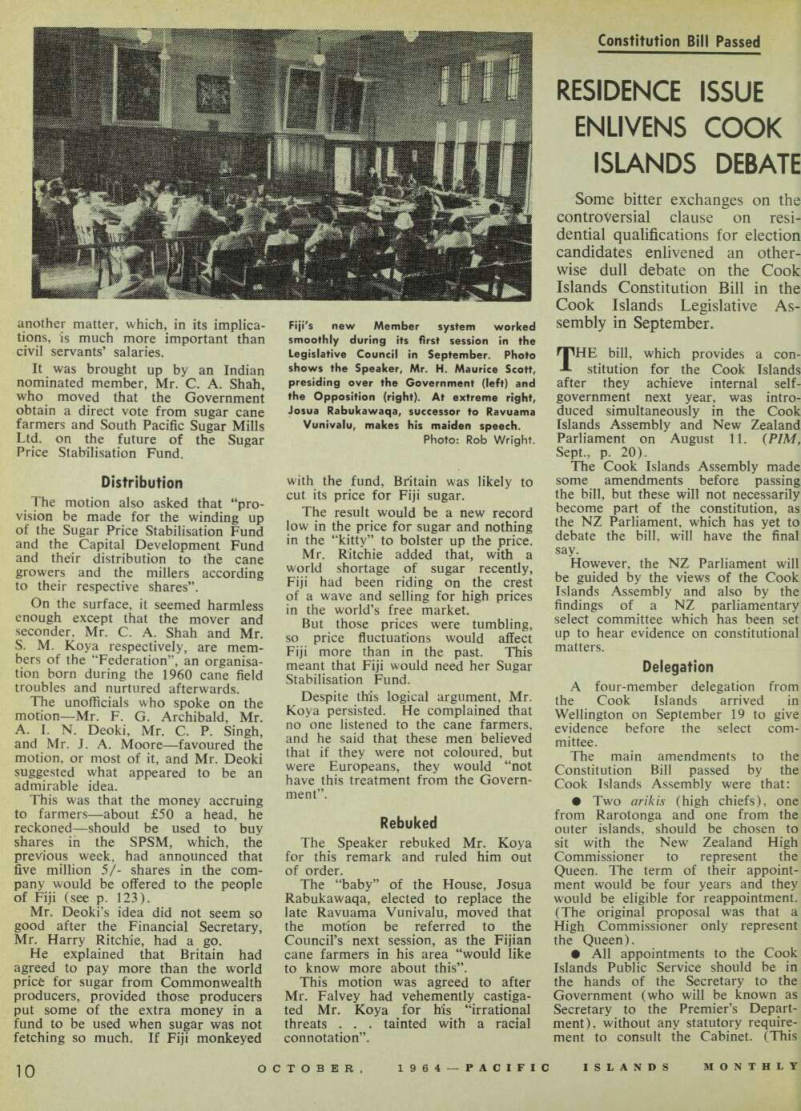
Fiji's new Member system worked smoothly during its first session in the Legislative Council in September. Photo shows the Speaker, Mr. H. Maurice Scott, presiding over the Government (left) and the Opposition (right). At extreme right, Josua Rabukawaqa, successor to Ravuama vunivalu, makes his maiden speech.
Photo: Rob Wright,