Pacific Commerce and Produce
pp. 125-128 · Read in the full issue
£2Sm. Expansion
Programme For
Nickel Industry
Le Societe le Nickel, the French company that operates New Caledonia’s nickel industry, is to undertake a £25 million
(Australian) expansion pro
gramme in New Caledonia.
THE company’s director-general, Mr. Jean Guillard, outlined de tails of the programme recently to members of the Noumea Chamber of Commerce.
The programme will be financed principally by loans from various credit institutions, banks, etc. But at least one-fifth of the cost will be borne by shareholders of the com pany.
New shares will be offered on the French stock markets, and some will be offered to New Caledonian in vestors.
It is hoped that new equipment to be installed in Noumea will double the production of ferro-nickel matte within three years, bringing produc tion to 50,000 tons a year.
New Mining Centres New mining centres on the east and west coasts of New Caledonia will be created, each with ore treat ment plants costing about £.400,000.
These plants will transform the ore from the mines into “pellets”, which will go to the furnaces on arrival in Noumea with hardly any other preparation.
Treatment of the ore in this manner means that it will be possible to make use of ore with a lower nickel con tent than that currently used.
About 600 workers will be needed in the new mining centres, and about 500 more will be required in the Noumea smelters when the expansion programme is completed.
In outlining these plans, Mr.
Guillard raised the point—a sore one with local unions and the majority party, Union Caledonienne —that the company would probably have to bring in specialised personnel from France “as a good deal of mechanisa tion will be introduced with the new set-up.”
He also raised the touchy point that New Caledonia would have to help the Nickel Company by fore going customs revenue on much of the equipment to be imported for the expansion programme.
He added: “I hope that my com pany will be accorded a little relief from the heavy tax burden it carries.
The export tax paid by the company will, of course, increase, but I hope that it will not be doubled.”
PI M’s Noumea correspondent says that the controversial points raised by Mr. Guillard will be bitterly thrashed out at future meetings of the local Territorial Assembly, which will “certainly be hostile to them”.
Increased Profits
For Burns, Philp
THE consolidated net profit of Burns, Philp and Co. Ltd. for the year ended March 31 was £1,661,176. The actual increase was £304,031 (23.8 per cent.) and was the highest in the company’s history.
The gain in net profit in the previous financial year was £241,190.
The capital of the company will rise to £9 million with a proposed further bonus issue of one-for-four this year.
The group trading profit rose by £556,068 to £2,671,994. The invest ment income was £929,826, a rise of £49,712.
The dividend of 10 per cent, (steady for 12 years) required £720,000, an increase of £60,000.
The accounts showed a sharp increase in the market value of the group’s investments.
While the book value of invest ments in listed companies rose by only £249.075 to £10,846,125, the market value of the holdings went up by £4,101,959 to £24,294,713.
The directors reported that the company’s ships continued to be well supported, but expenses con nected with their operation again rose disproportionately.
To minimise losses, the Australian- Malaysia service was curtailed by the sale, after balance date, of the Burnside at any “acceptable price”.
By comparison with previous years there was “a gratifying increase” in merchandising sales, through both the wholesale and retail branches.
But rising costs again absorbed much of the advantage.
Revenue from investments and
plantation interests was up to ex pectations, although production on some properties was slightly lower because of dry weaher.
The cocoa tonnage showed a further increase, and while prices were somewhat lower than last year, the markets remained profitable for the better grades of produce.
The company has made four bonus issues in the last six years: 1958, one-for-four; 1959, one-for five; 1962, one-for-five; 1964, one for four.
Tonga Looks At
Sugarcane
FJiONGA may follow Western A Samoa’s example and try to . grow sugarcane to save overseas exchange. The Tonga Copra Board has started an investigation into the possibility of establishing cane.
In July Mr. Carl Riechelmann, a member of the board, went to Apia to see at first hand what is being done in Western Samoa. While there he discussed the crop with Mr. Van .Goes, the FAO expert who is advising and helping Western Samoa to establish a sugar industry.
Tonga already has a mill, bought two years ago for experiments in milling sugar and other crops.
It has been estimated that a crop of 130 to 150 acres of cane would be needed to meet local requirements.
Tonga’s 1963 sugar imports were 519 tons, worth £38,992.
Fiji Fertiliser
Discovery
JAEPOSITS of fertiliser have been found in some of the Lau islands of Fiji, and now the Colony is making inquiries about them.
Samples of the deposits are being tested by the Department of Agriculture, and the results should be known by the end of the year.
But indications are that some of the deposits could be used to supply phosphates for fertilisers for local agriculture.
All the islands have been closed to prospectors for the time being to prevent speculative staking of claims.
The position will be reviewed when the tests of the sulphate deposits are finished.
Tahiti Firm Moves
From Historic Site
AGENCE Tahiti Poroi, one of -Ci- Tahiti’s leading travel, shipping and import-export firms, moved in August from its old Quai du Com merce quarters in Papeete, to temporary premises a block away in the new Gregory Lau Building.
Within 18 months, it will occupy its permanent new office in a building now under construction at the corner of the Quai du Commerce and the Rue des Ecoles.
There were some sentimental regrets for its owner, Mr. Alfred T.
Poroi, on quitting the old office which occupied the downstairs corner por
tion of the block-long, blue-painte building known locally as Fare Tor (or Chez Tony, in its Frenc version), and owned by the late Tor Bambridge.
The building fronts the Quai B Hackheim, where there are alwai a dozen overseas yachts moored bov on to the Quai.
The premises were once occupie by the old South Seas firm of S. I Maxwell & Co. Maxwell’s office w* managed for years by a Mr. T. I Bunkley, an American who arrive in Tahiti in the early 1890’s. Alfre Poroi got his first job with Bunkle and worked with him for many yeai while S. R. Maxwell & Co. wei agents for the Union Steam Ship C< of NZ. P S. R. Maxwell & Co. was liquidate in 1936 and the Union Steam Shi Co. established its own branch offic with J. S. Coster as manager an Alfred Poroi as his assistant. Mi Poroi became manager in 1951 whe Coster retired and when the USS Cc closed its Papeete branch in 195 he carried on under his own steac as a travel and shipping agent am importer-exporter.
His firm has the agency for Fia cars and MAN trucks as well a other important French lines.
Mr. Poroi these days mixes politic with business. He has been Mayo: of Papeete for years and since 196: has been Senator for French Poly nesia in the French Senate.
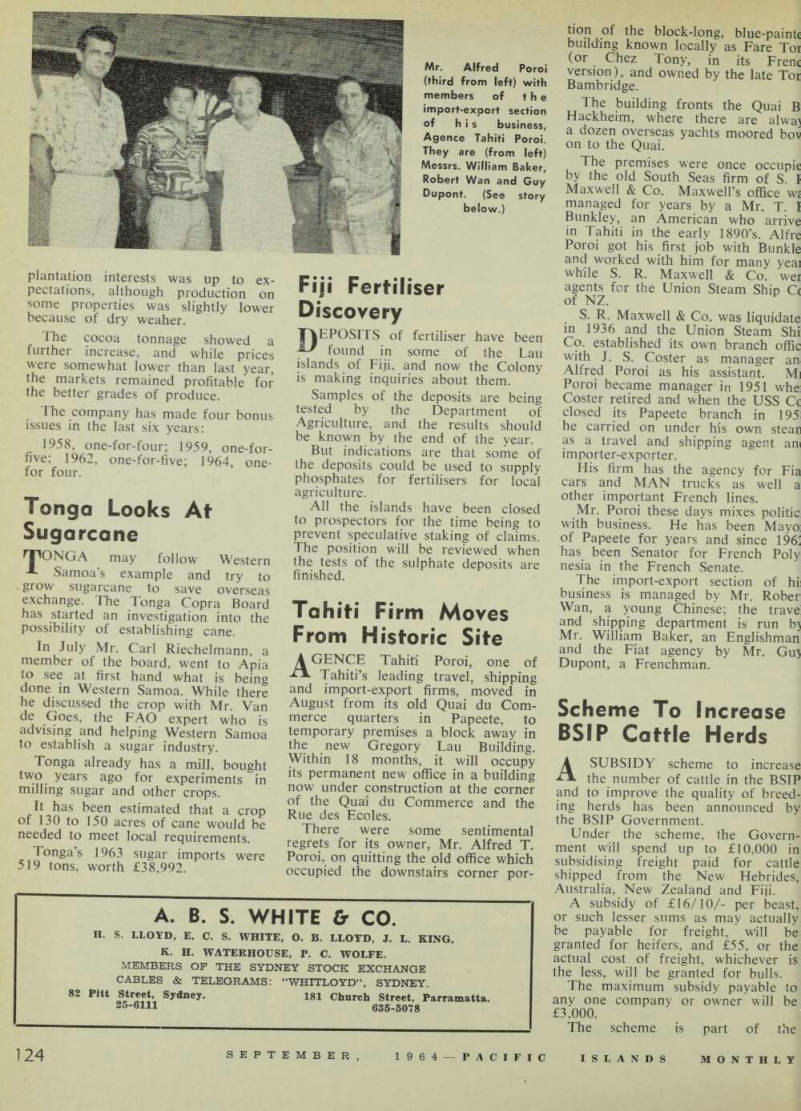
The import-export section of hi; business is managed by Mr. Rober Wan, a young Chinese; the trave and shipping department is run b} Mr. William Baker, an Englishman and the Fiat agency by Mr. Gu> Dupont, a Frenchman.
Scheme To Increase
BSIP Cattle Herds
A SUBSIDY scheme to increase the number of cattle in the BSIP and to improve the quality of breed ing herds has been announced by the BSIP Government.
Under the scheme, the Govern ment will spend up to £lO,OOO in subsidising freight paid for cattle shipped from the New Hebrides, Australia, New Zealand and Fiji.
A subsidy of £l6/10/- per beast, or such lesser sums as may actually be payable for freight, will be granted for heifers, and £55, or the actual cost of freight, whichever is the less, will be granted for bulls.
The maximum subsidy payable to any one company or owner will be £3,000.
The scheme is part of the
Mr. Alfred Poroi (third from left) with members of the import-export section of his business, Agence Tahiti Poroi.
They are (from left) Messrs. William Baker, Robert Wan and Guy Dupont. (See story below.)
tectorate’s development plan, and funds allocated will come from :eeds of the sale of the British imon Islands Trading Corpora te ultimate object of the scheme to reduce the Protectorate’s mdence on imported meat dies and to make greater use :attle on coconut plantations.
ilolo's Falling
ofit
JLOLO Gold Dredging Ltd. net profit for the year ended May 1964, was 285,300 Canadian ars, compared with 440,235 irs in the previous financial year, me from investments, other than imonwealth-New Guinea Timbers , fell slightly from 187,000 irs to 161,600 dollars, tie company now has only one ge in operation and the report the president and managing dor, Mr. J. W. Austin, said that as the lower economic operation that dredge which was the :ipal reason for the profit fall, r. Austin said that legal action still pending on the writ issued nst the Commonwealth Govern t over outstanding subsidy pay ts concerning Australian duty
velopment of
isima Mine
ICIFIC Island Mines Ltd. has signed an agreement with Cultus orations Ltd., Canada, to develop Misima gold mine in Papua 4, August, p. 8). tie agreement provides that us will spend £400,000, which entitle it to a 60 per cent, est in the mine. Pacific Island es finished its exploratory drive the island in July.
iuri Co. Quits
mikoro
IE Kauri Timber Company ceased operations on Vanikoro August and all native and ipean employees have left the id. 11 equipment and stores were ped to Honiara by the Philkari ed by D. & J. Gubby, of Santo, the BSIP Government vessel, % fisher. n auction sale of this equipment o be held at Honiara on Sep ber 10.
An official of the Kauri Timber Company said in Melbourne that Japanese and other timber interests will not at present resume the opera tions at Vanikoro.
The last shipment of logs was made on August 15 by the Fiji Maru to Japan.
The meteorological section con ducted at Vanikoro by the Common wealth Bureau of Meteorology on behalf of the South Pacific Air Transport Council is being re equipped and it is understood that it will continue operations for some time.
Buoyant BSIP
Revenue
THE revenue position in the BSIP in the first six months of 1964 was most encouraging, according to the Financial Secretary, Mr. L. M.
Davies. Imports and exports were running at higher levels than ever before.
Preliminary figures showed that to June 30 the yield from import duty of £191,000 was about 3 per cent.
above the estimate. Export duty had yielded £ 150 ,000, about £23,000 above the estimate, because of the high world price of copra. & The Protectorate’s copra pro duction from January to June was 12,997 tons, 218 tons less than the output for the first six months of 1963. In every month except January, production was high, but it will have to remain that way if last year’s production is to be exceeded.
"Hidden" Timber Port
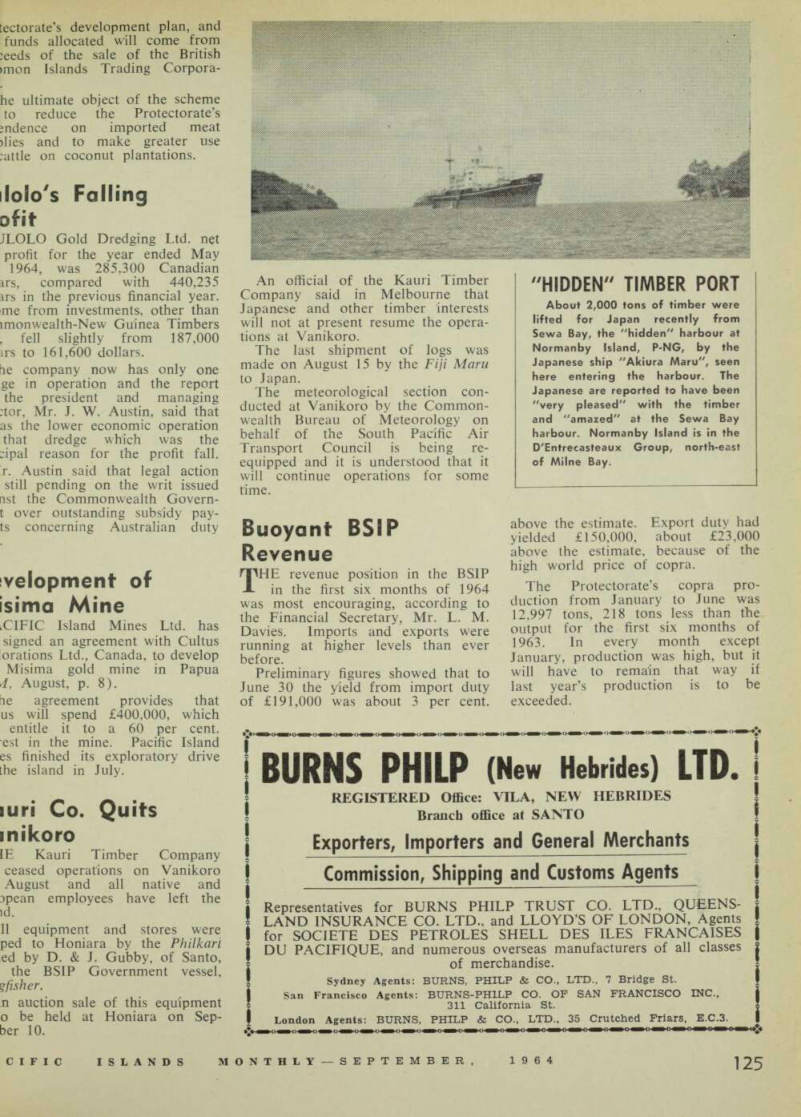
About 2,000 tons of timber were lifted for Japan recently from Sewa Bay, the "hidden" harbour at Normanby Island, P-NG, by the Japanese ship "Akiura Maru", seen here entering the harbour. The Japanese are reported to have been "very pleased" with the timber and "amazed" at the Sewa Bay harbour. Normanby Island is in the D'Entrecasteaux Group, north-east of Milne Bay.
I Concern Over NG
Coffee Exports
rpHE Papua-New Guinea Coffee A Marketing Board is seriously j worried that P-NG is in danger of 1 losing its £A 1,250,000 coffee export trade to Australia.
A statement made in August by the board’s chairman, Mr. lan Downs, who is also an elected member for the Territory’s House of Assembly, said the board had “paid very close attention to present trends in coffee exports to Australia and to overseas and that as a result it was most concerned at the declin ing percentage of Territory exports going to Australia.
The Territory supplies Australia with about 30 per cent, of its total coffee needs.
Mr. Downs said the board was concerned about this decline because of the special value attached to a firm market with such a near and friendly neighbour and because the level of sales to Australia could be of great importance to the Territory in later years of the International Coffee Agreement.
Under the international agreement the Territory’s exports to Australia are exempt from the general quota system.
The board had decided, Mr.
Downs said, that after a careful study of the situation it would take firm steps in the coffee year starting October 1 this year to ensure 60 per cent, of Territory exports went to Australia.
He added that an important factor in the present situation was the rapid growth of Australian import con sumption of coffee which now appeared likely to reach 14,000 tons in the coffee year 1963-1964.
Aap-Reuter.
Samoa Soap Industry
fFHE Western Samoa Trust Estates -*■ Corporation has ordered equip ment for a soap factory which it hopes to establish at Vailele within the next 12 months.
The machinery will be capable of producing any kind of soap, from plain laundry soap to luxury toilet soap. Initially production will be confined to laundry soap, and the output is expected to be about two tons a day.
Toilet soap and soap powder pro duction will follow later. It may also be possible to manufacture toothpaste, shampoos, and hair preparations.
In the last financial year Western Samoa spent £69,244 on imported soaps and detergents.