Adventurer
pp. 89-91 · Read in the full issue
Lively Memoirs Of A Lone Adventurer
To most Australians under the age of 40 or so, the name of Francis Chichester is not likely to mean much. But those over 40 will probably remember him as one of that intrepid band of airmen, including Kingsford Smith, Hinkler and Ulm, who performed astonishing feats of aerial derring-do in the days when aircraft were virtually tied together with string.
THE difference between Chichester and most of his better-remembered contemporaries is that Chichester is still alive and is still performing astonishing feats.
In 1960, 26 months after he had been told he had advanced cancer of the lung, he won a single-handed yacht race across the Atlantic in his yacht Gipsy Moth 111 in 40i days.
This was eight days better than. his nearest rival. But it was not fast enough for Chichester, who, at the age of 60, made a second, and recordbreaking solo crossing in mid-1962 in 33 days 15 hours.
During the 1960 race, Chichester also found time to write 50,000 words of log, which formed the basis of a book called Alone Across the Atlantic.
Now he has published an autobiography of well over 100,000 words, aptly called The Lonely Sea
and the Sky, which traces his ad venturous career from the age of 11 (when he was bitten by a snake) down to the present day. The book is a Book Society Choice, and deservedly so.
Chichester, who was born in England, was intended by his parents for the Indian Civil Service, Farm Job But he did not think studying at university until he was 25 in pre paration for this would be “a proper life”. So he left college of his own accord, whereupon his father more or less disowned him by getting him a job on a farm in Leicestershire, When Chichester was fired after upsetting a drayful of milk churns, his father shipped him off to New Zealand, After working in New Zealand as a station-hand on a sheep station,
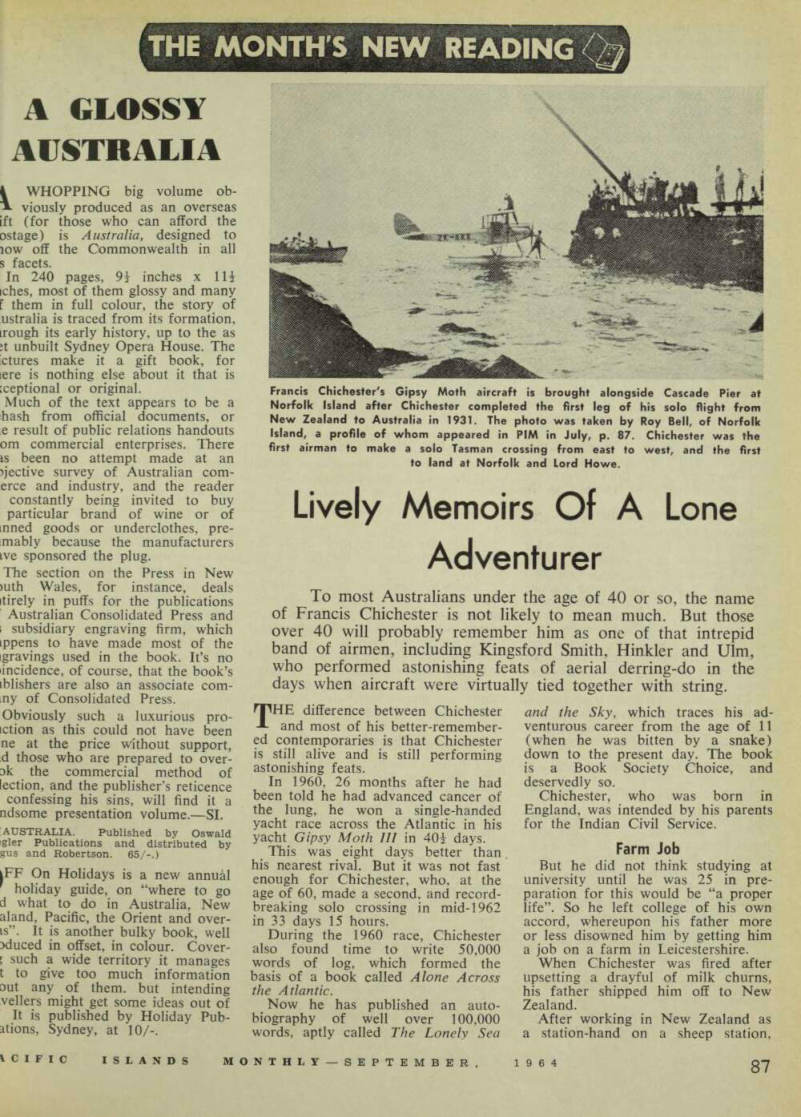
Francis Chichester's Gipsy Moth aircraft is brought alongside Cascade Pier at Norfolk Island after Chichester completed the first leg of his solo flight from New Zealand to Australia in 1931. The photo was taken by Roy Bell, of Norfolk Island, a profile of whom appeared in PIM in July, p. 87. Chichester was the first airman to make a solo Tasman crossing from east to west, and the first to land at Norfolk and Lord Howe.
Chichester tried his hand at writing, then worked for a timber mill, in a coal mine, and as a gold fossicker.
He made no money at these jobs, and as he had resolved on leaving England that he would not return until he had saved £20,000, he soon turned to more profitable pursuits.
These included selling yearly sub scriptions for the Christchurch Weekly Press and selling a book keeping system to farmers.
After a year, he had earned £7OO and had saved £4OO, which he invested in a real estate business with a man called Goodwin.
By the time Chichester was 26, he was earning £lO,OOO a year and he and Goodwin owned three companies operating in land. Goodwin then sold Chichester the idea of an aviation company, and so the Goodwin- Chichester aviation company was formed.
Learned To Fly The company took the New Zealand agency for A. V. Roe, bought two Avro Avians and began taking passengers on joy rides. Four of the best pilots in New Zealand were engaged but after they crashed the two planes a few times, Chichester got exasperated and learned to fly himself.
In 1929, just over 10 years after his arrival in New Zealand, Chichester returned to England for a visit.
There he bought a Gipsy I Moth, which weighed 880 lb. unloaded; and after a trial run round Europe, he decided to fly it to Australia solo.
“This may not seem much of a project today,” Chichester writes, “but at that time only one person had flown alone from England to Aus tralia, Bert Hinkler, a crack test pilot from Bunderberg”.
Chichester did the trip in 180 flying hours—not much longer than Hinkler’s time—and found himself something of a hero on his arrival in
Sydney. He then decided to fly the Tasman alone, which no one had yet done.
The problem was: How to do it?
His Moth was already carrying 60 gallons of fuel with two extra tanks fitted, and was taking off with a load equal to its own weight.
More than 100 gallons were needed to span the Tasman, but no more tanks could be added to the Moth, and no plane with the necessary range was obtainable in New Zealand.
Three Hops
Finally, Chichester decided that the only way out was to make the crossing in three hops—from the northernmost tip of New Zealand to Norfolk Island (481 miles); from there to Lord Howe Island (561 miles); and from Lord Howe to Sydney (480 miles).
However, as he couldn’t find out much about the topography of either island —the Pacific Islands Year Book was still a thing of the future then— Chichester decided to turn his Moth into a seaplane and alight on the sea.
This decision created all sorts of flying and technical problems, in addition to which was the problem of navigation: How could Norfolk and Lord Howe be found from the air?
Norfolk Island, approached frc the northernmost tip of New Zealai was only half a degree wide, or oi one-fourteenth as wide as t Hawaiian Islands, which were 1 smallest target hitherto aimed at an aviator —from San Francis< Moreover, there were no radio ai then.
Astronomical Navigation
In the end, despite “expert” opini to the contrary, Chichester decid that the only way of finding 1 islands was by “shooting” the sun and he began learning astronomy navigation.
While he was doing this, an Ai tralian pilot, Menzies, crossed 1 Tasman by air for the first tin using the same plane in whi Kingsford Smith made a record flij from England to Australia.
This, at first, was a disappointrm to Chichester, but he soon got it as he was “firmly gripped by 1 idea of finding my island by my o system of navigation”.
Chichester’s account of how, 1931, he eventually did find b( Norfolk and Lord Howe Islands his own system of navigation for a highly dramatic part of his ben for, besides the difficulty of this fo of aerial navigation, Chicheste
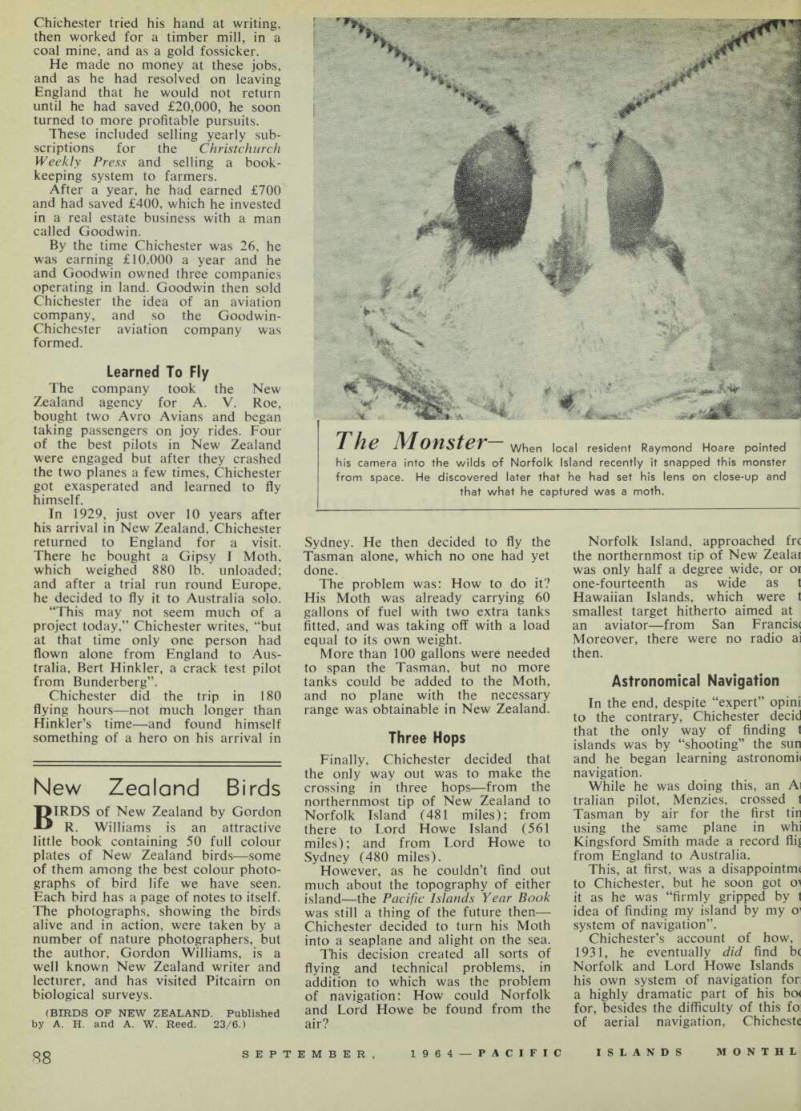
The Monster- when local resident Raymond Hoare pointed his camera into the wilds of Norfolk Island recently it snapped this monster from space. He discovered later that he had set his lens on close-up and that what he captured was a moth.
lane was so sensitive after floats /ere added to it, that it dived or limbed abruptly whenever he moved is head.
The last few minutes before he ighted Norfolk Island were almost nbearably exciting, for if he missed is landfall, he was finished. There /as not enough petrol in his tanks 3 enable him to search for it for mg, and there was no other land e could make for.
Like A Lifetime “Every minute seemed a lifetime, s I scanned the horizon ahead,”
Chichester recalls. “The wind was ropping with approaching nightfall . . The sea looked grey blue, cold nd hostile.
“At 5.08 p.m. I ought to have ighted the island 10 miles earlier, yell, I thought, this is a grand nish; risking everything on the cool r orking out of my own system.
“At 5.09 I thought I saw land away ) the left, but it changed shape as watched it, for it was a cloud on le horizon. At 5.12 the island ought > have been in sight 15 miles earlier.
“Suddenly I relaxed, feeling that orrying was stupid when there was othing I could do. The cloud lifted, nd there was land. I felt like burst ig with thrill and elation. My ivigational system had proved right.”
Wrecked At Lord Howe Chichester piloted his frail craft ) Lord Howe Island four days later ith the same “bang-on” accuracy 5 to Norfolk. But on the night of is arrival, his plane was wrecked y a cyclone while anchored in the igoon.
Undaunted, Chichester set about ;building it himself, with the aid of le islanders; and after six weeks, e flew on to Australia.
An epic flight to Japan followed; nd, six years later, a 21,000-mile ight from Sydney to London, via eking.
During the war, Chichester served s a navigation instructor in the oyal Air Force, but he was not lowed to fly, and was not allowed ) wear pilot’s or navigator’s wings n his tunic.
After the war, Chichester founded i entirely new business in England -map and guide publishing—and, sing too old to fly, took up sailing.
Judging by the way life has gone >r him so far, he must have a few tore careers and adventures ahead P him yet. But it is difficult to tiagine that he could write a livelier aok about them than his present tie, The Lonely Sea and the Sky. -RL.
(The Lonely Sea And The Sky.
odder and Stoughton. 45/-).