Many Changes
p. 73 · Read in the full issue
Veteran Lord Howe Islander Has Seen Many Changes
From a Lord Howe Correspondent The name of Wilson has long been associated with Lord Howe Island— since 1878 in fact —and the Wilsons are now the largest family on the island, which has a population of about 240.
THE oldest Wilson on the island is Herbert Thomas, who is now in bis 80th year. He is one of the few :>f the “old school” who remain.
Mr. Wilson (pictured) was born on Lord Howe on December 9, 1884, and has spent all his life there, except For a break of about a year in 1904- 35, when he worked in Sydney, and For other brief periods. With such a long association with the island he can be fairly described as a “walk ing history book” about his home land.
His father, Thomas Bryant Wilson, ihe patriarch of the family, arrived
at Lord Howe in the schooner Esperanza in 1878 from Fiji.
He was a well-educated man, and as there was no schoolteacher on the island it was natural that he should accept such a post when it was offered to him.
Thomas Bryant Wilson married Mary Thompson, who had been his oldest pupil at school, and they had five children, of whom Herbert was the second.
Palm Seed Exports T. B. Wilson was the first person to export Kentia palm seeds from Lord Howe to Europe. His consign ments went to the Kew Gardens, London.
Herbert Wilson did all his school ing on the island. In those days school was a half-day affair. He spent the other half collecting palm seeds, or in helping to provide for his family by hunting, fishing or garden ing.
He has seen radical changes on the island. Steam has replaced sail, and now flying-boats have replaced steam as a regular means of transport to and from the island.
Bullocks and horses are things of the past, and trucks, cars and tractors operate in their stead. Oil and kero sene lamps have given way to elec tricity.
Herbert Wilson has been interested in many Lord Howe ventures besides the export of palm seeds com mercial fishing, vegetable and flower seed growing, and the tourist in dustry.
Semi-Retired Now leading a semi-retired life, he farms about an acre and a half of land for vegetables and fruit, mainly for his family. Any surplus goes into the tourist industry in the way of supplies for guesi houses.
He works his land with a hoe and a fork.
For a change, he takes a day off here and there and goes fishing.
Herbert Wilson was one of the first Lord Howe residents to accept the Seventh-day Adventist teaching.
This was in 1913 under the ministry of Pastor Butz, who was well known in the Pacific.
With a natural flair for story-tell ing, plus a good memory, he has given much enjoyment to others. One of his favourite stories is how he just missed a watery grave when he was 34.
Watery Episode
After the Bums Philp ship Makambo ran aground on a rock on the eastern side of the island in June, 1918, she had to be beached to stop her from sinking.
When she was refloated, one of the anchors was left in a position from which it was impossible for the ship to recover it.
Mr. Wilson and four other islanders undertook to shift the anchor to a position where the ship could pick it up on the next trip.
Using two surf boats lashed to gether with spars, they hooked on to the anchor at low tide and started to lift it out. But the weight was too much and the spars broke. The two boats crashed together like a clam with the five men still inside.
As they sank in about 60 ft of water, Mr. Wilson pulled his knife from his pouch and cut away the lashings, allowing the men to escape.
Two other, older men, watching from the beach, had seen what hap pened, and they launched another surf boat and went out to help the men.
Mr. Wilson said he never cared much for swimming, and after that experience cared even less.
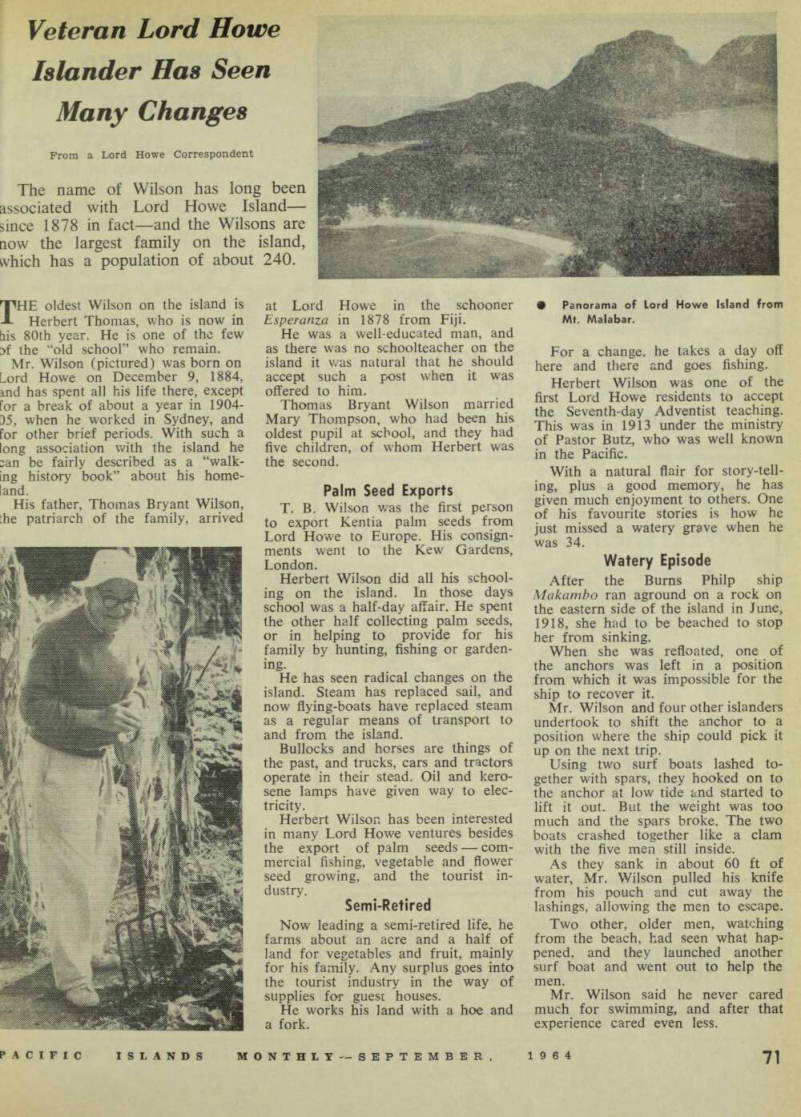
Panorama of Lord Howe Island from Mt. Malabar.