At Rarotonga
pp. 65-67 · Read in the full issue
Famous Brigantine
'Yankee' Wrecked
From W. H. Percival, in Rarotonga
Rarotonga’s rugged coral reef,
which has claimed at least 14 ships since 1833, wrecked an
other vessel during the early
hours of Friday, July 24. This
was the beautiful brigantine,
Yankee, famous in the Bahamas,
the Pacific Islands, Australia,
and many other parts of the world.
YANKEE arrived at Rarotonga on July 16 in the course of a world cruise. On arrival 18 people were on board, including Captain Derek Lumbers and eight crew mem bers.
The 96 ft. steel-hulled brig was anchored off the reef at Avarua, Government and business centre of :he Cook Islands located on Raro ;onga’s northern coast.
Her two anchors were down and bolding well, but her two powerful diesels were out of action due to un serviceable generators and flat bat teries.
Efforts had been made to re pair the generators and charge the batteries, but these efforts came too late to save the famous sailing ship.
The day before the shipwreck the seas were moderate but in the early hours of Friday morning they became rough and Yankee began to pitch and strain at her anchor cables.
Captain Lumbers worked on the generators on board until 2 a.m., un worried by the building seas because the two anchors were holding well, but about 4 a.m., Yankee began to drift towards the reef. It seems that the flukes of one of the anchors had snapped off, and the other anchor started to drag. As the vessel was swept towards the reef the mate, Paul Cook, bellowed the command —“All hands on deck”.
Cook Goes For Help At about 5 a.m., the Yankee's rudder was scraping the reef.
The ship’s two boats had floated astern and were lost when their painters broke.
Captain Lumbers ordered the pas sengers to wear their life jackets and to stay in the saloon. He instruc-
ted ship’s cook, Jay dee Jones, to paddle ashore in a rubber dinghy and to try to obtain new batteries and all possible assistance.
Rough seas were cascading over the reef and Jones’ task was not easy, but he reached shore across
the narrow lagoon and hurried to a telephone.
He asked the Union Steam Ship Company for help from the com pany’s tugs, but the tugs were high and dry ashore in their shed, and between them and the harbour lay a
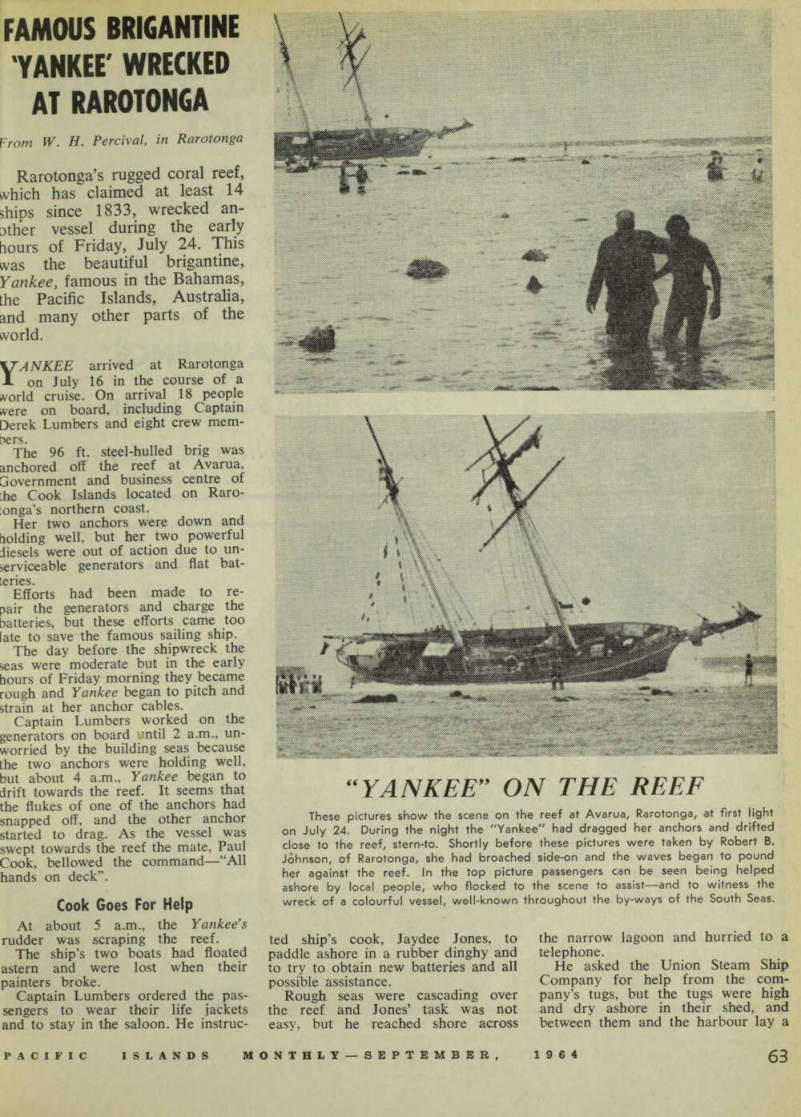
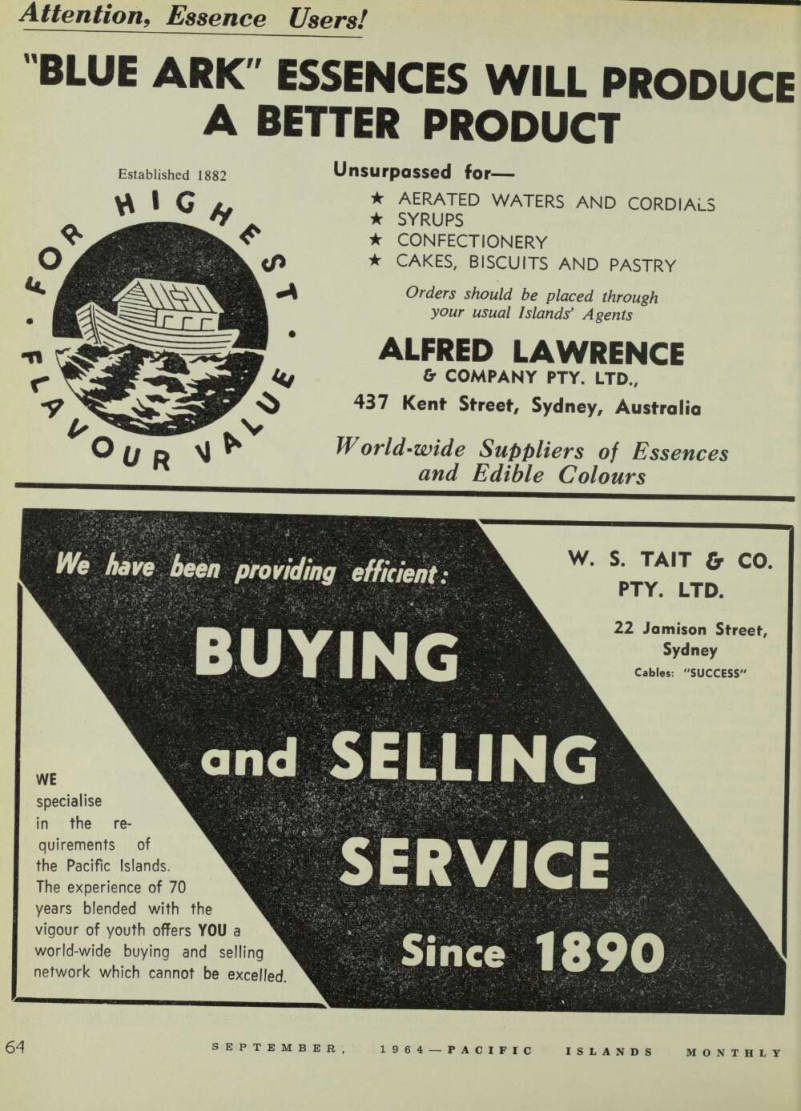
“ Yankee” On The Reef
These pictures show the scene on the reef at Avarua, Rarotonga, at first light on July 24. During the night the "Yankee" had dragged her anchors and drifted close to the reef, stern-to. Shortly before these pictures were taken by Robert B.
Johnson, of Rarotonga, she had broached side-on and the waves began to pound her against the reef. In the top picture passengers can be seen being helped ashore by local people, who flocked to the scene to assist —and to witness the wreck of a colourful vessel, well-known throughout the by-ways of the South Seas.
large lighter which would first have to be moved. No labour was avail able at that early hour.
Flares were fired from the Yankee and an S.O.S. flashed by lamp.
Ashore, other officials were roused From their beds.
The only vessel in port capable Df towing the 96 ft brig off the reef tvas the small motor ship, Tagua, vhich had arrived at Rarotonga only he previous day on her maiden voy age from Hong Kong, for the inter lock Islands trade.
But the Tagua had been fumigated )n arrival with a deadly gas and lobody was allowed on board until ;he was declared safe by Public iealth inspectors. It was about 8.45 i.m. before her master, and one of ler owners, Captain Dunsford, and lis crew were able to go on board.
Just as they prepared to do so it vas noticed that the Yankee, about a nile away, had swung broadside on o the reef—which meant there was low no hope of towing her off. The ttempt was abandoned.
Crowd Watches Rescue Meanwhile, a crowd had gathered t the scene of the wreck to watch he rescue of passengers.
Big waves kept pounding the tricken brig, throwing great bursts if spray as high as the lower yards nd working the vessel higher up on d the reef.
Suitcases were piled on deck ready d be taken ashore. The deck was ilted at about 60 degrees.
As the Yankee lurched and rocked inder the impact of the rollers, about 0 young Maori men waded out to ward the vessel and hung on to a ne thrown from the ship.
Down the life-line came passengers nd crew and those who had gone board to help.
An on-the-spot recording was made y Mr. Percy Henderson for Radio Larotonga. He stood in waist-deep 'ater and, when the waves surged in, ad to place his tape-recorder on his ead to protect it.
The oldest passenger, a white earded man of 65, was helped along le beach by two stalwart Maori oys.
The last to leave the Yankee was aptain Lumbers.
The famous Yankee was built in 912 at Emden, Germany, for use s a North Sea pilot vessel. In 1945, le was aquired by Britain, and some me later was bought by globe rcling American Irving Johnson.
Under his command and over a period of years, Yankee became well known in the Pacific.
Irving Johnson maintained Yankee in first-class condition and filled her with young and fit people who worked as crew and helped pay the expenses of Yankee’s round the world cruises. When owned by the John sons the brig made seven happy Paci fic cruises.
Recent Ownership
About 1957, Johnson sold Yankee to a Mr, Reed Whitney and took up cruising through Europe’s waterways from Scandinavia to the Mediter ranean.
Later Yankee was purchased by Captain Mike Burke and a syndicate known as Windjammer Cruises Inc., which operates four large schooners out of Miami, Florida, on almost weekly tourist cruises.
Yankee’s first round-the-world voyage under the new ownership was made in 1961, and it was not a happy voyage.
Neither was the current one which ended on Rarotonga’s reef. It started from Nassau in the Bahamas in early February. In April, a tragedy oc curred when the brig called in at the
Galapagos Islands. One of the pas sengers, Miss Sara Reiser, aged 70, went for a walk on one of the islands and never returned. An in tensive search failed to find her.
There were other troubles too, trouble with equipment from the start of the cruise, trouble with the crew, and considerable dissatisfaction among the passengers.
From the Galapagos, Yankee sailed to Tahiti and Bora Bora and from there to Rarotonga. She was to have visited Tonga, Suva, Singapore, sailed through the Suez Canal to Gibraltar and then crossed the Atlantic on the last leg to Nassau.
Now she lies on Rarotonga’s reef, which has claimed many ships and many lives, her sailing days apparently ended.
The Cook Islands Marine Board held a preliminary inquiry into the stranding of the brigantine soon after the disaster, but withheld its decision after hearing evidence and inspecting the wreck and its equipment.
The names of those on board the Yankee on arrival in Rarotonga were: Captain Lumbers, R. Addison, J. Addison, D. Allan, J. Appelbaum, M. Appelbaum, P. Cook, A. Flynn, M. D. Hunt, J. Jones, N. McNamara, D. Nightingale, M. Olin, C. Pharo, J. Townsend, M. E. Vincent and M.
Waterson.