Along The Watery
pp. 49-57 · Read in the full issue

Route To Tarawa
Although I’ve now spent over half my life connected in some way with Pacific Islands, I had never, until late July, set foot on what is supposed (erroneously), to be most typical of the Pacific scene—a coral atoll.
ALL my islands have been high, wide, upthrust, volcanic; some have been almost continental in size.
A few atolls I had glimpsed, coming back from Tahiti, from an altitude of 25,000 to 35,000 feet, when they look to be no more than discoloura tions on the vast expanse of Pacific ocean.
But in July I walked, slept, ate, for three days, on two of them— Funafuti, in the Ellice Islands, and Tarawa, in the Gilberts—by courtesy of the long-awaited inaugural flight of Fiji Airways from Suva and Nadi to the G & E Islands Colony.
The route, Suva-Tarawa, is 1,400 nautical miles (a nautical mile is 320 ft longer than the ordinary variety), and the return, fortnightly service takes three days—with a free afternoon and a night at Funafuti, first day out; an afternoon and a night at Tarawa, on the day follow ing; and return all the way to Suva on the third.
The inaugural flight was no Press junket. I was sole representative of the profession; no champagne flowed — just endless cups of instant-coffee produced by engineer Ken Christof fersen; and by the time the plane had shaken the last of Fiji’s Yasawas
off beneath its tail and headed north into limitless and empty blue sea and sky, all 11 passengers were feeling like part of the crew.
This was real flying again, like New Guinea in the old days before air-hostesses; and to me, anyway,
(Continued on p. 49)
Cjoes 'WJalLaLout and sdtoli-
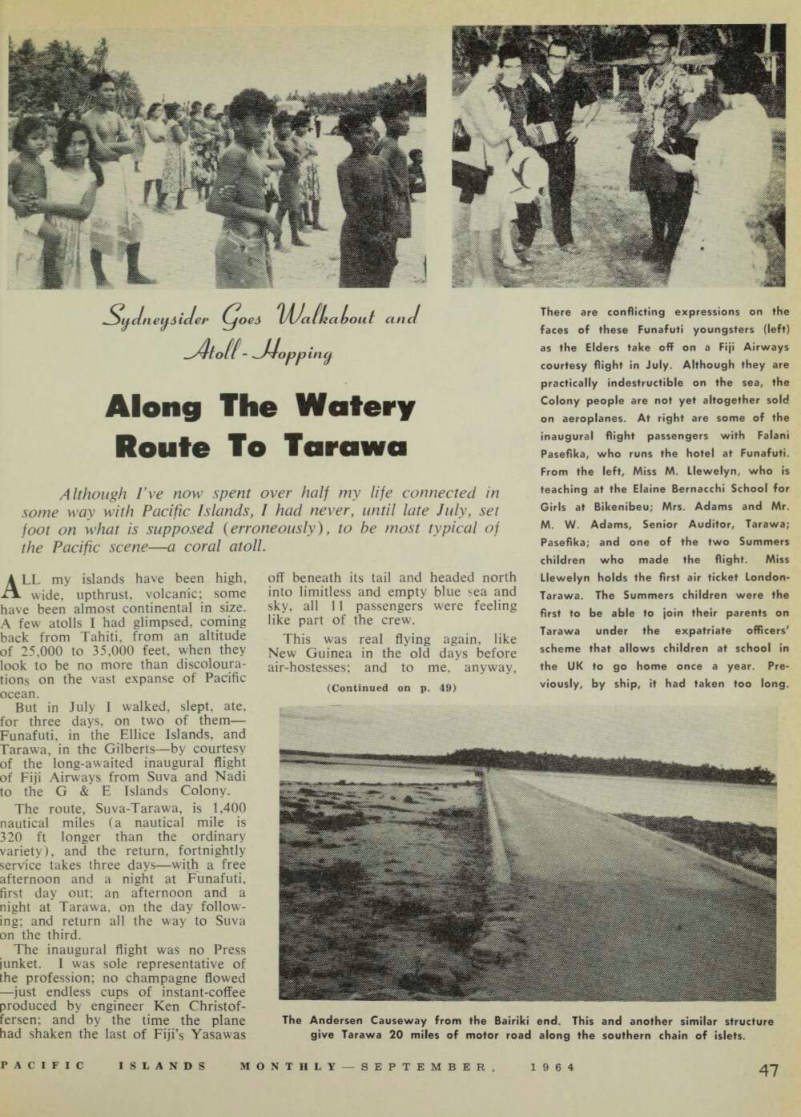
There are conflicting expressions on the faces of these Funafuti youngsters (left) as the Elders take off on a Fiji Airways courtesy flight in July. Although they are practically indestructible on the sea, the Colony people are not yet altogether sold on aeroplanes. At right are some of the inaugural flight passengers with Falani Pasefika, who runs the hotel at Funafuti.
From the left, Miss M. Llewelyn, who is teaching at the Elaine Bernacchi School for Girls at Bikenibeu; Mrs. Adams and Mr.
M. W. Adams, Senior Auditor, Tarawa; Pasefika; and one of the two Summers children who made the flight. Miss Llewelyn holds the first air ticket London- Tarawa. The Summers children were the first to be able to join their parents on Tarawa under the expatriate officers' scheme that allows children at school in the UK to go home once a year. Pre viously, by ship, it had taken too long.
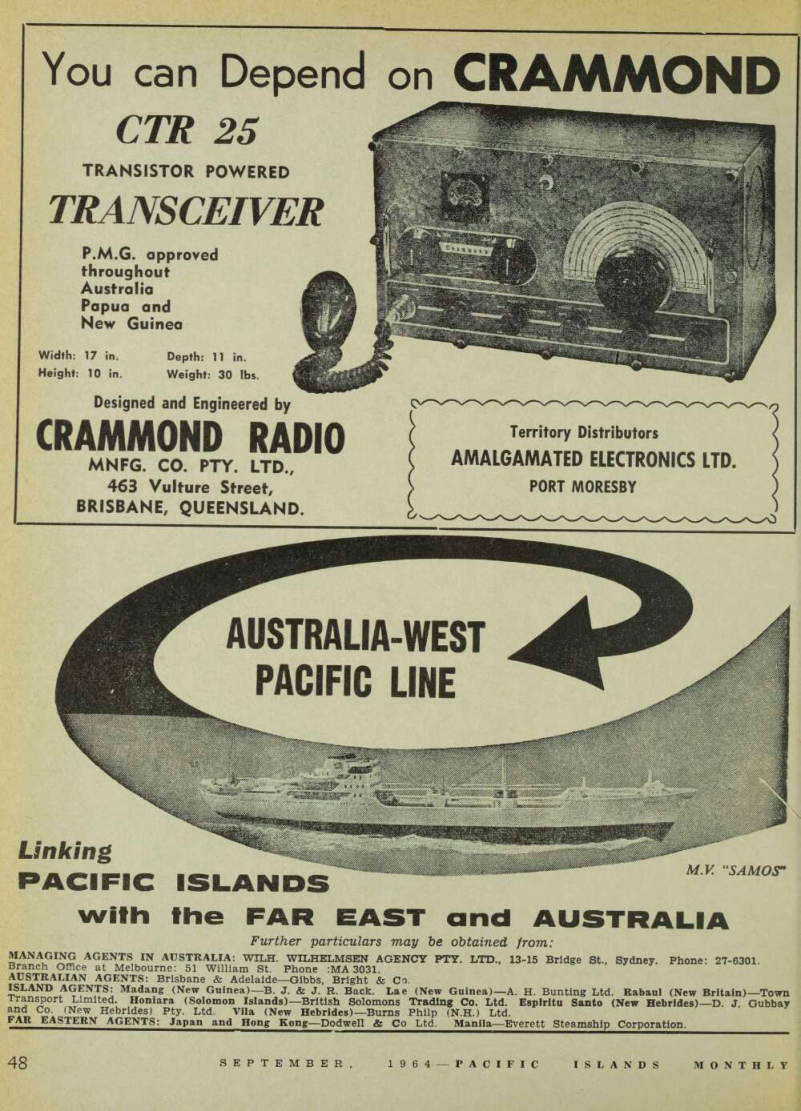
The Andersen Causeway from the Bairiki end. This and another similar structure give Tarawa 20 miles of motor road along the southern chain of islets.
nitely to be preferred to the moon isule, anonymity of a jam-packed Nothing much can happen in Heron aircraft the airline uses hout everyone being aware of it. fhe aerial sextant dangles from the f of the cabin and is in such istant use by Captain M. Morrissey I second pilot, Neil Ganley, you ;in to have a new appreciation the business of pin-pointing a few are miles of atoll in about 12 lion square miles of salt water, everyone waits for, and mentally :s off, the few radio directional cons on the way; the pilots do ir course-plotting and navigation the front seat of the plane and r one is allowed to go and look; I there is time and scope for a e between “flight deck” and senger compartment. About 45 mtes from Tarawa, the captain led the plane up in a gentle bump I yelled through the open cockpit »r: That was the equator.”
Was it, by God!” said one of the ing customers. “Next time go ler it.”
Mishap
)n the ground, pilots’ sleep and ; hours become a matter of public cern and so do the other incidents travel. When we broke an aerial ilator on our first take-off from awa on the return flight ( PIM, just, p, 6) and landed again with yards of aerial wire flailing all
over the place, everyone got out to inspect.
There was a perfectly good duplicate aerial on the other side of the fuselage, no doubt capable of homing us on all the beacons on the way back. It seemed to me that the quickest way out of the trouble was to cut off the broken wire and be on our merry way, and I said so.
Pilot Ganley, a very serious young man, looked horrified and said at once “That would immediately cut the chances by half!”
Still looking severe he took him self off to a small grass-hut they have beside the Bonriki strip and began to figure how many “hours” were left in himself and Capt.
Morrissey. If the aerial couldn’t lie fixed inside two hours (which, in the event, it was) they were going to ground themselves, and us, until the next day.
Somewhere, recently, I’ve read an article in an American magazine that said that New Zealanders, by tem perament, made the best commercial airline pilots. After travelling for three days with these two I’m inclined to believe it myself.
Atolls are unimpressive from the air, even from the 8,000 or 9,000 ft at which FA’s Herons normally cruise on this route. Although there are nine atolls in the Ellice Group (with a land area of only 11 square miles), and 16 in the Gilberts (land area 114 sq. miles), only a few of them are actually seen as more than
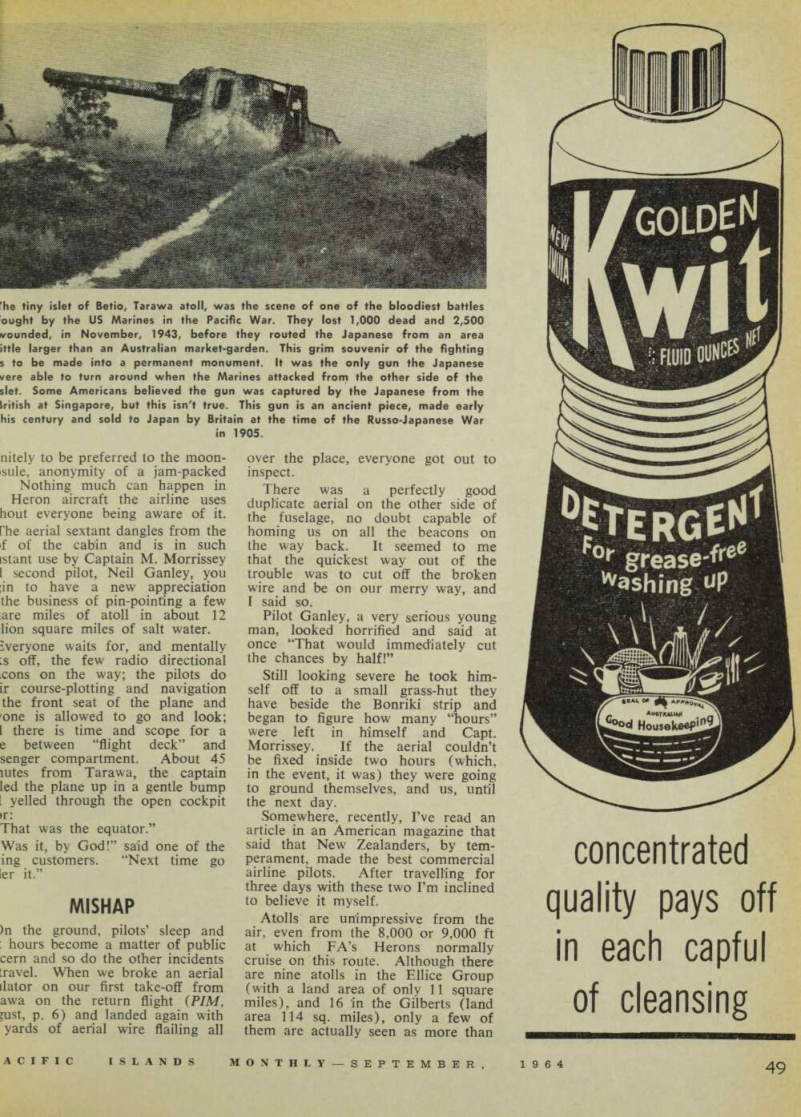
The tiny islet of Betio, Tarawa atoll, was the scene of one of the bloodiest battles [?]ought by the US Marines in the Pacific War. They lost 1,000 dead and 2,500 Wounded, in November, 1943, before they routed the Japanese from an area little larger than an Australian market-garden. This grim souvenir of the fighting [?]s to be made into a permanent monument. It was the only gun the Japanese were able to turn around when the Marines attacked from the other side of the slet. Some Americans believed the gun was captured by the Japanese from the British at Singapore, but this isn't true. This gun is an ancient piece, made early his century and sold to Japan by Britain at the time of the Russo-Japanese War in 1905.
smudges in the blue haze, off to starboard or to port.
From the time the last of Fiji’s Yasawas passes from view, until landfall is made on Funafuti four hours later, not so much as a speck of land is sighted. And for the first three hours out of Funafuti heading towards Tarawa on the following morning there is nothing but more sea and more sky until Tabiteuea, about mid-way along the Gilbertese chain, swims tentatively into view.
Those who imagine that this route will be a procession of picturesque green islands passing in procession will be disappointed and will get better value for money on the Rabaul (NG)-Honiara (BSIP) route which is one of the flight bonanzas of the world. But at the beginning of their air age these atolls of the GEIC have a naturalness that most of the other Pacific Islands have long since lost.
However, neither the main islets of Funafuti or Tarawa can probably be called typical, Funafuti not yet having outlived its American period; and Tarawa being the centre of administration for the whole GEIC.
Healthy People
Six hundred people live on Funafuti, all except about 10 on the main islet which also accommodates the airstrip, hospital, hotel, Ellice Islands administrative headquarters and a branch of the main trading organisation, the Wholesale Society.
Copra, the only commercial enter prise, is cut from the other 29 islets that make up the atoll, but the 5,200 ft airstrip robs the main islet of a big chunk of its growing land.
None of the atolls in the Gilberts or Ellice has anything approaching arable land. All are composed of
dead coral, elevated a few feet above sea level, each with a thin sprinkling of decayed vegetable matter in which little but coconuts and pandanus have much chance of survival.
On atolls with good rainfall, taro, breadfruit and bananas are sometimes precariously grown in compost pits but generally the native diet is fish and coconuts. The people, however, look fit and healthy and, according to the AMP in charge of the Funafuti hospital, food deficiency diseases are rare to the point of non-existence.
The airstrip runs almost the whole length of the main islet and looks like an old road, or the bottom of
a creek bed from above and doesn’t improve very much on closer acquaintance.
The Americans occupied Funafuti during the war and build the first airstrip on the same site. After the war and resumption of normal isolation, the local people replanted it with coconuts and now have cut them down for the second time.
Most of the reconstruction work on the strip has been done by hand, men, women and children pitching in to dig out the coconut roots and fill in the hollows left behind.
During the festivities that marked the arrival of the first scheduled
ght one of the Elders, explaining is and the delays that had held up impletion of the strip and the hotel, it the blame on the Government Tarawa.
“They” had sent only a “female >zer” (which we gathered was a rail instrument with a blade only few feet wide), to help on the ■ip; and two hammers and a saw build the hotel. If this was the se, the islanders indeed performed iracles.
The village houses are built almost rtirely of old timber and iron Ft over from the American occupa m that ended nearly 20 years ago id for this reason Funafuti has a ffish and poverty-stricken air that probably doesn’t entirely merit.
The feast that was prepared for e three crew members and 11 issengers that night was extensive lough to have occupied the entire ark force for a week and sufficient feed the hundred or so people who ere in the meeting-house with us id the several hundred more who t outside peering in.
Great palm-platters of native od, flanked by two drinking nuts >iece were placed before us, by a oup of girls in stiff palm-rib skirts at struck out like millet-brooms rtx cotton dresses.
The guests, confronted by such a ass of food, merely nibbled round e edges and pushed things about, pparently no more was expected ;cause as soon as we began to flag this task the platters were hisked speedily away and re stributed amongst our hosts.
Chorus Line
At 8.30 the chorus line formed, e girls and youths in two straight les one behind the other, and the mcing began. Funafuti girls are lort and plump and their bristling do nothing for the [houette.
They wear crowns of flowers, a Tahitienne, but their dances consist r a little foot shuffling and a great ;al of hand movement, like the unoan siva and not like the erotic ahiti tamure.
The dances, and the chants that ) with them, tell stories of voyages id historical events rooted so far ick in the mythical past as to be ; incomprehensible to the per irmers as to us.
The rhythm is supplied by a solid luad of non-dancers who sit around i upturned box with a mat on top; n this they beat out the time, icouraged by a cheer-leader who hips them into a crescending frenzy F pounding to round off each item.
Seemingly at random but no doubt
in traditional pattern, Elders bobbed up in the intervals between dances and addressed us at length, bringing nearer the moment that Captain Morrissey has been dreading all day —his speech in thanks for the lavish hospitality. He doesn’t mind flying planes, to almost non-existent spots of land, over miles of open ocean, but public speaking is another matter.
Only towards the end of the enter tainment was there any indication that a night out in Funafuti can consist of more than a whole lot of box thumping, oratory and graceful hand movements.
One middle-aged man and three middle-aged women suddenly took the floor and with some tantalising body work and some cunning foot movements went some way towards proving what the anthropologists have always told us—that the Ellice Islanders are Polynesians after all.
All visitors were then invited to take the mat floor with local partners in the Funafuti version of the Twist.
This diversion not only took the captain’s mind off his speech for a moment but clearly was the item that the outside audience had been waiting for. If our antics and
gyrations didn’t exactly lay the polite adults in the aisles, it at least set the kids rolling on the coral road in gales of daughter. * * * Tarawa has all the charm that Funafuti lacks; an air of prosperity; a small but friendly European com munity (the only Europeans on Funafuti at the moment are a few missionaries); and a slight metro politan air that comes from being the administrative centre for the whole of the GEIC.
There are nine large and half a dozen small islets on the triangular atoll but the islets most in use, and the only ones the short term visitor is likely to see, are strung from west to east, along the base of the triangle.
The commercial and administrative
life of Tarawa goes on on these islets—from Bonriki in the east to Betio in the west, and the fact that half a dozen islands are involved makes both commerce and admini stration so much more involved.
The Causeways
In 1963, however, two causeways were completed that now make it possible to drive about 20 miles from the airstrip at Bonriki all the way to the tip of Bairiki, where the central administration has its HQ.
Previously, communication be tween the islets was by water or only at low tide when it was possible to walk, ride a bike or wade. Tarawa residents, pre-1963, lived like mariners with tide tables handy, so that they might know when they
could visit the next islet. Now som of them have bought cars to replac the once universal bicycle.
But no causeway will ever lin Bairiki and Betio, the most wester! islet where the port installations, th Wholesale Society, the club, th district headquarters of the Gilber (as opposed to the central goven ment of the whole Colony), an police headquarters are located.
Betio is three miles away aero; the lagoon and communication is b launch which runs on a fixed tim< table.
Transport Problems
A cocktail party held at the hot( at Bikenibeu, which is three mile from the airport at Bonriki, is sti something of a transport problem fo folks from Betio; and it’s still quit an effort for people from, say, th education establishments at Bikenibe to make use of the club, which i on Betio.
The land area, Betio to Bonriki is only a few square miles, ye longitudinally the various establish ments have strung themselves ou over a city-sized 20.
In contrast to the second-han< timber of Funafuti housing, Tarawi has evolved a cement-block, thatched roof house for its civil servants tha is practical, cool and pleasant Electricity, refrigeration, freeze] goods have removed most of the physical disadvantages that caused
• R. W. Robson, who visited the oup just before the Pacific War, call them the “Lousy Islands”.
Jfe is still not the lush tropical adise of the romanticists but in world of shrinking administrative lortunities it has many compensa ns. Now, only the fundamental, k-bottom problems remain. fhe new fortnightly air service has ttered the Colony’s isolation, but iing a booming tourist industry for ich the atolls are not particularly ted, it can do nothing of itself solve the poverty of natural re irces. \dd to this a rapidly expanding mlation, lack of political ambition the part of the Gilbertese and jctance to assume leadership and i get some idea of the unique ninistrative problem the GEIC sents in the 1960’s era of Instant tionhood. f some genius could devise a ans of sawing these poor atolls from their reefs and floating them >OO miles nearer the Solomons, h which they are partners in the stern Pacific High Commission, it ?ht solve the riddle of the future.
Mready the authorities are doing next best thing—planned migra i to the relatively underpopulated IP. This may, of course, be y a short-term measure—depend on just how long the Melanesians the Solomons are willing to hold m the door to the Polynesians i Micronesians of the Ellice and bert Groups. one in the Colony professes know any ready-made panacea GEIC problems. They’re playing by ear—and the new air service in well as an accompaniment.
[?]E HOUSING SCENE: Although it is built [?]h the prevailing war-time timber and [?]rugated iron, the house in the top [?]ture, in the main village on Funafuti, quite a neat piece of work; most of others look as though they have been [?]mped there by a hurricane. Centre: [?] LMS Church on Funafuti is a huge [?]cture, mostly of timber, but like the t of the village it's seen better days. [?]re is a plan afoot to build a new one. tom: A typical Government house at [?]awa where modern cement blocks have [?]en combined with traditional thatch to [?]duce something very suitable for the [?]rironment. Inside they are spacious, [?]l and attractive. This one belongs to G. Pitkeathly, Chief Education Officer, [?] sits practically on the beach on the side of Bikenibeu. One can think of [?]rse fates than having to live and work here.