A Packet Of Cigarettes A Year
pp. 25-29 · Read in the full issue
The P-Ng Education Report
A Packet Of Cigarettes A Year Versus A New Guinea Congo!
Reviewed by a Special Correspondent The report of the Commission on Higher Education jn Papua and New Guinea has at last been published by the De partment of Territories, in a handsome offset quarto. It is a most comprehensive document of 335 pages, which discusses everything from the age of entry into primary school, through the use and abuse of Pidgin and Shakespeare's English and the place of religion, to the possibility of raiding UNESCO for funds. The main points were published in PIM, August (p. ID
)F the nine chapters, two are de voted to the general and the ducational backgrounds, one to “A 'review of Proposals”, and one to h e 172 recommendations. Two hapters deal with technical and pro essional education and three with the reposed university.
The main proposal on the technical ide is for the establishment of an nstitute of Higher Technical Education, initially with an emphasis n general civil engineering to diploma ivel.
Other types of higher vocational raining—administrative, agricultural, jgal, medical—are dealt with in de ul.
No standard pattern is advocated for them: the present Administrative College should in time become an in stitute of the university, which should also take over the existing Papua Medical College; there should be a Law School; the Agricultural College at Vudal (and any future such colleges) should be affiliated with the university rather than inside it. ™ . The Government has given its bless /Ti^ e J. nstlt ute of Higher Tech nic.al Education but not as yet to the university, despite a statement by the former Minister for Territories, Mr.
Hasluck, so long ago as 1962, that an institution of university type would be started in the Territory by 1966. (Over)
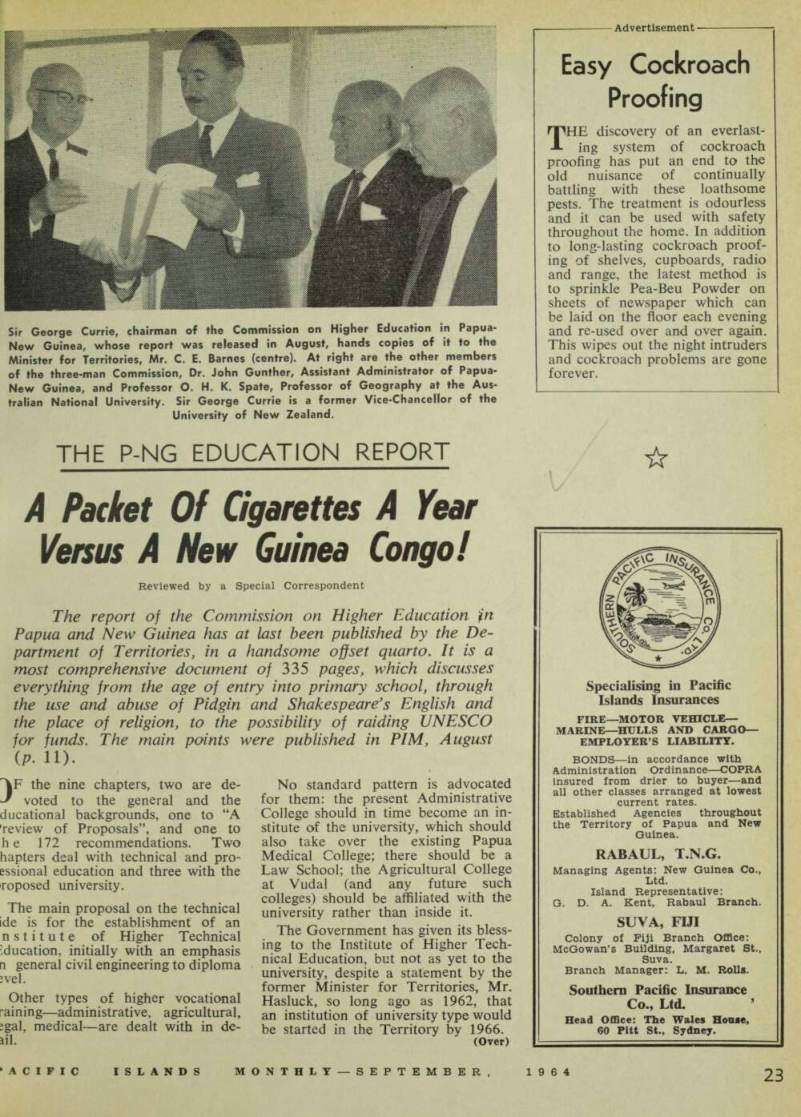
Sir George Currie, chairman of the Commission on Higher Education in Papua- New Guinea, whose report was released in August, hands copies of it to the Minister for Territories, Mr. C. E. Barnes (centre). At right are the other members of the three-man Commission, Dr. John Gunther, Assistant Administrator of Papua- New Guinea, and Professor O. H. K. Spate, Professor of Geography at the Aus tralian National University, Sir George Currie is a former Vice-Chancellor of the University of New Zealand.
‘he Commission discusses the pos lity of giving New Guineans their iary education in Australia, but a variety of reasons holds that should in general be done in the ritory itself. strongly favours an autonomous 'ersity rather than a college at icd to one or more Australian 'ersities, mong its reasons are the need for integrated educational system ed to New Guinea conditions er than to methods and syllabuses sed to suit Australian students.
Commission also believes that, igh staff recruitment will not in case be easy, the brighter and e adventurous pioneering types are needed will not be attracted hey are to work to rules and lods devised in some superior in tion thousands of miles away and , totally different social environ t. t the same time, the Commission 5 pains to emphasise its recognition a laudable desire to maintain dards led some witnesses to favour ollege subordinate to an Aus an university, and it proposes to t this genuine need by associating ralian academics with the govern and examining bodies of the New lea university.
The Site n the politically vexed question he site, the Commission—after thy discussion—opts for Port esby as against Goroka, the other )r contender. Vulcanology, if ing else, rules out Rabaul, and is a dark horse. oroka would obviously be a most ictive setting for a university, but things considered—and not only extra cost of installing and run a big complex at Goroka—it is that in the Commission’s view advantages of Port Moresby, not as the seat of government, but a sense the most “cosmopolitan” re of affairs, the window on the ide world, outweighed the argu ts for Goroka. To be effective, University should be in the ket place, not in an ivory tower i Shangri-La. le Commission suggests that in, 20 years from now there will a real need for a second uni ty, and by that time Goroka Id most likely be the logical site it. oblems of organisation and ice of a necessarily residential uni ity are dealt with in consider detail. In view of the urgent ssity for greatly strengthening
secondary education, and hence teacher training, the Commission re commends that the first degree granted by the university should be the Bachelor of Education.
Initial teaching faculties of Educa tion and of Arts are proposed, with Science following as soon as may be.
At an early stage, Deans should be appointed to plan future faculties of Agriculture, Law, and Medicine.
In the Commission’s view—and it
took a good deal of evidence from African experts—there is no time for delay in establishing the university; or rather there are very serious risks in delay.
Numbers would be small to begin with, but this would be an advantage in the initial “running-in”, and it is important to be ready for the really substantial numbers of secondary school leavers to be expected by the early 1970’5. (Over)
fhere is also a very strong political ument for an early start, t can hardly be denied that a use of Assembly with an elected igenous majority is a political de apment which outstrips economic I educational advance. It is there e vital to train New Guineans for complex tasks of running the mtry.
Moreover, should there be much ay, sectional interests —New inea versus Papua, Highlands sus the coast, Chimbu versus Tolai, h versus town, tribe versus tribe night v/ell find political expression >ng enough to make the university >olitical football. )n the other hand, if a university -e started in time to develop its n solidarity and its own tradition, could itself become an invaluable fying and stabilising factor.
Outside Aid fhe cost? It will run into millions, course, and —although the Com >sion recommends seeking outside , and makes some specific pro ;als in this matter—most of it will ne from the Australian taxpayer.
But the Commission estimates that capital costs of installing the In ute of Higher Technical Educa i and the university, spread over years, would amount to half a :ket of cigarettes per Australian ■ year. This was before Mr. Holt’s 3get, so knock off half a cigarette ■ person per annum.
But there are, of course, many icr demands on the cigarette packet.
I the same, the Commission riously believes it would be cheaper in risking a Congo.