New Constitution
p. 22 · Read in the full issue
For Cook Islands
Before Paruament
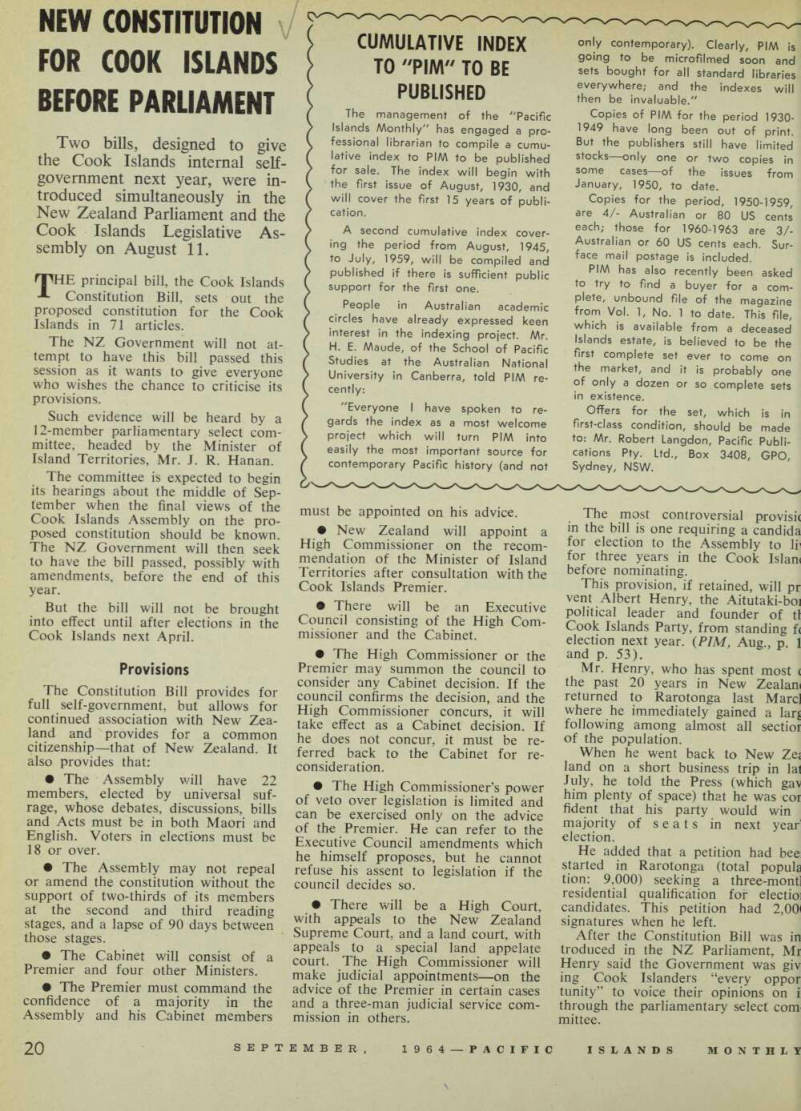
Two bills, designed to give
the Cook Islands internal self government next year, were in troduced simultaneously in the New Zealand Parliament and the Cook Islands Legislative As
sembly on August 11.
THE principal bill, the Cook Islands Constitution Bill, sets out the proposed constitution for the Cook Islands in 71 articles.
The NZ Government will not at tempt to have this bill passed this session as it wants to give everyone who wishes the chance to criticise its provisions.
Such evidence will be heard by a 12-member parliamentary select com mittee, headed by the Minister of Island Territories, Mr. J. R. Hanan.
The committee is expected to begin its hearings about the middle of Sep tember when the final views of the Cook Islands Assembly on the pro posed constitution should be known.
The NZ Government will then seek to have the bill passed, possibly with amendments, before the end of this year.
But the bill will not be brought into effect until after elections in the Cook Islands next April.
Provisions The Constitution Bill provides for full self-government, but allows for continued association with New Zea land and provides for a common citizenship—that of New Zealand. It also provides that: • The Assembly v/ill have 22 members, elected by universal suf rage, whose debates, discussions, bills and Acts must be in both Maori and English. Voters in elections must be 18 or over. • The Assembly may not repeal or amend the constitution without the support of two-thirds of its members at the second and third reading stages, and a lapse of 90 days between those stages. • The Cabinet will consist of a Premier and four other Ministers. • The Premier must command the confidence of a majority in the Assembly and his Cabinet members
must be appointed on his advice. • New Zealand will appoint a High Commissioner on the recom mendation of the Minister of Island Territories after consultation with the Cook Islands Premier. • There will be an Executive Council consisting of the High Com missioner and the Cabinet. • The High Commissioner or the Premier may summon the council to consider any Cabinet decision. If the council confirms the decision, and the High Commissioner concurs, it will take effect as a Cabinet decision. If he does not concur, it must be re ferred back to the Cabinet for re consideration. • The High Commissioner’s power of veto over legislation is limited and can be exercised only on the advice of the Premier. He can refer to the Executive Council amendments which he himself proposes, but he cannot refuse his assent to legislation if the council decides so. • There will be a High Court, with appeals to the New Zealand Supreme Court, and a land court, with appeals to a special land appelate court. The High Commissioner will make judicial appointments—on the advice of the Premier in certain cases and a three-man judicial service com mission in others.
The most controversial provisic in the bill is one requiring a Candida for election to the Assembly to lr for three years in the Cook Islam before nominating.
This provision, if retained, will pr vent Albert Henry, the Aitutaki-boi political leader and founder of tl Cook Islands Party, from standing f( election next year. {PIM, Aug., p, 1 and p. 53).
Mr. Henry, who has spent most c the past 20 years in New Zealam returned to Rarotonga last Marcl where he immediately gained a larg following among almost all sectior of the population.
When he went back to New Ze£ land on a short business trip in lat July, he told the Press (which gav him plenty of space) that he was cor fident that his party would win majority of seats in next year’ election.
He added that a petition had be© started in Rarotonga (total popula tion: 9,000) seeking a three-mont] residential qualification for electio] candidates. This petition had 2,001 signatures when he left.
After the Constitution Bill was in troduced in the NZ Parliament, Mr Henry said the Government was giv ing Cook Islanders “every oppor tunity” to voice their opinions on i through the parliamentary select com mittee.