Tropicalities
pp. 19-21 · Read in the full issue
Tahiti, which until a few years o had no newspapers, now >ks to be going to break some rt of record in the other direc u. It has almost as many irnals as there are shades of
litical opinion.
ES NOUVELLES, which is the oldest daily, was joined about months ago in the daily field by Journal de Tahiti which is owned Bambridge interests and reflects nbridge politics which, for Tahiti, pretty progressive. soon, however, there will be a new skly in which Mr. Alfred T. Poroi, der of a rival political party, has lominant interest. This weekly. La peche, will, we understand, have a tion in English to cater for
glish-speaking tourists.
Mso in the present weekly field are Tahiti, from the same stable as Journal; Echo de Polynesie; La •sse; and Le Canard Tahitienne. addition there is a glossy quarterly led Tahiti Magazine published by owners of Les Nouvelles. rhe only political party without a uthpiece seems to be the RDPT— ;, then, the RDPT doesn’t exist ier any more although the mem s in the Territorial Assembly who re elected under its banner in the t elections, in 1962, still number to the UT’s eight (UT being the mbridge party); and the UTD’s ; (UTD is led by Alfred T. Poroi
who is Senator for French Polynesia in Paris).
The RDPT, which was nationalistic and at the height of its power during the time of the now-exiled Pouvanaa a Oopa, was dissolved towards the end of 1963 under some old French law which provides for this if it is considered that a party’s continued existence isn’t in the best public interest.
The 14 members in the Assembly are now reported to be looking for a new name for themselves.
Baptism For A
Marine Creature
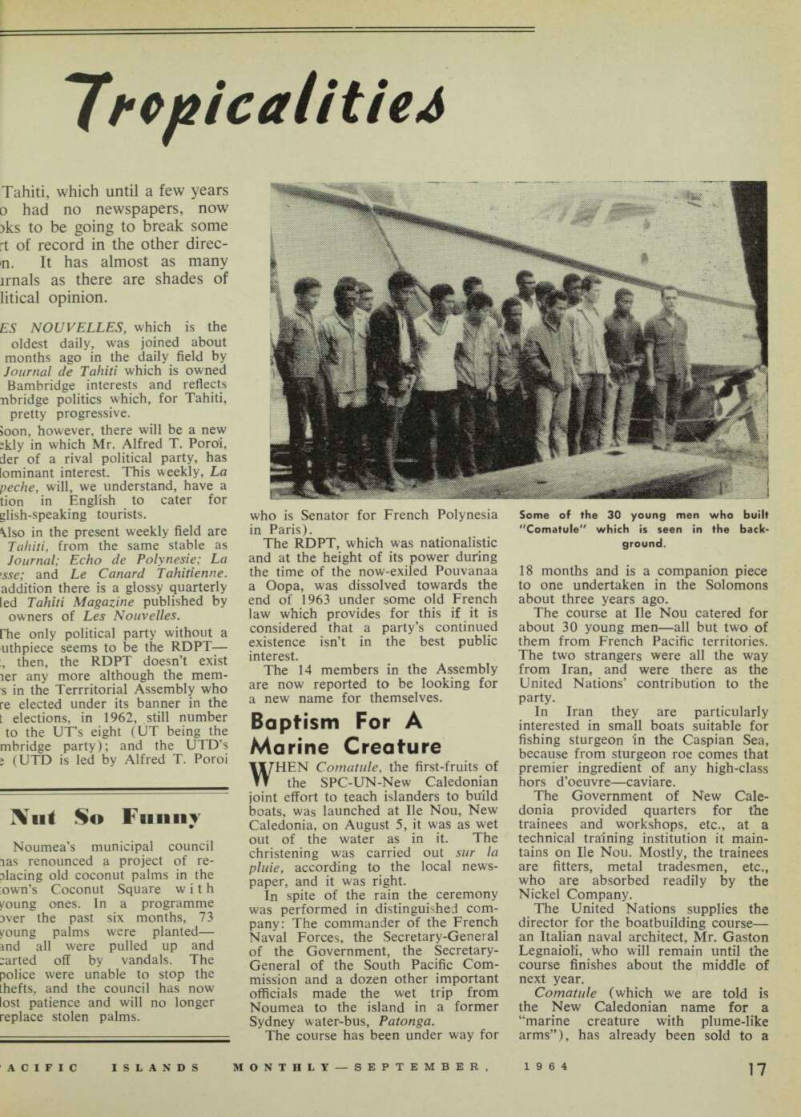
WHEN Comatule, the first-fruits of the SPC-UN-New Caledonian joint effort to teach islanders to build boats, was launched at He Nou, New Caledonia, on August 5, it was as wet out of the water as in it. The christening was carried out sur la pluie, according to the local news paper, and it was right.
In spite of the rain the ceremony was performed in distinguished com pany: The commander of the French Naval Forces, the Secretary-General of the Government, the Secretary- General of the South Pacific Com mission and a dozen other important officials made the wet trip from Noumea to the island in a former Sydney water-bus, Patonga.
The course has been under way for
18 months and is a companion piece to one undertaken in the Solomons about three years ago.
The course at He Nou catered for about 30 young men—all but two of them from French Pacific territories.
The two strangers were all the way from Iran, and were there as the United Nations’ contribution to the party.
In Iran they are particularly interested in small boats suitable for fishing sturgeon in the Caspian Sea, because from sturgeon roe comes that premier ingredient of any high-class hors d’oeuvre—caviare.
The Government of New Cale donia provided quarters for the trainees and workshops, etc., at a technical training institution it main tains on He Nou. Mostly, the trainees are fitters, metal tradesmen, etc., who are absorbed readily by the Nickel Company, The United Nations supplies the director for the boatbuilding course— an Italian naval architect, Mr. Gaston Legnaioli, who will remain until the course finishes about the middle of next year.
Comatule (which we are told is the New Caledonian name for a “marine creature with plume-like arms”), has already been sold to a
Some of the 30 young men who built "Comatule" which is seen in the back ground.
local underwater exploring club.
Two other boats are on the stocks —one is for Wallis Island and the other is a harbour runabout for Noumea.
Samoan Cattlemen
Make An Impact
rpHE recently formed but active -*■ Western Samoan Cattlemen’s Association has hit on a novel way of raising breeding standards among the livestock of members.
They have been given, cheaply, some pure-bred Hereford bulls by
Western Samoa Trust Estates Corporation and are running a regu lar monthly raffle for one of these breeding bulls. They sell 200 tickets at 5/- each.
If the bull is won by someone other than a cattleman, the associa tion buys it back for £3O to raffle again.
In this way the association is rais ing funds; and members are given a chance of getting a first class bull for only 5/-.
The winner of the first raffle was Te’o Peneia, of Ale'ipata, a Samoan cattleman who also farms cocoa, bananas, taro, coconuts and pigs;
operates two stores and a bus; a: is on the board of the associatic A major driving force behind t association has been University California graduate, Frank Moors, Department of Agriculture livesto officer.
He recently promoted, with oth cattlemen and departmental officia a successful field day for cattlemi at Avele Agricultural College.
He is now working on plans f a s .^ ow an d rodeo next ye which, with growing department! public and cattlemen’s suppoi promises to be a popular additic to the calendar of annual entertai ments in Western Samoa.
Is Mr. Ansett
Looking This Way?
T HE success of Fiji Airways in pr. viding, with their Nadi-Vil Honiara service, a handy exit froi Melanesia for travellers who hitherl had to use either the Australia-Ne Guinea or Vila-Noumea service appears to have attracted some notio The service, with Heron aircraf was at first fortnightly, and is no’ twice weekly, leaving Honiara f c Fiji on Wednesdays and Saturdays.
But it is still difficult to get a se£ —the accommodation being almo; filled with public service personne presumably because the service is sut sidised by the British Government concerned.
A persistent rumour in Honiara although it is without official backin —is that the tireless, questing eye o Australia’s airways chief, Mr, Re Ansett, has been studying the situa tion here.
It is said that Mr. Ansett envisage
a Brisbane-Honiara-Lae-Philippines
Far East service, and that he may usi in this some of his present aircraf which may be displaced from Aus tralian services by new purchases.
Honiara’s airport appears capabh of enlargement to take bigger aircraf than those now used.
It could be that Mr. Ansett also i; interested in the tourist potential o] the Solomon Islands. Guadalcanal like New Guinea, definitely has £ tourist potential—limited in the pasl by lack of transport and of first-class hotels.
These things, of course, can be remedied. Mr. Dalrymple-Hay is re ported to have plans for the early addition of a block of modern bed rooms to his big, rambling Mendana Hotel, which lies attractively under the casuarina trees alongside the Point Cruz waters.
he Big Push In
outh Seas Curios
HTCAIRN Island is a mere dot in the Pacific with less than 100 idents, most of whom, as we all ow, are descendants of the Bounty itineers.
Their economy is based mainly on : sale of souvenirs to passengers ships which heave to off the island - a few hours.
Naturally there is no fortune in s sort of trade, but what it has :ted the islanders has helped them live a fairly comfortable existence, d it is vital that the trade be kept if the Pitcairn islanders are to ve a future on their island.
The population of the island has ;n declining slowly, and fewer ps have been calling at the island.
So in an effort to boost their ?nomy the South Pacific Com ssion has published for the South cific Office, Suva (which keeps an ; on both Pitcairn and Tongan airs) 50,000 leaflets which jstrate Pitcairn souvenirs The Pitcairn Islanders will receive ,000 of the leaflets, which they 11 distribute to ships when they go t in the long boats to sell their uvenirs.
Their hope is that the leaflets will go overseas and that through them they will build up a mail-order busi ness.
The remaining 25,000 will go to Mr. Reid Cowell, of the South Pacific Office, for distribution, also in the hope that the mail-order business will
be built up. The leaflets say: "We shall be pleased to fill any orders and to answer inquiries.
“We shall send your souvenirs through the post carefully packed, and stamped of course with Pitcairn’s own stamps which, themselves, are highly prized by collectors through out the world.”
And there are guarantees of promptly attending to orders, quality, and money back if the buyer is not satisfied.
Some of the items available are Bible cases, Panama hats (as “light as a feather”), barrows specially manufactured to counter the island’s rough terrain, walking sticks made from the wood of a coconut tree, models of flying fish which are often seen off the island’s rocky coast, beautifully carved vases and birds, and plates and vases from the ripe shell of the coconut.
Meanwhile the South Pacific Com mission’s Sydney office in late August was putting the finishing touches to a 96 page booklet illustrating the handicrafts available for sale through out all territories of the South Pacific, and aimed at building up business in South Seas artifacts generally. Many of the illustrations are in colour, and details of prices and availability are given.
This booklet is the sequel to the 12-month survey by Mr. Angus Mcßean, SPC Social Development Assistant, now school-teaching in the New Hebrides. It will be one of the most valuable, and certainly the most interesting, of all the SPC re ports. Some copies will be available for sale, but most will be distributed to likely buying agencies.
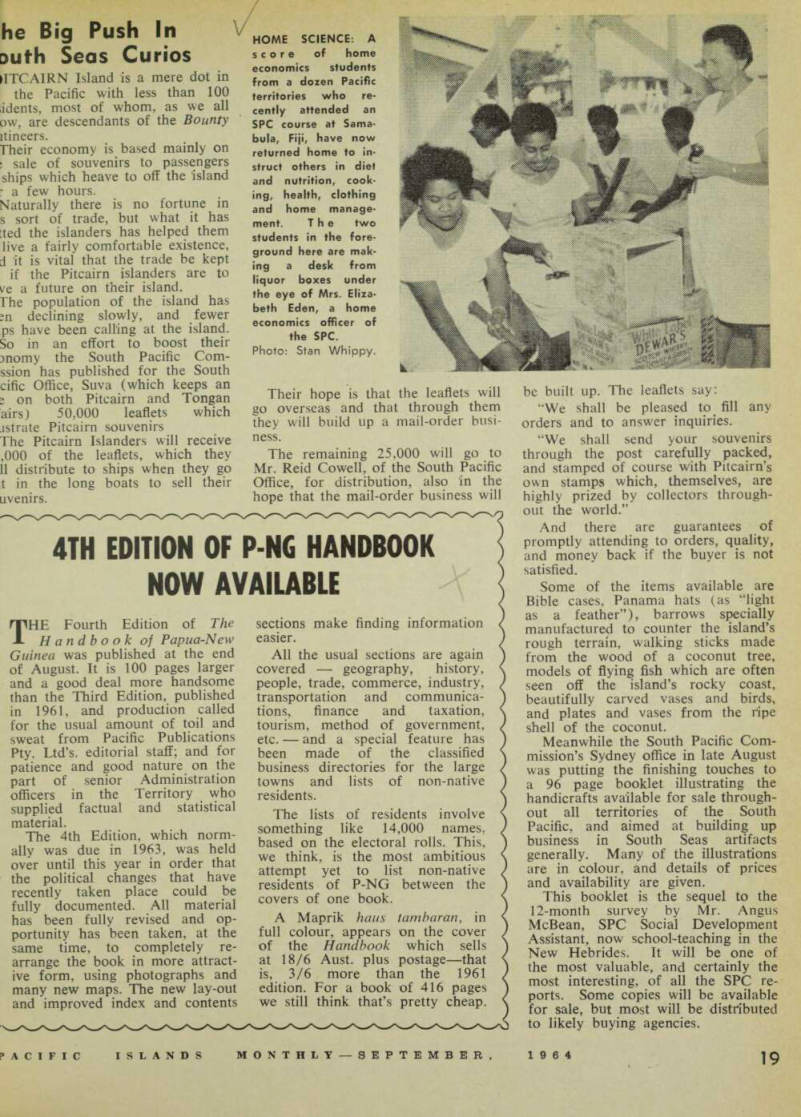
Home Science: A
score of home economics students from a dozen Pacific territories who re cently attended an SPC course at Sama bula, Fiji, have now returned home to in struct others in diet and nutrition, cook ing, health, clothing and home manage ment. The two students in the fore ground here are mak ing a desk from liquor boxes under the eye of Mrs. Eliza beth Eden, a home economics officer of the SPC.
Photo: Stan Whippy.