Fiji's Fast-Growing Airline
pp. 15-16 · Read in the full issue
Has Equipment Troubles
With its new service to Tarawa, GEIC, established since late July, Fiji Airways now not only cut back and forth across the International Date Line but fly across the equator into the Northern Hemisphere.
THE new service, added to existing inter-territory services (Fiji- Tonga, Fiji-Western Samoa, Fiji- Honiara, BSIP, via Vila and Santo, New Hebrides), plus the increasing frequency of domestic Fiji services, gives FA some claim to being the fastest growing airline in the Southern Hemisphere.
The trouble is that its equipment doesn’t always keep pace with the increasing number of tasks it is called on to perform, and this is felt acutely at present, at the height of Fiji’s winter tourist season and with another international air operator— Air-India—coming in to Nadi.
FA has made the British Heron the work-horse of its fleet and now operates five of them. These are insufficient to cope with potential, particularly when it is frequently necessary to send two Herons, work ing in tandem, to cope with inter national travellers between Nausori (Suva) and Nadi.
Several new Herons are on order and should be in service within a few months. In the meantime, the search for a suitable replacement aircraft for the Heron—already going on for some years—has been stepped up.
The Heron is a four-engined
plane with a passenger capacity, on inter-territory flights, of about 11 passengers.
Probably what is needed is some thing with a passenger capacity half as large again; but to get the correct aircraft, with the same safety factor as the Heron, capable of putting down on some of the “bush” strips the airline is forced to use, is a complicated problem in airline logistics. There are few commercial aircraft available with all the required characteristics.
Nauru Next On a jet-age basis the Heron is slow; it is also unpressurised and fairly cramped for passengers. But whether it is really less comfortable to travel in than with 110 other people, crammed into the economy class section of a big jet, is debat able.
The airline is 13 years old this September. It was formed in 1951 by the late Harold Catty as a private company; its first plane was a twin engined de Havilland Rapide and its first route Lautoka-Nadi-Nausori, the fare for which was then £4 from Lautoka and £3/12/6 from Nadi.
All of its overseas routes were acquired after Qantas bought the air
line in 1958. Qantas shares owner ship with BOAC and New Zealand’s TEAL on behalf of their respective governments.
One reason why FA’s fleet seems to lag behind the number of potential paying customers is no doubt this divided ownership. It’s hard to force a unanimous decision from three bosses, especially when they are as far apart as Sydney, Auckland and London; and when the people who have to make the decisions have never been wait-listed for Tonga, or had to book three months in advance for Honiara.
Air traffic always tends to in crease; already it looks as though a fortnightly service will soon be in adequate for Tarawa. This will be specially so if the airline takes the next logical step and extends 400 miles from Tarawa to Nauru.
This is being seriously discussed and when it happens, FA will then take four days over this service instead of the present three, the extra day being spent in the return flight, Tarawa-Nauru-Tarawa.
Nauru already has a serviceable airstrip that is used only about once every four years when a UN visiting mission is flown in, or when there is a ministerial visit. There is no plan to bring the other phosphate island.
Ocean, into the service as Ocean has no airstrip and it would be difficult to build one.
When Nauru is brought into the orbit, 11 seats on a Heron, once every two weeks, are going to be completely inadequate for the num ber of people who will wish to use the service.
Local Boom Local air transport in Fiji is in for a boom, too. The new strip on Ovalau should be in use by October.
This is situated on the south-west point of the island and will service Levuka which is now the centre for a new fishing industry.
A Drover or a Piper Caribbean will be used on this strip initially and the strip will later be improved and included in a schedule to Taveuni and Vanua Leyu. Ihe Ovalau strip is only 15 minutes fly ing-time from Nausori.
The Government also plans new strips for Kadavu, the big island 50 miles south of Suva; and at Lakeba and Vanuabalavu, in Lau.
On Viti Levu, the private strip at Korolevu, used now by the Piper Caribbean under charter, is being improved. This strip was extensively damaged in the big floods of last March and while renovation work is in progress it is being enlarged so that it will take a Drover. The aim is to introduce scheduled services that
will cover Nadi-Korolevu-Suva- Ovalau. The present charter service is a convenience, but it can be expensive.
When the late Harold Gatty started his air service on September 1, 1951, there were a lot of prejudiced Kai Vitis who could see no sense in paying £3/12/6 to fly from Nausori to Nadi, in an hour, when they could have their back bones fractured and their teeth rattled out in seven hours on the abominable coastal road to the same destination.
Since then Fiji has become air minded. Like most other respected local institutions, Fiji Airways comes in for its share of criticism. But whatever the airline’s few minor sins of omission and commission, its pioneering aviation efforts have turned the Colony into what the romantic travel writers have always insisted Fiji is—the Hub of the South Pacific.
Tongan Nurses
Graduate
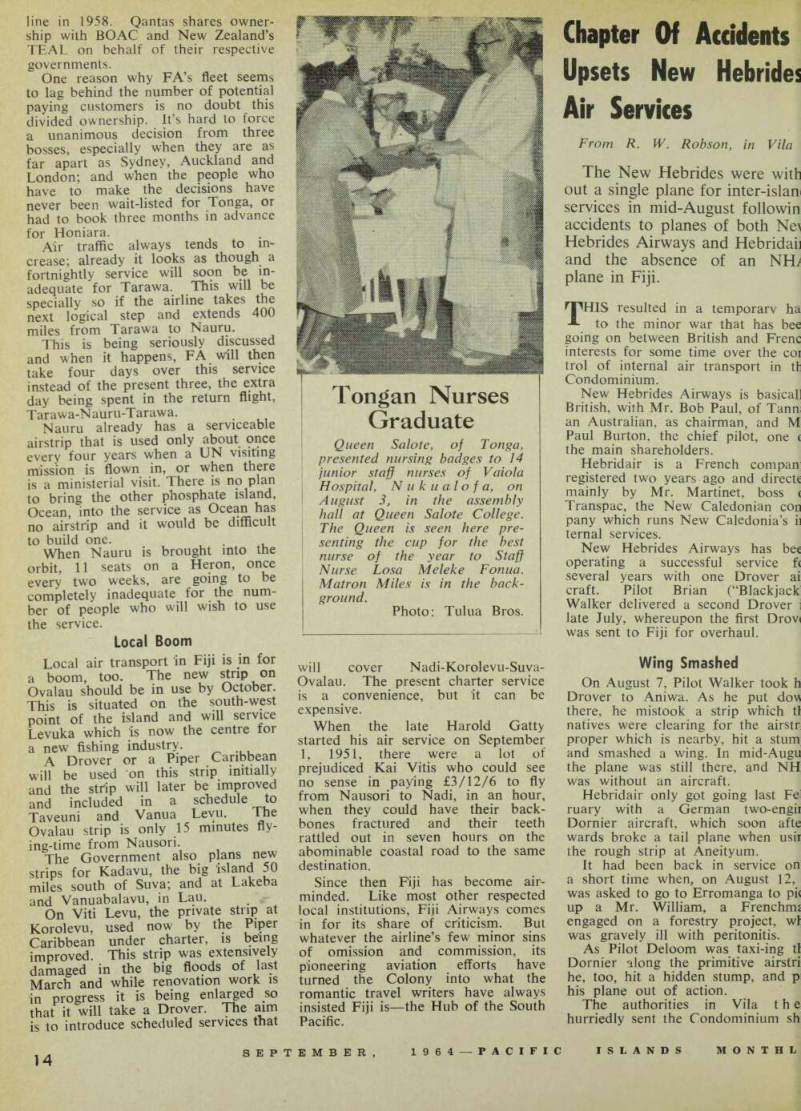
Queen Salote, of Tonga, presented nursing badges to 14 junior staff nurses of Vaiola Hospital, Nukualofa, on August 3, in the assembly hall at Queen Salote College.
The Queen is seen here pre senting the cup for the best nurse of the year to Staff Nurse Losa Meleke Fonua.
Matron Miles is in the back ground.
Photo: Tulua Bros.