S.P.C. Has "Plenty
pp. 14-15 · Read in the full issue
Of Work
To Keep It Busy"
From R. W. Robson, in Noumea There were scores of them, leaflets and pamphlets and book lets. They were packed with technical information for the guidance of residents of the
Pacific Islands, especially the
indigenous peoples.
covered a couple of broad shelves. They told how to combat rhinoceros beetles; build a big or a little boat; form a co-operative society; use coconut fronds or pan danus leaves effectively in plaiting bags; produce better pigs; spell and re-fertilise gardens; deal with ulcers, or tuberculosis or malaria; establish classes for simple reading and writing—subjects without number.
Much impressed, I turned to Secretary-General W. D. Forsyth, who was showing us around the big establishment of the South Pacific Commision at Anse Vata, Noumea: “You and I saw this thing established 15 years ago, when you were the foundation organiser, and I was a not very friendly critic,”
I said. “I remember how you divided the operations into three sections— Health, Social Development and Economic Development. If the pro duction of literature counts, your Sections have certainly been busy, over all those years.”
Diplomatic Posts
Since his first term as Secretary- General, Mr. Forsyth has been away in Australian diplomatic posts across the world, including about five years as Australian Minister at the United Nations in New York. It was interest ing to talk to him again, about these things, after all that time.
The six original nations in the South Pacific Commission (Britain, France, United States, Australia, New Zealand and the Netherlands) according to my calculations, have subscribed about £3 million to the work of the South Pacific Commis sion. Have the territories received £3 million worth of practical help?
Mr. Forsyth was emphatic. Where, prior to 1949, each territory’s development was haphazard—subject often to the whim of an individual Administrator, and mostly guided by an individual head of a department,
who knew little and cared less about what his opposite number was doing in a neighbouring territory—it is now more or less co-ordinated.
Administrators now are increas ingly guided by the research and recommendations of the central body. They realise that the larger proportion of their administrative and developmental problems are common to all the territories, and they are helped by the reports of the SPC experts, who visit all territories, and study the experiences of local officials.
Lost In Pigeon-Holes I reminded the Secretary-General of early PIM criticism—of how the reports of the sectional directors went up to the SPC, and how the latter’s recommendations went for ward to the responsible Ministers of the six nations concerned, and how they often were lost in the Ministerial pigeon-holes, instead of going on, with instructions, to the various territories’ Administrators.
There had been much waste of effort, time and money.
I learned from Mr. Forsyth that that now is largely a thing of the past. The supporting nations, through their representatives on the SPC, are consulted, as a matter of course, on matters affecting policy and finance; but nowadays the SPC experts, wherever practicable, deal directly with the individual territories, through the departmental heads con cerned. They are greatly helped by the various UN experts, who now come to the Islands in increasing numbers.
I turned back to that mighty arra of “literature”. There was abundar evidence that the accumulated know ledge and experience of 15 years ar getting to the right places an achieving the general purpose c raising the standards of life in th territories, and helping in th establishment of order and culture.
Mr. Forsyth reminded me o another SPC achievement. Ever three years, there is a South Pacifi Conference. Delegates mainly fror the indigenous races of each territor meet in some handy place—ead of the chief territories has had it turn as host—and discuss their com mon interests and problems. Abov all, through this instrumentality, the have learned to know each other, a Pacific Islanders.
Everyone agrees that these con ferences have had a remarkabl effect in extending the vision o Islands’ leaders who, before Work War 11, scarcely knew that othe groups of Islanders existed. An these conferences encouraging thi Islanders to think in terms of nation hood?
I noticed that there still are s b flagpoles along the front of the SPC building to carry the flags of the con tributing nations while the Commis sion is in session. The sixth used tc fly the Netherlands flag while tha country had West New Guinea, bu
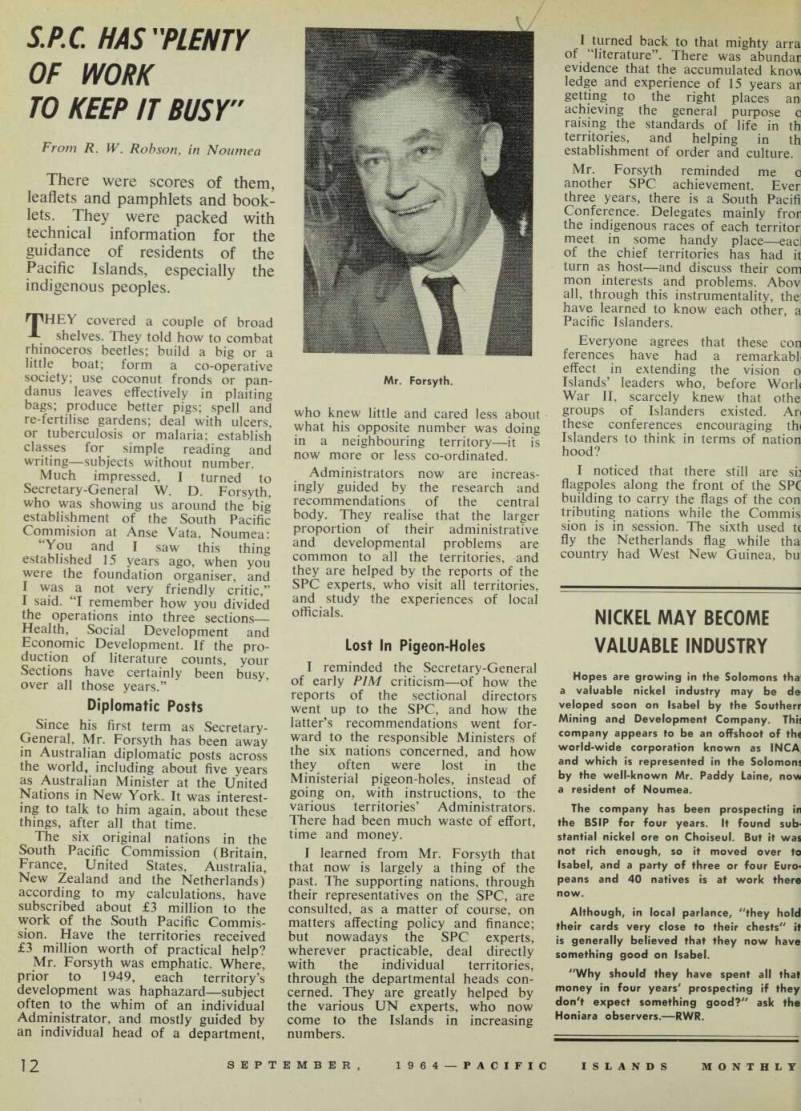
Mr. Forsyth.
seems that in October it will fly e flag of Western Samoa.
This could be very interesting, le SPC’s six original sponsors sre there because each of the six itions was responsible for the wernment of certain Pacific T'er ories. Now Western Samoa, one the various Pacific Territories rmerly under European govern ent has come to nationhood, and is a flag of its own.
Since the SPC was established 15 ars ago, something never then visaged is taking shape rapidly— mely, in the South Pacific, as all er the world, the subject peoples e being thrust into independent tionhood.
Is it the intention that each Ter ory, as it achieves nationhood, will n the European sponsor nations the SPC? If that is so, are they consult together only in relation health, social development and anomic development? How are ly going to keep political develop ;nt off the agenda paper?
I put this up, speculatively, to Mr. •rsyth.
The face of the Secretary-General ;istered horror. “That’s not in the arter,” he said. “We have plenty occupy us without that."
“But,” I persisted, “the successful velopment of health, economic and :ial services, especially education, II lead inevitably to self-gover ;nt. Why shouldn’t you run out pamphlet or two on the respon ilities of self-government? Give ;m a bit of political science.”
Mr. Forsyth closed the discussion th a snap. He looked over the aftops to where the Tricolour was ttering firmly in the trade wind.
“Leave it to the gentlemen in the aital cities,” he said. “We’ve got ;nty here to keep us busy.”
See also stories pages 15, 17 and 19.
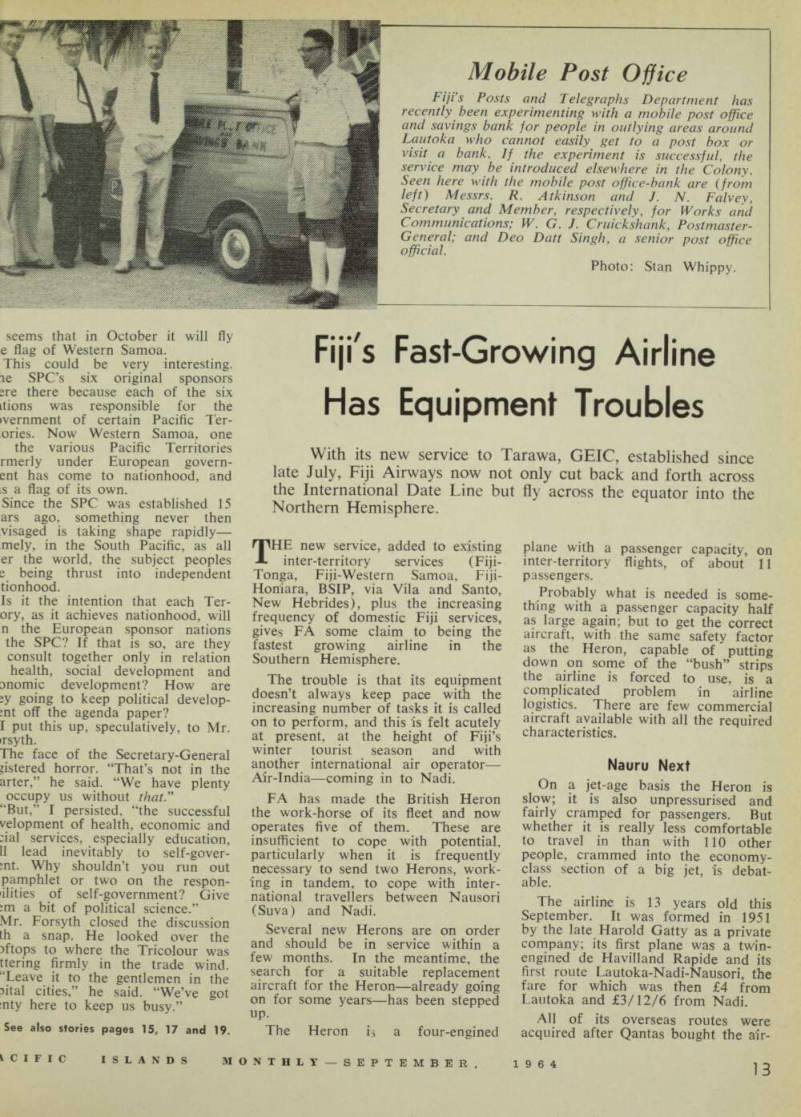
Mobile Post Office
Fiji’s Posts and Telegraphs Department has recently been experimenting with a mobile post office and savings bank for people in outlying areas around Lautoka who cannot easily get to a post box or visit a bank. If the experiment is successful, the service may be introduced elsewhere in the Colony.
Seen here with the mobile post office-bank are (from left) Messrs. R. Atkinson and J. N. Falvey, Secretary and Member, respectively, for Works and Communications; W. G. J. Cruickshank, Postmaster- General; and Deo Datt Singh, a senior post office official.
Photo: Stan Whippy.