Citizenship And
pp. 11-13 · Read in the full issue
Nauruans Say Australian Citizenship And Curtis Island Are Out
The three-man Nauruan delegation led by Head Chief Hammer Deßoburt on July 20 rejected Australian Government proposals that the Nauruans should be resettled on Curtis Island, off the Queensland coast.
THE NAURUANS, declared the delegation, now want to stay on Nauru after the phosphate is worked out; they want a Legislative Council leading to self-government by 1967; they want to take over the phosphate workings themselves and have the royalty raised to 14/8 per ton.
After the Commonwealth Govern ment had failed to agree on these points the current talks, which had been going on for about a month, broke down. Two members of the delegation returned to Nauru but Hammer De Roburt remained in Australia.
No one believed that the break down was the end of the affair and within 24 hours of it the Minister for Territories, Mr. C. E. Barnes, had announced that he and the Head Chief would meet again in Canberra in late August. In any event, as the Minister has already indicated (see
p. 10), the Nauruans have plenty of time left to change their minds before the phosphate cuts out. About 30 years—give or take one or two.
Various plans to re-settle the Nauruans have been going on since mid-1961, when the three administering authorities of Nauru (UK, NZ and Australia), each offered to take the islanders into their respective countries and give them full citizenship. For reasons of climate and long association it was considered that Australia would be most appropriate and after shopping around, Curtis Island, off the Queensland coast, seemed to offer the best possibilities.
Under this proposal, the Nauruans were to be given the freehold of the 180 sq. mile island (area of Nauru: sq. miles); housing; electricity; water and sewerage services; and commercial enterprises such as agri culture and fishing which were to
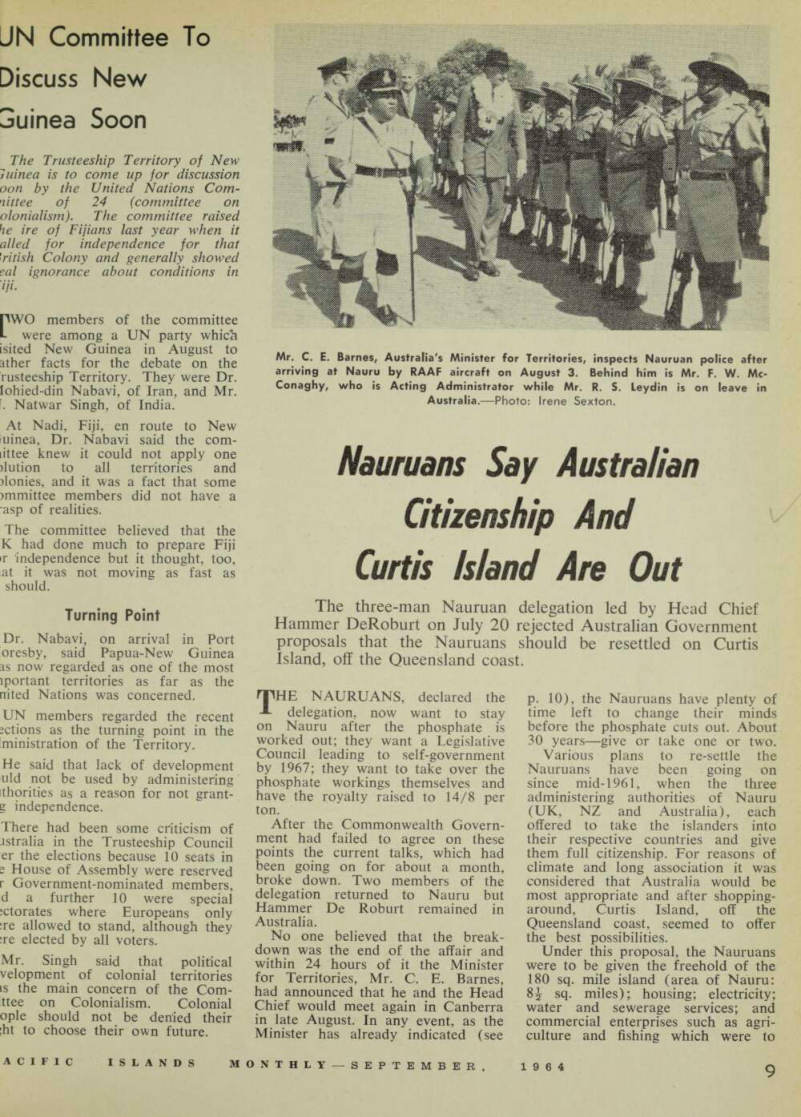
Mr. C. E. Barnes, Australia's Minister for Territories, inspects Nauruan police after arriving at Nauru by RAAF aircraft on August 3. Behind him is Mr. F. W. Me- Conaghy, who is Acting Administrator while Mr. R. S. Leydin is on leave in Australia. — Photo: Irene Sexton.
be established for them. The total cost to Australia, NZ and UK was estimated to be about £lO million.
On Curtis the Nauruans would have extensive powers of local govern ment.
In the Canberra discussions, the Nauruan delegation said that these proposals were unacceptable. They wished to be settled on Curtis as a separate and independent nation; they did not wish to become Aus tralian citizens, or be subject to Australian laws on taxation, im migration, Customs, etc. They did not want to be absorbed into the Australian community or lose their identity—which they felt would happen if the Australian plan were adopted. They believed that if Australia had control over defence and quarantine on Curtis Island, Australia’s interests would be safe guarded.
As Curtis Island is virtually part of Queensland mainland—so close, in fact, that it could be joined by a causeway or bridge—this is a point to which neither the Commonwealth nor Queensland are ever likely to agree. This being so, the Nauruan delegation asked that negotiations to acquire Curtis be discontinued and stated that they were now of the opinion that the Nauruan people should stay on Nauru and not resettle at all.
Increased Royalties
Having failed to agree on a future home, the delegation then failed to reach any agreement satisfactory to them on the payments they should get for their phosphate. This was considered as a separate question to that of resettlement.
Under the current agreement made in 1960 (and due for revision in July 1964), the Nauruans’ phosphate income is as follows: (a) A lump sum of £l2O per acre to landowners for use of phosphate bearing land above the 80 ft contour; £6O per acre for land below that level; (b) A royalty of 1/9 per ton of phosphate mined—l/1 of this going direct to the landowner and the other 8d invested for him for 15 years; (c) The sum of lOd per ton of phosphate mined to be paid to the Nauruan Royalty Trust Fund—out of which the Housing Fund and the Nauruan Local Govt. Council is financed; (d) Royalty of 1/- per ton to the Nauruan Community Long-Term Investment Fund.
In addition to the above, the
British Phosphate Commission pays the difference between Administration revenue (from Customs duties, postage stamps, etc.), and the actual cost of administration—in 1962 the amount the BPC paid on this score was £494,780.
Before the Nauruan delegation could make its demands, the Com monwealth Government offered to raise the payments into the Long- Term Investment Fund from 1/- to 3/-, which would result in a fund of £2O million by the year 1990 and from which Nauruans would get at least £1 million per annum income; and the royalty rates paid to Nauruan landowners and the Local Government Council from 2/8 to 4/-. [Australia subsequently decided to raise the Long-Term In vestment royalty to 3/- per ton, inspite of the breakdown in talks.] The Nauruan delegation proposed that the royalties be increased to 14/8 —basing the figure on what they believed were the payments made by the BPC in respect of phosphate mined on Ocean Island.
The Australian Government said that there was no basis for com parison between Ocean Island and Nauru. Ocean Is. produced about 300,000 tons of phosphate per annum while Nauru exports would shortly be boosted to 2.5 million tons p.a.
Moreover, the BPC paid a straight out 25/8 per ton on phosphate ex ported from Ocean. Of this only 2/8 per ton went to the landowners and the other 23/- per ton went into
Gilbert and Ellice Is. Colony con solidated revenue and was used for the benefit of the 50,000 people in the Colony. [The Banabans of Ocean Is. to whom the 2/8 per ton is paid in royalties, have been resettled on Rabi Is., Fiji, which was purchased for them after the war. They enjoy all the rights of normal freehold landowners on Rabi, and have their own local government, but otherwise are subject to all the laws of Fiji.] The Nauruan delegation then proposed that ownership of the phosphate industry on Nauru be transferred to the Nauruan people because it was their only natural resource. The Australian represent atives disagreed and pointed out the present and future benefits accruing to the Nauruan people from a vigorous and efficient phosphate industry.
They explained that the legal basis for the BPC operations stemmed from the purchase of phosphate rights from the commercial under taking which had owned them prior to World War I.
Nauruan Dream-World The Nauruan leaders’ dreams of pie-in-the-sky may be tempered by time, and for Nauru there is still a good slice of time left. Nonetheless, the whole Nauru issue indicates just how difficult it is today for any administering Government to win on any count.
In the last few years Australia has
;aned over backwards to cater for tie whims of 2,700 Nauruans who ut for an accident of timing in 914 would have been annexed to apan and could already have been fft to their fate.
The Australian offer to give the lauruans Australian citizenship and d invite them to live in Australia ; the first big breach of the so alled White Australia Policy for diich Australia is eternally being riticised. But having offered to reak down the old immigration wall lustralia is now criticised on the rounds of trying to rob Nauruans f their national identity.
Between the wars the Nauruans 'ere held up as the richest and most Drtunate of Pacific Islanders in that icy had an asset which was being 'orked profitably for them, without 'Orry to themselves.
Since the war the idea has grown p in some quarters that they have een exploited for the benefit of mstralasian farmers and systematic lly robbed of their birthright by ime ogres called the British hosphate Commissioners; and that le phosphate on Nauru should ave been left alone until the Jauruans, in the fullness of time, ot around to doing something about themselves.
In their present suggestion that icy take over the phosphate work ig themselves, the Nauruans have een well tutored by many experts, rom Russian and Indian delegates i the United Nations to Australian Yade Union leaders.
Adverse publicity about Nauru and its phosphate is partly the fault of the British Phosphate Commissioners themselves who run their non-profit making organisation, as represent atives of the UK, NZ and Australian governments, from an ivory-tower in Melbourne. There, hidden away, like three unwise monkeys who profess not to see, hear or talk about what goes on, they shun any sort of publicity like the plague.
As a result, frustrated reporters who cannot get near them do less than justice to the BPC and stories in newspapers, radio and TV are frequently angled against them. The Commissioners might have made it easier for everyone concerned if they had appointed a good public relations officer 10 years ago.
Everyone recognises that the Nauruans, the BPC and the administering Governments have a problem over the future of the islanders and no one blames the Nauruans for trying to get as much out of the situation as they can.
But it is largely due to public ignorance of the background or what has, in fact, already been done for the people, that the Nauru delegation was able to break off talks in a pet on August 20 and decide that if they cannot have everything they want they won’t play at all, but will stay put on their own island to spite everyone.
In this context it might be in teresting to know just how many Nauruans, other than the leaders, really want to stay isolated 2,000 miles from anywhere once the phosphate is worked out; and how many, if approached individually, would jump at the chance to resettle in Australia.
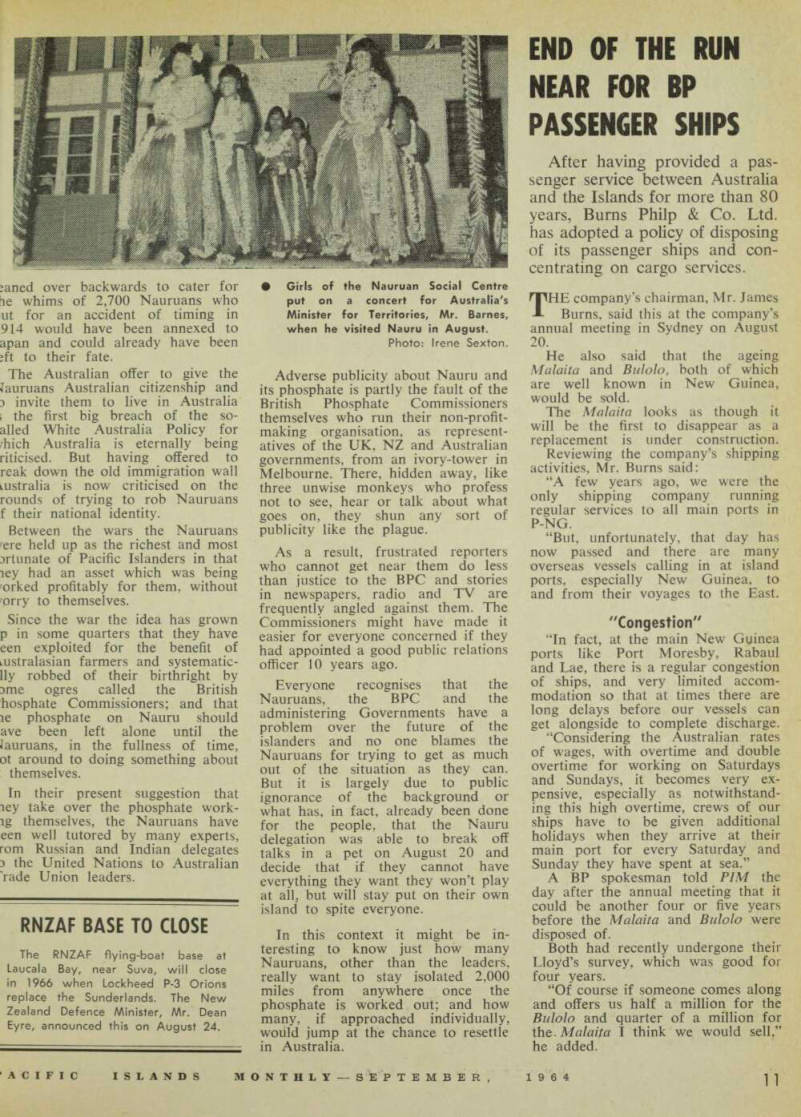
Girls of the Nauruan Social Centre put on a concert for Australia's Minister for Territories, Mr. Barnes, when he visited Nauru in August.
Photo: Irene Sexton.