Travel
pp. 135-137 · Read in the full issue
India Now Within Easy leach Of S. Pacific
Talk
The inauguration of Air-India’s daylight service be veen Sydney and Nadi early in August has put the great ib-continent of India within easy reach of travellers om all major island groups of the South Pacific.
i S most of the South Pacific islands 1. are connected by air with Nadi, avellers can now reach India from icre without changing planes.
India, a land of great variety enically and climatically, offers le visitor the opportunity to see mturies-old art and architecture de by side with modern science id technology.
Added to this is great variety in ie dress and customs of the country’s 50 million people.
Hindustani is the national language, at English is spoken and under ood by many of the people. Almost /eryone the tourist is likely to come i contact with has, at least, a nattering of English.
Major Seasons
India has three major seasons— inter, summer and the monsoon ainy season). The winter months 'Jovember-M arch) are pleasant iroughout the land, with bright inny days. In the northern plains ie minimum temperature at times rops steeply and there is snowfall i the hills.
Abroad
In the south, Maharashtra and the Deccan, and in Eastern India, De cember and January are pleasantly cool, and never really cold.
The summer (April-June) is hot in most parts of the country, and it is during that season that hill resorts such as Darjeeling, Shillong, Simla, Mussoorie, Kulu and Kashmir Valleys, etc., provide cool retreats.
The south-west moonsoon season usually starts about the middle of June on the west coast, and it reaches other areas later. With the exception of the south-eastern areas, India re ceives most of its rainfall between June and September.
The south-eastern areas receive most of their rainfall from the north east monsoon between November and June.
Clothing
In the north, where the evening and night temperatures drop steeply in winter, woollen clothing is neces sary from the middle of November to the middle of February.
Winter in other parts of the country is mild, and tropical clothing is suf ficient. For those visiting the hill re sorts during this time, heavy woollens are essential.
During the summer months, only light tropical and cotton clothing is comfortable. But for the hill resorts, light woollens are best. Evening dress is optional.
Hotels The standard of hotels, and with it the rate for accommodation, vary throughout the country. In New Delhi, for example, there are hotels equal to the best in the world, while in Bombay the standard is only fair.
Calcutta is not a good city for hotels.
"Pacific Islands Monthly" is a member of the Austi&ttan National Travel Association and the Pacific Area Travel Association.
But even though some of the bigger centres might not have a generally high standard of public accommoda tion, there are, as a rule, two or three places which can offer com fortable, if old-fashioned, accommo dation. The older hotels are rarely air-conditioned, but most of the new ones are. Rates are about <£2/10/- a day upwards.
Food Sampling
India gives travellers an excellent opportunity to sample tasty, exotic foods. India is the home of curry, but they have not kept it to them selves, except that curry served out side India rarely compares favour ably with the home product. (Fiji
is an exception for Fiji-Indians claim they can make a much better curry than Mother India citizens, even though they call them Madras, Bom bay, Bengal, etc., curries).
The visitor may find the curry which the Indians themselves eat is a little too hot or spicy. Indian restaurants, aware of this, cater for their visitors’ needs by offering a much milder version.
Most hotels and restaurants also offer Western-style meals. Each of the bigger centres has its own specialty.
Delhi offers roast chicken, butter made from buffalo milk; Calcutta offers excellent local sea fish, cheeses, and a limited variety of fruit in season (mangoes, papaws, limes); Bombay has the famous Bombay duck, which is a kind of dried fish, along with a variety of sea foods; and in Madras and Bangalore there are such regional dishes as pan cakes with potato filling, rice cakes, and crisp spicy wafers of rice or flour.
India has a multitude of liquor
laws, which vary from State to State.
Some States are completely dry, while others have partial prohibition.
In the dry States, tourists may find it tough going. Hotels have “liquor rooms” where the drinking must be done.
Maharashtra, Gujerat and Madras are completely dry, and in Bihar, West Bengal, Jammu and Kashmir, there is no prohibition.
On production of a tourist intro duction card, visitors can get liquor permits in Bombay from the India Tourist Office, the security inspector at the airport, the excise inspector at Mole Station, in many of the large hotels; and in Madras from the India Tourist Office.
In some places, such as Delhi, drinking in public is prohibited, but overseas visitors can buy liquor from authorised v/ine dealers, or order it in their hotel rooms. In almost all big cities, such as Calcutta and Delhi, certain days of the week are observed as “dry days”, when the sale of liquor is prohibited.
Customs formalities in India are
not as streamlined as in Fiji—wher they are streamlined indeed. Visitor to India may sometimes wonde whether the battle to get past the re* tape at the airport is worth it—bu it is.
Return first-class air fare Nad to Bombay is £A6SO/13/-; econom; class is £A467/4/-. In some months there is an excursion fare fo economy class travel of about £A3I2 Excursion Fare From Fiji, the excursion fare i< available in January, March, July September and November, and froir Bombay on the return journey ir February, April, June, August
October and November. The ex* ursion ticket is valid for a year, but Lopovers are not allowed between Jadi and Bombay.
There is a special Sita World ravel 13-day tour of India, costing bout £A237, including internal air ares, hotel accommodation, sight eeing, guide fees, etc. It does not in lude fare to and from India, De ails are: Wednesday —Arrive Bombay by tir-India and stay overnight at Taj dahal Hotel.
Thursday —Morning sightseeing to •lephanta Caves; afternoon tour of he city and Hanging Gardens..
Friday —Bombay to Udaipur by ir, and go to Lake Palace Hotel; ifternoon tour to the Palace of the daharana.
Saturday —Udaipur to Jaipur (the ’ink City), and stay at Rambagh *alace Hotel; afternoon excursion to \.mber, including an elephant ride.
Sunday —Morning sightseeing tour n Jaipur, and then by air to Delhi; ;tay at Ashoka Hotel.
Monday—Morning sightseeing tour of Old and New Delhi; afternoon free.
Tuesday —Free. All meals and accommodation at the Ashoka Hotel.
Wednesday —Delhi to Agra, city of the Taj Mahal, by air; afternoon visit to the Taj Mahal; stay overnight at Clark’s Shiraz hotel.
Thursday —By air to Benares, the holy city on the banks of the River Ganges; afternoon city tour; stay at Clark’s Hotel.
Friday —Early morning visit to the Burning Ghats, including a boat ride on River Ganges; afternoon flight to Calcutta, biggest city in India; stay at Grand Hotel.
Saturday —M o r n i n g sightseeing tour of city; afternoon free.
Sunday —By air to Madras and stay at Connemara Hotel; afternoon city tour, including the marine drive.
Monday —Leave India by Air-India.
The
Pacific
Lae's Transair Lodge
Is One To Remember
FOR simple, friendly yet efficient accommodation for the air traveller, the TAA-owned Transair Lodge is the place to stay in Lae.
New Guinea. Lae is the terminal point for the TAA and Ansett-ANA trunk services between Australia and P-NG, and the centre for internal air opera tions. It will get bigger and busier.
Lae has the Hotel Cecil, at present being operated by a receiver after the owning company struck trouble, and the Transair Lodge. Steamships Trading Co. will start in the next nine months a £250,000 hotel at Lae. but it will be two years before it is in operation.
Meanwhile the Transair, with 52 beds, is available to all air travellers, and bookings can be made through mainland agencies.
But it is important to book in advance, as sometimes special tours take all the accommodation, and travellers should see to it that their travel agent makes a firm booking.
Transair started life not long after the war as a staff and travellers’ lodge for Qantas, which then had the trunk line monopoly between Australia and the Territory. It at that time filled a valuable gap in the Lae accom modation scene.
Accommodation is bungalow style, with a central dining room and
lounge, and covered walks connect ing with the bungalows.
Each bungalow has a common bathroom and toilet and writing room, but there are wash basins in the rooms and efficient central fans, although no airconditioning.
Services include a night porter, shoe-cleaning, same-day laundry, free morning and afternoon tea, transport to and from the airport and of course special calls to meet aircraft.
Transair is not licensed, but the TAA Social Club, which is part of the central service block, is. Genuine air travellers have no difficulty in being signed in to the club as guests, and drinking conditions are pleasant.
The Lodge is five minutes walk to the main Lae shopping centre.
Rates are £A4.0.0. single, £7.0.0 double, including meals. If asked to share, which sometimes can happen when the Lodge is heavily booked, single is £3.10.0.
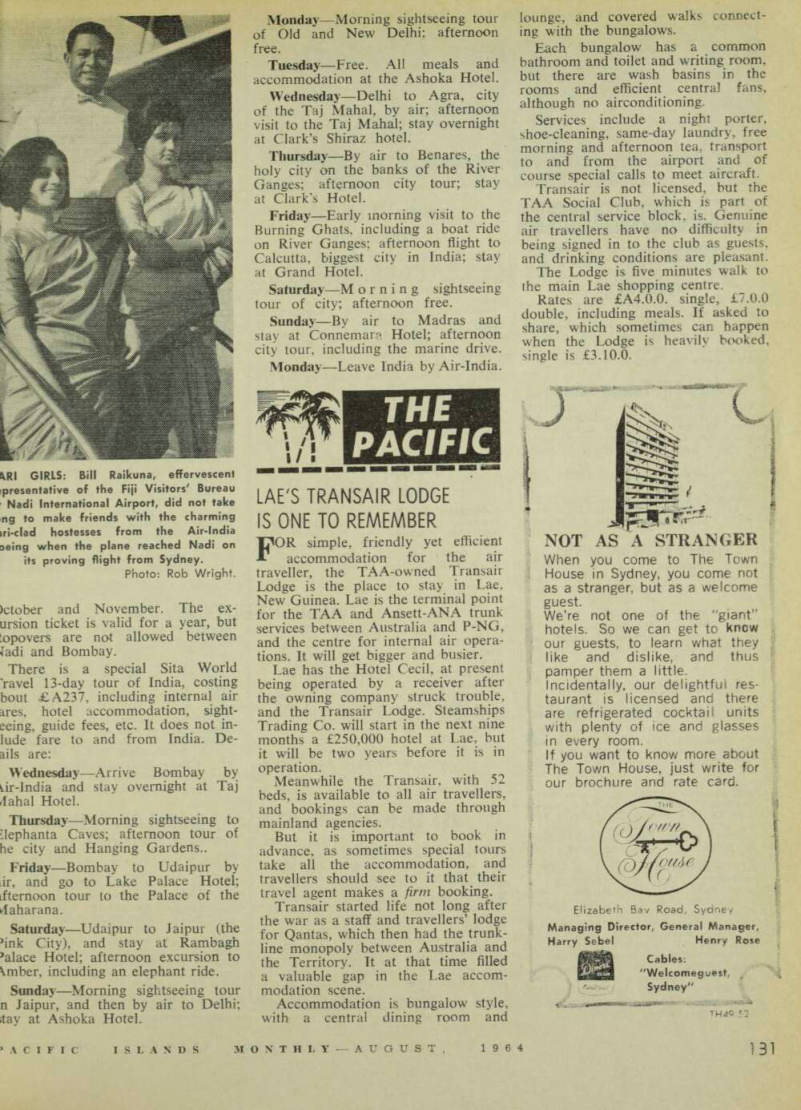
ARI GIRLS: Bill Raikuna, effervescent presentative of the Fiji Visitors' Bureau Nadi International Airport, did not take [?]ng to make friends with the charming [?]iri-clad hostesses from the Air-lndia Being when the plane reached Nadi on its proving flight from Sydney.
Photo: Rob Wright.