Pacific Commerce and Produce
pp. 127-129 · Read in the full issue
Fiji's Trade Figures Don't Balance Again—But...
From a Suva Correspondent When, each year about this time, Fiji releases its trade statistics, not the least interesting set of figures to be given prominence in the public mind is that showing trade balances between Fiji and some other countries.
FOR years, the figures have shown that Australia has sold more to Fiji but Britain has bought more, since the greater part of Fiji com nerce is, in fact, in the hands of Aus ralia, this imbalance has been re garded by many people, in some jeculiar way, as something rather be ow the belt.
The insinuation has been that Aus ralia ought to be ashamed of itself or not balancing its trade.
The latest figures—those for 1963 —are now out, and the pattern is the ame, or even more so.
Australia last year lead the field >y exporting goods worth £F5,775,000 o Fiji, an increase of more than :900,000 on the previous year; vhich gave her 28.6 per cent, of 7 iji’s import trade.
Britain sold the British Colony goods worth £F4,733,000, which was virtually the same as the previous year, but the UK took the largest share of Fiji’s exports—worth more than £F9,298,000.
But there has been one important addition to the latest statistics. Fiji has officially pointed out that, when releasing them, criticism of trade im balances is not always intelligent, as circumstances vary.
Official Comment Reported the Commerce and In dustries Officer, Mr. R. W. Parkinson: “There is often a good deal of com ment on this bilateral aspect of trade and suggestions made that some countries should buy more from us because we buy from them.
“These considerations are common enough in world trade—though whether the outcome of bilateral agreements is desirable may be de bated—but with our small range of exportable commodities it is virtually impossible to attempt to strike a balance with individual countries.
“For instance, there is little we could export to India or Indonesia, but it suits our importers to buy petroleum and textile products from these sources.
“Clearly any attempt to balance out country by country would need rigid controls and would very strictly limit our importers’ ability to find the best source of supply and our exporters’ opportunity to sell where they could get the best returns.
“It is unlikely that such action would be in the best interests of Fiji.”
The fact is, of course, that Aus tralia is a tropical country and pro duces the goods that tropical Fiji wants to export. Britain doesn’t.
Australia produces her own sugar,
and Britain bought from Fiji sugar worth £8,259,274, which accounted for virtually all but £1 million of her purchases from the Colony.
Australia has her own supplies of coconut products, which is why Japan took all Fiji’s copra last year and the UK took the greatest part of the coconut oil.
But Australia bought all Fiji’s gold, worth more than £1,557,000.
Fiji in 1963 had favourable trad ing balances with: United Kingdom, £4,565,000; Canada, £3,147,000; United States, £1,899,000; Western Samoa, £457,000; West Germany, £373,000; the Netherlands, £283,000.
There were adverse balances with: Australia, £3,837,000; Japan, £1,473,000; India, £1,125,000; Indo nesia, £1,042,000; New Zealand, £840,000; Hong Kong, £740,000; Singapore, £537,000.
Overall, Fiji had a favourable trade balance in 1963—the first for six years.
Total trade running at more than £42 million, £9 million higher than in 1962, left a net balance of £1,865,000.
Mr. Parkinson, a cautious man, said that the long term effect of such sudden and sweeping changes in the state of the economy would be of vital interest, but it was probably safe to say that the overall state of the economy had never been stronger than it was at the end of 1963.
The favourable position was due almost entirely to the sugar industry in which there was a far greater out put than ever before, at prices close to those which ruled during the Suez crisis of 1956.
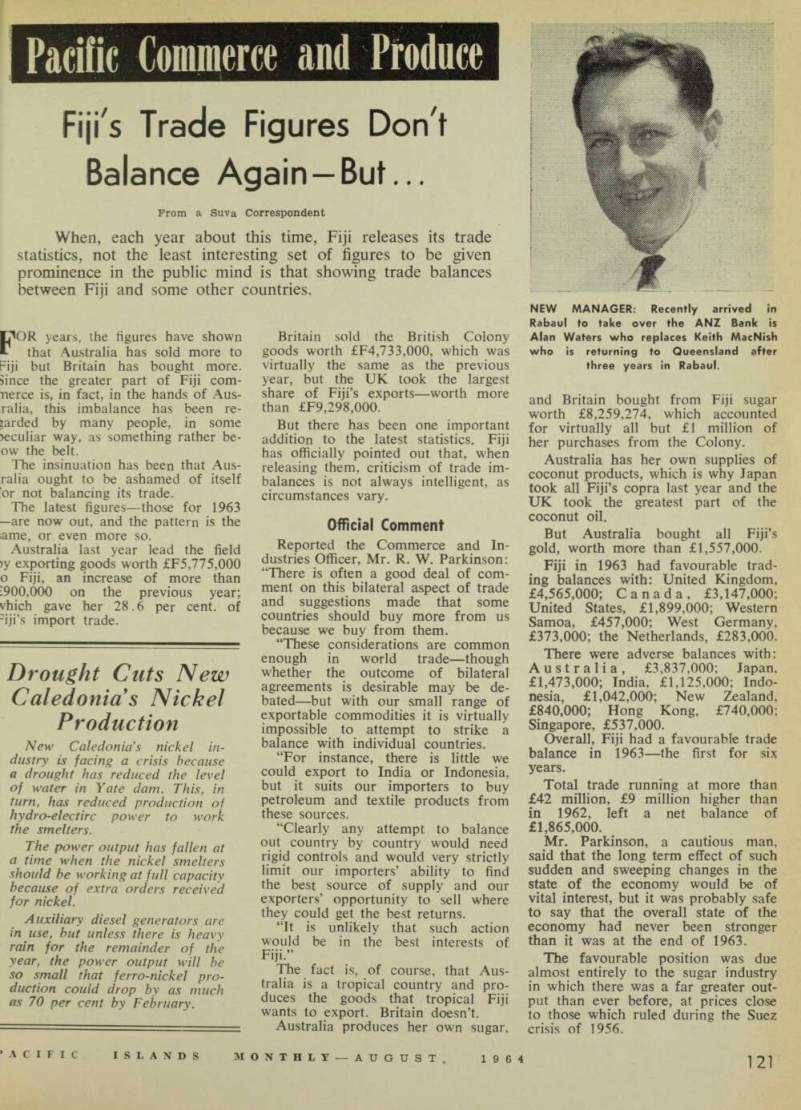
NEW MANAGER: Recently arrived in Rabaul to take over the ANZ Bank is Alan Waters who replaces Keith MacNish who is returning to Queensland after three years in Rabaul.
Strike Settled At
Fiji's Vatukoulo
BOTH sides in a dispute which arose at Fiji’s Emperor Gold mine at Vatukoula made an amicable settlement in July.
The dispute arose through the management of the Emperor Gold Mining Company Ltd. refusing a request of the Fijian Mineworkers’
Union to dismiss a senior under ground foreman for allegedly using abusive language to union members.
The refusal prompted the union to strike in June. A deadlock was reached and work was resumed only after the Governor, Sir Derek Jakeway, set up a commission of inquiry into the dispute.
Evidence was heard in public, but no report of the findings of the Com missioner, Senior Magistrate A. J.
Jeddere-Fisher, has been published (and it is not now expected to be).
Copies of the report are under stood to have been sent to the parties and after a visit to the mines by the Labour Commissioner, Mr.
J. Amputch, in July a joint statement was released in which it was revealed that the union executive committee had made proposals for the settle ment of the dispute, and that the company had accepted them. The foreman was to apologise.
About 1,500 men are enrolled in the union. The industry in Fiji supports about 5,000 to 6,000 on the field.
The dispute came at a time when a revised working agreement between the union and the company is under negotiation.
During the inquiry Mr. A. Watson, the company’s general manager, told the Commissioner that the industry could not afford any loss of pro duction or increase in costs.
Mr. Watson produced a cable from the company’s chief general manager,
Mr. N. E. Nilsen, which asked him to bring to the notice of the Fiji Government and the union officials the company’s great concern at strike action, because of the company’s limited financial resources.
The cable added that the com pany’s delicate economic position, with a fixed price for gold, prohibited acceptance of either an interruption of revenue or of in creased expenditure.
The cable did not seem to augur well for shareholders’ dividend prospects (no dividend on ordinary shares has been paid since 1956) nor a union demand for revised wage scales.
New Company Law
In Papua-New Guinea
THE new Papua-New Guinea Com panies Ordinance came into force on July 1. Public companies are now required to lodge with the Registrar of Companies much more detailed returns, annual balance sheets, etc., than previously.
The P-NG Secretary for Law, Mr.
W. W. Watkins, said recently that the new laws could affect most com panies operating in the Territory as nearly all, technically speaking, were public companies.
BSIP Logging Projects
THE Allardyce Lumber Cos. Ltd. hopes to start logging this month in the Allardyce Harbour area at Santa Ysabel, BSIP. A second com pany, the Kalena Timber Cos. expects to start operations in the Viru Harbour-Kalena Bay area, by the end of the year.
The BSIP Government and local landowners in the Allardyce Harbour area have entered into an agreement under which the landowners will receive £4,000 as a down payment
for 75,000 acres of timber land. The landowners will receive annual ments each year timber extractior takes place.
The Colonial Timber Corporation of which the Allardyce Lumber Cos.
Ltd. is a subsidiary, exported trial shipments of logs. The exports from that area will be mainly the Campnosperma species.
The Government and the Kalena Timber Cos. are working under a similar arrangement in the Viru Harbour-Kalena Bay area, where 68,000 acres will be worked. The terms include the payment of 10 per cent of timber royalties to former landowners in each year in which timber working takes place.
In the initial stages the exports
11 be mainly the Calophyllum ecies. , Mr. G. E. C. Meats, a director of i company, expects that 100,000 per feet of logs and 20,000 super »t of sawn lumber should be pro ced a day when the company is in 11 operation.
iji Expects Record
ugar Crop
IHE Fiji sugar crop for 1964 is expected to be a record 320,000 is, the chairman of the Colonial gar Refining Cos. Ltd., Mr. J. W. inlop, told the annual meeting of ; company at Sydney in July.
Mr. Dunlop did not say what the Dp would be worth, but it should between £15,000,000 and 6,000,000.
The 1964 return should be about ,000,000 more than that of 1963, len it was £14,375,000, but the :reased output for 1964 (21,000 ns above that of 1963) is likely to ing less per ton.
The 1963 average was just below 3, f.0.b., while for 1964, based on rly July world prices, and the aranteed return of £Stg.46/0/10 r 126,000 tons under the British Dmmonwealth Sugar Agreement, the erage will be a little better than ■7.
Mr. Dunlop told shareholders that ops had not been much affected ' severe flooding in March this year.
After mentioning previous expan- Dn, including an increase in the
capacity of the mills to crush 320,000 tons of raw sugar this year, Mr.
Dunlop said there would be further expansion in the next two years, when extra cane would come from existing growers, growers re-entering the industry and new growers.
The acreage under cane was expected to increase materially, and there would be large capital expendi ture to raise the capacities of trans port, milling and sugar storage in the next two years.
Mr. Dunlop said that Fiji (and Australia) had shown themselves, by performance, to be reliable suppliers to the US. If there was to be a change in quotas the CSR Cos. hoped that the reliable perform ances would be favourably recognised for both Fiji and Australia.
Profit Tops £7m.
CSR’s consolidated net profit for the year ended March 31, was £7,395,839, an increase of £2,889,022, or 64.1 per cent, over the previous year.
The final dividend was 1/6 a share, making a total distribution of 2/6 (12i per cent.) for the year.
The board hopes to maintain dividends at the rate of 12 J per cent.