Cruising Yachts
pp. 99-109 · Read in the full issue
Pacific Shipping And Cruising Yachts
More Formosan Trochus Poachers Arrested
The crew of a Formosan fishing boat was arrested at gun point in July for trochus-poaching in the Fead Islands, about 170 miles north-east of Rabaul. This was the second time in less than two months that a Formosan fishing boat’s crew was arrested for trochus-poaching in the Pacific.
rHE first instance occurred at Aneityum, the southernmost island i the New Hebrides, on May 27.
PIM. July, p. 103).
In the second case, the arrests 'ere made by Captain Bill Hallam, retired ship’s master, who is lanager of a coconut plantation in le Fead Islands. He arrested 10 len on July 12.
After receiving a radio report from -aptain Hallam, the P-NG Admi istration sent an official party •om Sohano in the Government boat Hvani to investigate. The party com rised the District Commissioner for ougainville, Mr. P. Mollison, a lagistrate and a contingent of native olice.
The Nivani escorted the Formosan oat to Rabaul where, on July 17, le captain was fined £5 for being an legal immigrant.
Captain Hallam, in radio-telephone
calls to associates at Rabaul, said that the Fead Island natives had complained to him on July 11 that Formosan seamen were raiding the islands for shell fish and coconuts. He sighted their junk the next day and followed it in a powered canoe.
The Formosans would not let him near them so he went back to his house for a gun. He found them still brazenly shell-fishing on the reef so he told them to go ashore.
“They wouldn’t move so 1 sent a shot over their heads and they under stood quickly enough,” Captain Hallam said. “I have arrested them and their ship, which I have every right to do under marine law”.
Captain Hallam added that he made the Formosans sail their boat to an anchorage near his house, where he kept watch on them. There had been no violence nor attempts to escape.
Earlier this year, Captain Hallam unsuccessfully chased a mysterious sampan whose crew was reported to have made two unauthorised landings in the Fead Group. (PIM, April, p. 105).
Captain Hallam and a few white missionaries are the only people apart from native subsistence farmers who live on the Fead Islands.
Commenting on the poacher nuisance, a P-NG Administration spokesman said in July that there was little the Administration could do about the fishermen as they were “operating on a shoestring’.
Footnote : A Japanese fishing ship, Hoyogo Maru, landed a swimming party of 14 men at Funafuti in the GEIC on June 7, but village police men ordered them back on board.
The Japs obeyed.
New Bunkering System
At Levuka
The Shell Oil Co. has installed a £65,000 bunkering system at Levuka to cater mainly for the Japanese fishing fleet which will be based near there.
The supply lines and the main tanks have been finished, but work is still to be done on the office block and loading docks. With the new in stallation. Levuka has become the second bunkering port in Fiji.
When the Japanese-owned fishing fleet reaches maximum strength of 105 catchers, plus a mother ship or two, Levuka, the former Fiji capital,
NEW HEBRIDES WHOPPER: This swordfish, caught off the island of Tongoa recently by Captain Guenet, of the Condominium ship "Rocinante", is believed to be the largest ever caught in New Hebrides waters. It measured 3 metres, 60 cms., or about 11 ft. 7 in.
Photo: R. E. Norman Smith.
will be busier than it has been for several decades.
Towards the end of June, Levuka welcomed its first oil tanker, the Jane Maersk, which, coming with 4,000 tons of diesel fuel for the Shell Co’s new installation, was the first tanker and the largest ship to tie up at the wharf.
Under charter to Shell, the Jane Maersk is 555 ft long and has a capacity of 20,000 tons. She was brought alongside without difficulty by the pilot, Captain P. H. Gosschalk.
Until she arrived, the largest ship to tie up at the wharf was the President Tyler, a 10,500-ton troop ship, which spent a week at Levuka during World War 11.
Whalechaser Refitted
For New Role
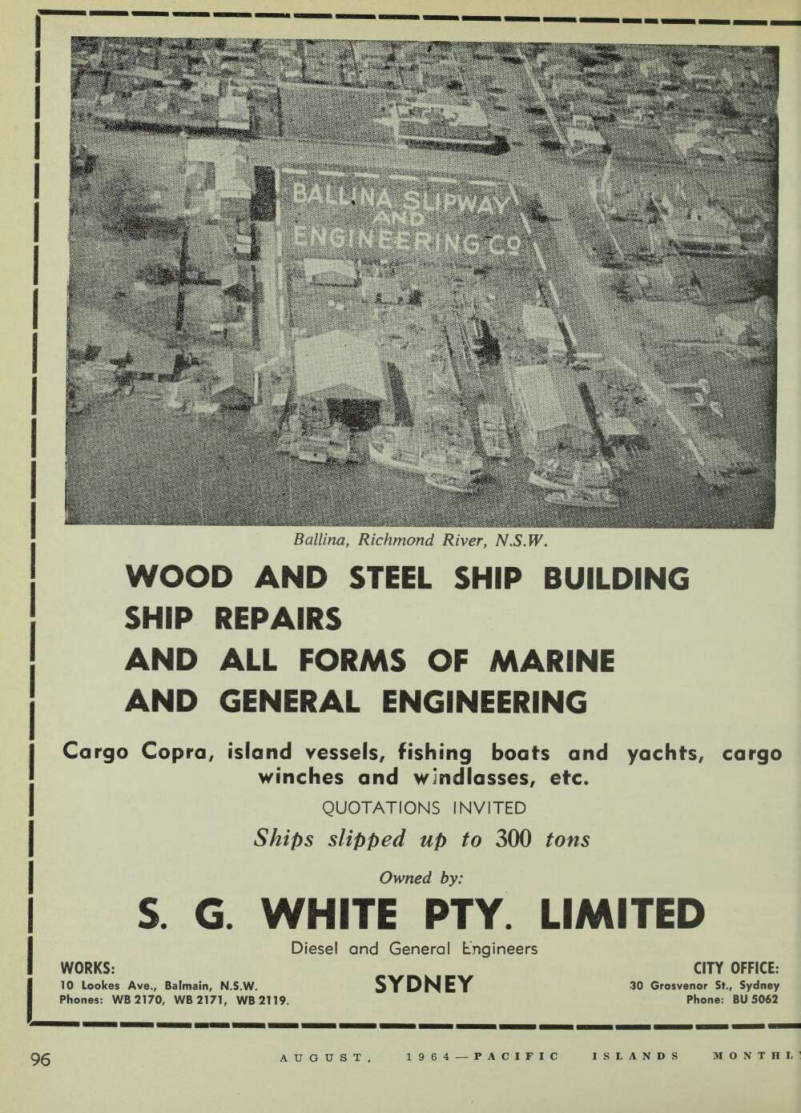
The Byrond I, an old whalechaser, das been refitted at Ballina, NSW, for a new job as a hydrographic survey ship on the Australian and New Tuinea coasts. She has also been *iven a new name, Ataluma.
The cost of refitting the ship was about £75,000. Most of her machinery das been duplicated so that main enance work can be carried out without the need to interrupt surveys.
The crew will be changed every »ix months. The Ataluma will operate at sea for long periods during which ihe will be provisioned and refuelled vithout sighting land.
Increasing Lord Howe
Tourist Boat Fleet
A cause of complaint by visitors to Lord Howe Island may be removed luring the coming summer by the addition of five boats to carry tourists an excursions.
Last season only one boat, licensed o carry 14 passengers, was available :or tourist excursions outside en :losed waters; and there was also a glass-bottomed boat available for :oral viewing licensed to carry 15 aassengers.
The biggest of the new boats is aeing built at Lord Howe by Mr. Alan »Villiams, proprietor of the Somerset 3resthouse. Most of the material has ■>een imported from Australia.
She will have a length of 45 ft, a 3eam of 14 ft and a 5 ft draught, and will be equipped with two-way •adio and echo-sounding gear.
Although the primary purpose of he boat is for the pleasure of tourists, he commercial possibilities have not 3een overlooked. Mr. Williams has ffans for a freezing plant, and may mgage in commercial fishing.
Mr. Neil Woolnough returned to Lord Howe in April with plans,
timber and a shipwright to build a sailing catamaran, and a glass-bot tomed boat. One hull of the cata maran is finished and the second is well on the way. Both boats should be in operation by October.
Mr. Clive Wilson is having a 33 ft passenger craft built at Sydney, designed specially for Lord Howe conditions. Her beam will be 12 ft and the loaded draft will be 2 ft.
Subject to a stability test, she will be licensed to carry 24 persons on outside excursions. She will be powered by a 97 hp Parsons diesel engine, and will have two-way radio.
The boat will be freighted to Lord Howe Island.
The fifth vessel is expected to be a 40 ft twin screw passenger and fishing boat for Mr. Carl Dignam.
Mr. Dignam is not yet certain of building arrangements, but hopes that the craft will be ready late in 1964 or early in 1965.
Australia-Islands Freight
Rates Increased
On August 1, shipping companies regularly engaged in the Australia- Fiji service, increased freight rates to and from Australia by 15/- a ton.
The increase comprises 7/6 to cover the recent Australian basic wage rise and 7/6 to cover “normal increased trading costs”.
The shipping companies concerned said that the “normal increased trading costs” included the higher stevedoring costs in Fiji through recent substantial wage increases for dock workers.
The companies also announced that
the Lautoka differential freight rate had been eliminated and the new rate would be 182/6 a ton from Sydney to both Suva and Lautoka, and 207/6 a ton from Melbourne to Fiji.
The companies which maintain regular services between Australia and Fiji are the CSR Co. Ltd. (Rona), Matson Lines {Mariposa and Mon terey), Pacific Shipowners {Lakemba) , and USS Co. Ltd. ( Waiana ).
More Jap Ships For
Pacific Trade
The Daiwa Line of Japan has bought two new ships to trade between Fiji and Japan. They are the Fiji Maru (9,830 tons) and Tahiti Maru (9,053 tons).
The Fiji Maru was scheduled to leave Japan about July 4, and arrive in Fiji, via Guam, Apia and Pago Pago about July 26. On the return voyage she is expected to call at Lautoka, Noumea, Vila, Santo and Honiara.
The Fiji Maru has accommodation for nine passengers and cruises at about 15 knots.
The Tahiti Maru, which cruises at about 14.5 knots, can accommodate six passengers.
The ships have been added to the line’s existing Pacific fleet because of increased trade.
Work Begins On Deep
Water Berth At Honiara
Hornibrook Constructions Ltd. engineers and other staff assembled at Honiara late in July to start work on the deep water berth at Point Cruz, Under the contract, the work has to be finished by Christmas Eve, 1965.
Lau Outrigger Canoes
Create Interest In Suva
To show that they are still supreme in the building and handling of out rigger canoes, 24 Lauans from Kabara in Fiji’s Southern Lau Group set sail in five canoes ranging from 18 ft to 30 ft on June 28, and arrived at Suva on July 7.
They struck bad weather for most of the 200-mile voyage and lost one canoe—the smallest—when it was swamped by rough seas.
Fortunately, the auxiliary ketch Makogai was escorting the fleet and was at hand to pick up the crew of two, Filipe Temo and Jone Mate.
The canoes visited Suva for the Methodist Conference independence celebrations. They took part in two races in Suva Harbour and attracted large crowds to the waterfront.
The canoes are small compared with the giant drua (twin hulls) which were built by the Lauans’ ancestors in the early days.
These carried more than 100 people and took them on long voyages. One type of drua had a dais on the deck for the chief.
The dura had holds where food and other goods were stored.
Chinese Junk On
Australian Coast
Mr, Dudley Shuter, a retired grazier who now lives at Redland Bay,, near Brisbane, recently sailed the Lorrie, an 80 ft junk, from Hong Kong to Brisbane. He intends to use his acquisition as a demonstration model and sell craft like if for use in Australian waters.
The Lorrie had quite an eventful journey. She narrowly missed a typhoon off the Philippines, then she struck a floating log, and finally ran on to a reef north of Cooktown. She was winched off the reef without damage.
Finally, at Cairns, the Immigration Department refused to allow the five Chinese crew ashore, even though Mr. Shuter had adopted one of them.
In addition to the crew, the Lorrie carried two American missionaries.
She was joined by a shipwrecked yachtsman when she put into Thurs day Island for repairs and water.
Although fitted with sails, the
Lorries twin engines were used for her voyage.
Mr. Shuter said on arrival at Brisbane that a fleet of junks could become a useful addition for the meat trade with Asia. Each junk could carry 60 to 70 head of cattle.
"Bulolo" Ploughs Into
Rabaul Wharf
The Burns Philp ship Bulolo (6500 tons), carrying 200 passengers, hit a steel and concrete wharf at Rabaul while berthing on July 6, and ploughed 6 ft into it. She tore out electric cables and fractured concrete castings up to 200 ft away.
Five sections of one strake in the bow were sprung, and the hull was torn in two places. But no one was hurt.
The Bulolo was under the command of Captain Brett Hilder, of Sydney.
It was reported that the Bulolo was making a wide sweep under her own power to come alongside the
wharf. She got too close, however, and rammed the wharf head on, causing a cloud of concrete dust and sparks from tearing steel.
Despite the mishap, the Bulolo left Rabaul on schedule on July 7. She had a small steel-plate patch over some small holes in her bow.
Engineers worked throughout July 6 to make temporary repairs to her bow. Full repairs will be made when the Bulolo returns to Sydney.
Lord Howe Island Cargo
Handling Plan
The New South Wales Government has made a grant of £15,000 for waterfront improvements at Lord Howe Island.
Two construction engineers visited the island in June and said they hoped that work would start late in July.
One project is to provide cargo handling facilities at Ned’s Beach on the eastern side of the waterfront; a second is to improve the jetty land ing area on the western side.
In the past it has been necessary for men to wade into the water, and carry cargo out of surf boats when unloading at Ned’s Beach.
The plan for this beach involves building a slipway and cradle and then a travelling hoist to carry the boats out of the water for unloading on land.
Need To Replace "Matua"
Within Five Years
The USS Co. Ltd. will have to consider replacing the 4,250-ton Matua within the next five years, the company’s chairman and managing director, Mr. F. K. Macfarlane, said recently. He said the ship was reaching the end of her economic life.
The Matua, which was launched in 1936, recently underwent a survey at Auckland. The survey was more ex tensive than anticipated, and she was
unable to resume her schedule on June 23, as planned (PIM. July, p. 103).
The Matua operates a passenger and cargo service between New Zealand ports (Auckland, Welling ton, Lyttelton) and Suva, Lautoka, Nukualofa and Apia.
New Role For Famous Cook
Islands Trading Schooner
The former Cook Islands trading schooner Tiare Taporo (173 tons) was scheduled to leave Auckland about the middle of July for New Guinea to trade between that territory and neighbouring islands.
The schooner, which is 50 years old, has made several “last” de partures from Auckland and Raro tonga, but has always returned like Dame Nellie Melba.
However, her owner, Mr. W. B.
Christophers, says her departure from Auckland this time will definitely be her last.
Fiji's Safety At Sea
Inquiry Ends
Fiji’s Safety at Sea Commission, which followed the Kadavulevu disaster in March, ended its public hearings on July 8.
The Kadavulevu capsized on March 29, while on a voyage from Nairai in the Lomaiviti Group to Suva. She was grossly overloaded, carrying more than 90 persons, whereas she was licensed to carry only 29, including a crew of seven. The death toll was either 89 or 90, and only three people survived.
The Safety at Sea Commission, comprising Mr. Justice Knox-Mawer as chairman, Mr. C. D. Aidney, a Suva businessman, and Captain S. B.
Brown, started public hearings after preliminary and formal inquiries into the Kadavulevu disaster (PIM, July, p. 97). At 24 public sittings they heard 42 witnesses.
The witnesses included the Comptroller of Customs, Mr. E. J.
Daru's New Wharf
Right out at the end of this embank ment is a much needed new wharf for Daru, in the Western District of Papua.
It is due to be completed this month.
The wharf cost £80,000 and will take ships up to 250 ft. A slipway will be built nearby, taking ships to 600 tons.
The embankment gives protection for smallcraft. Photo: P.NG Information.
A Coily Customer : a Tongan fisherman had a narrow escape from this nine foot eel recently after he shot a spear at it while fishing in the lagoon, but missed. The eel coiled itself round the man's body, and as its grip became tighter, the fisherman, in desperation, grabbed the eel's head and bit it many times. Eventually, the eel relaxed its grip and was dragged to a nearby canoe and killed. Photo: Hettig.
Mabbs; the Harbour Master, Captain E. L. James; the Assistant [arbour Master, Captain P. G. lough; the managing director of V. R. Carpenter and Co. (Fiji) Ltd., Ir. W. G. Johnson; the shipping lanager of Burns Philp (SS) Co. .td., Mr. G. R. Simpson; the stup ing manager of Morris Hedstrom ,td., Captain A. A. Visser; the 'omptroller of Transport and Civil aviation, Mr. G. Smith; and the ommissioner of Police. Mr. R. H. T. eaumont.
The Commissioners will send their iport to the Governor, Sir Derek akeway.
Mall Ship Pulled
Iff Reef
Toma Shipping’s 40 ft workboat, 'alama, was pulled off the reef ear New Massawa Plantation, New Britain, on the night of July 7. She ras not damaged. The Talama ran ground before dawn on July 7 after n overnight voyage from Rabaul to
deliver cargo to New Massawa about 50 miles away on the north coast of New Britain. Another Toma Shipping craft, the St. Christopher, pulled the Talama off.
Freighter Abandoned In
Coral Sea
The crew of the freighter Dorothie (1,058 tons) abandoned ship in Jomard Passage, off the eastern end of New Guinea, early on July 12, after the ship struck a reef the pre vious night and started to sink. The crew, five New Zealanders and 10 Chinese, were unharmed.
One of the New Zealanders is Mr.
J. P. (Jim) Shortall, a former PIM staff writer, who was serving as radio officer. Jim is widely known in the South Pacific.
The Dorothie was on a delivery voyage from Auckland via Sydney to a new owner at Hong Kong.
Jomard Passage is about 370 miles south-east of Port Moresby, and is on the route through the Coral Sea between Australia and Asia.
A British freighter, the Baron Jedburgh, which was about two and half miles away when the Dorothie was abandoned, rescued the 15 men from the stricken ship.
The master of the Dorothie, Captain L. Boulton, said later in Rabaul, that the Dorothie was a total loss. She had broken her back on the reef, and would probably sink if she was pulled off.
“This was my first mishap in more than 30 years as a ship’s captain, and this was my last voyage,” he said.
Captain Boulton, who was born in Sydney, has lived in New Zealand for the past 30 years and is best known as former master of the Maui Pomare, on the NZ-Cooks run.
The Dorothie, formerly called Karu, was a trader on the New Zealand coast for about 30 years.
Her regular run was between Auck land, Timaru and Dunedin, with oc casional calls at Wellington.
Earthquake Damage To
Mussau Island Wharf
Earth tremors, late in June and early in July, damaged a wharf at Mussau Island, 250 miles north west of Rabaul. The Seventh-day Adventist Mission reported that a new wharf, of concrete, sank one foot.
Tragedy On Formosan
Fishing Boat
A member of the crew of the Yik Cheong, a Formosan fishing boat, was killed when two ammonia cylinders, strapped to the ship’s deck house, exploded while the ship was in New Guinea waters on June 30.
The captain, Hui Ching Yit, was critically injured, and early in July was still between life and death in the Nonga Base Hospital, Rabaul.
Hui survived three days in the Yik Cheong, receiving only the most primitive treatment from the crew.
On arrival at Rabaul he was taken to the Nonga Hospital. Doctors in emergency operations amputated one arm and one leg. Hui also suffered severe burns.
Two Government ships, the Mangaia and the Laurabada 11, escorted the 70 ft Yik Cheong into Rabaul.
Savusavu Welcomes "Arcadia"
The first-ever visit of a cruise liner to Savusavu, unspoiled port on Fiji’s second largest island of Vanua Levu, was so successful last year, that the P and O-Orient Line was all for a second visit this year.
The Savusavuans saw their second P and O-Orient ship, the Arcadia, on July 9. She brought 1,200 free spending Australians to this little known part of Fiji, and Savusavu gave them a royal welcome.
There were Fijian ceremonies and feasts, swimming, reef exploration, and a genuine Fijian fish drive in
Jim Shortall.
lich the villagers drive the fish 0 an ever-diminishing circle before tching them.
When the Australians, sunburnt d laden with Fijian handcrafts and avenirs, arrived at Suva the next day ;y made the Suva folk jealous with :ir superlative descriptions of Savu m, ‘But, heaven be praised,” said the va shopkeepers, “the tourists had 3t most of their money in their llets, and handbags until they iched here”.
W Zealand Sailors
Haved Themselves
Suva has never seen a more well laved crowd of sailors than those entertained on July 9. Nearly 200 re at Suva for 24 hours when the w Zealand frigate HMNZS Rotoiti t in at the end of a cruise in Fiji 1 Rotuman waters.
Fhe Rotoiti had been to Suva only : ew weeks before with the cruiser, 4NZS Royalist, and on that oc ;ion the sailors “took the city irt”. 3afe and hotel owners, private zens, and The Fiji Times com ined about it, and this brought a vent apology from the Royalist’s nmander. [t was said at the time that the ps’ companies had not had shore ve for 30 days and were letting off am. 3n the second occasion either all steam had been let off at other •ts in Fiji, or the men were told, ffiave, or else”.