Days To Quiet Niuafo'ou
pp. 85-87 · Read in the full issue

Murder Case And Flu Outbreak Bring Eventful Days To Quiet Niuafo'ou
From Dorothy Lavin, in Nukualofa Life on Niuafo’ou, the northernmost island in the Tonga Group, has been very much out of the ordinary lately. Back in March, history was made when a European judge presided for the first time over the island’s court and heard the first murder case since 1897; and in June, the RNZAF at Laucala Bay had to make a mercy trip to the island with medical supplies because of an influenza epidemic.
NIUAFO’OU — better known as Tin Can Island because swimmers used to tow its mail in tin cans to and from ships anchored off-shore— is the home of about 600 Tongans, who five a simple life in the extreme.
There are no formed roads, and transport is by horseback or by horse and cart. The only mechanised vehicle, a tractor, is mainly used— with a trailer hitched behind-to cart :opra from the villages.
Copra is the island’s main export.
But bananas and citrus fruits grow in abundance in the rich, volcanic soil, plus most of the other food the Deople need Chickens and pigs are plentiful, tnd fish are there for the catching.
Most fishing is done from the *ocks because the rough weather dong the island’s unprotected coastine makes it impossible to use out- ‘igger canoes more often than not.
From the breadfruit trees, the Tongans cut the uprights for their lomes, and instead of nails they use he traditional method of binding Th f C f l°°l s are Sl i deS ° f the houses nade from woven leaves.
Crime on Niuafo’ou is so rare hat police are not needed, and a asking magistrate only occasionally lispenses justice.
The judge who had the distinction of presiding for the first time over Niuafo’ou’s court is Mr. H. S.
Roberts, Acting Judge of the Supreme Court of Tonga, when he arrived at the island, he found the same difficulty in landing as many would-be visitors before him.
Ac tU , , c a „ As J^' e ,, , s , no t wharf d P as * en « e . rs t? m ,he a ' . ThlS “I b ? a l try nifik^HnL a< tn en n tUr h if S l f 6 °? 8boa ! *° , a sbel f of *!, ock a " d bas ° f um P f . ro "> * e longboat to the shelf at just the “T, sw . ell ’ be „ IS , cle for at ,east a thorough wettln « ! nDT • l Damp, But Triumphant After considering all this, the Judge decided to risk a run through the surf in an outrigger canoe, and this was able to beach on the black sand after an exciting race over the reef and through the surf.
Slightly damp, but triumphant, the Judge stepped ashore from the out rigger and was met by a welcoming committee, who offered him the use of the tractor and trailer for the four-mile journey to Angaha, the “capital”, 400 ft above sea level.
However, the Judge decided to go by horseback rather than by un sprung trailer; and after the welcom ing ceremony was over, he set off gingerly, accompanied by an interpreter.
Before long he and his horse had come to terms, and Mr. Roberts was really enjoying the journey.
Vegetation crowded close to the track on both sides in a riot of green and bright tropical colours .
Several stops were made along the winding track for refreshments— sweet oranges swollen with juice straight from the trees, and coconut milk—before Angaha was reached.
At Angaha, Mr. Roberts found the Deputy Governor waiting to wel come him and a specially erected bungalow was ready for his use.
The bungalow consisted of a roomy bedroom, complete with double bed, separated from the rest of the house by huge tapa cloths, which had also been made specially for the occasion.
Tongan mats were on the floor; gay hibiscus flowers were everywhere; and there was a kerosene refrigerator stocked with cool drinks.
Fanned By Girls After a meal, during which girls brought bowl after bowl of island delicacies and fanned him while he ate, the Judge proceeded to robe himself for the big occasion while native drums beat out a solemn rhythm. Then the Registrar of the Court presented himself and an nounced that all was ready.
The Courtroom had also been
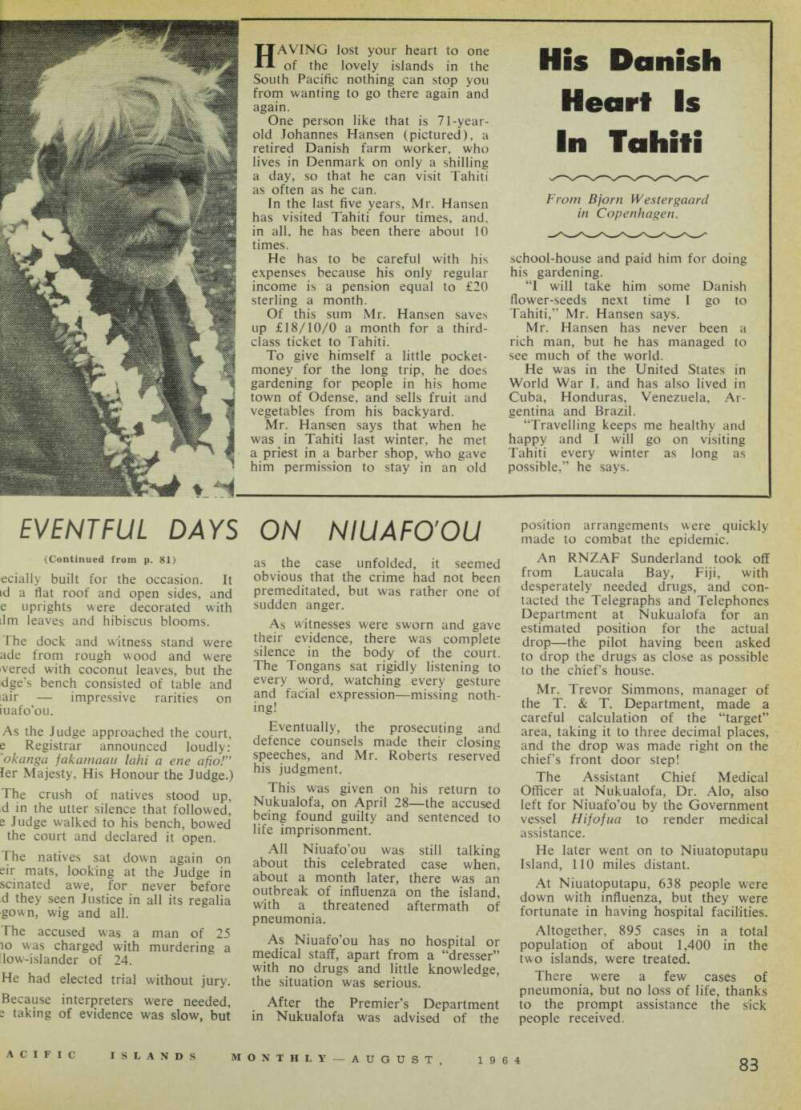
It was an RNZAF Sunderland such as this which made a mercy flight to Niuafo'ou in June.
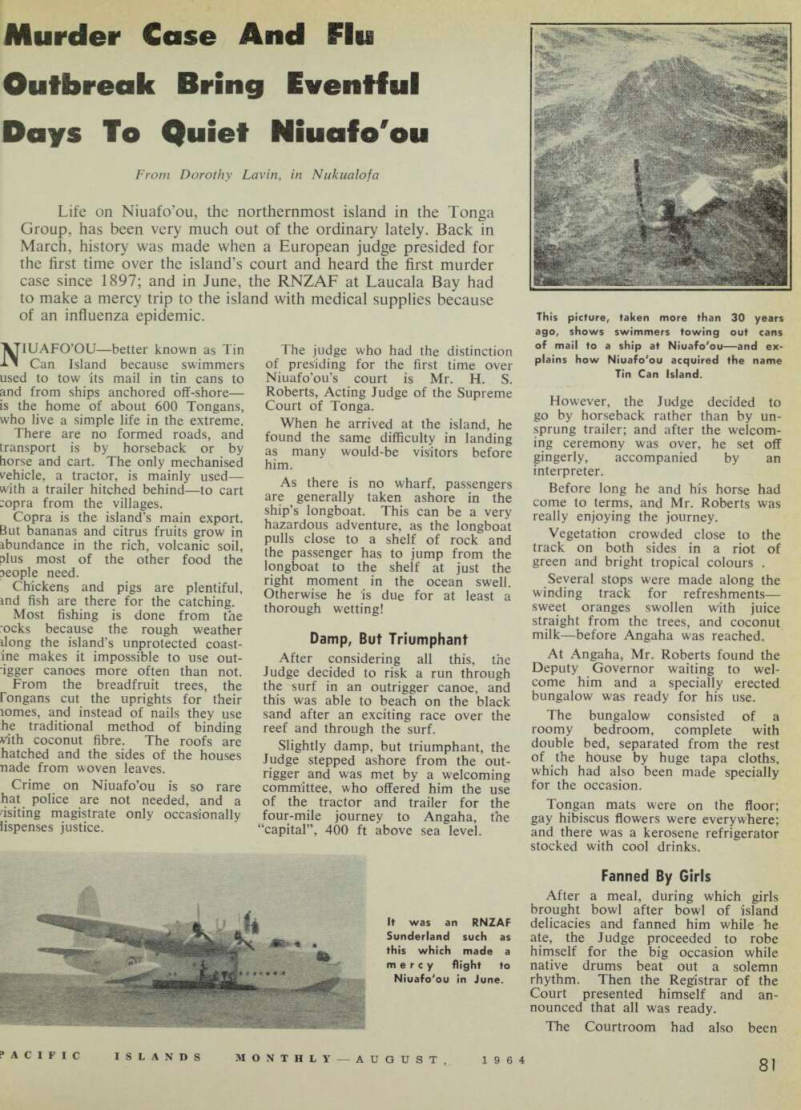
This picture, taken more than 30 years ago, shows swimmers towing out cans of mail to a ship at Niuafo'ou —and ex plains how Niuafo'ou acquired the name Tin Can Island.
ecially built for the occasion. It id a flat roof and open sides, and e uprights were decorated with ilm leaves and hibiscus blooms.
The dock and witness stand were ade from rough wood and were vered with coconut leaves, but the dge’s bench consisted of table and air impressive rarities on iuafo’ou.
As the Judge approached the court, e Registrar announced loudly: ’ okanga fakamaau lahi a ene afio!” ler Majesty, His Honour the Judge.) The crush of natives stood up, d in the utter silence that followed, s Judge walked to his bench, bowed the court and declared it open.
The natives sat down again on eir mats, looking at the Judge in scinated awe, for never before d they seen Justice in all its regalia gown, wig and all.
The accused was a man of 25 to was charged with murdering a !low-islander of 24.
He had elected trial without jury.
Because interpreters were needed, 2 taking of evidence was slow, but
as the ease unfolded if seemed
obvious th^the
premeditated, but was rather one of sudden anger.
As witnesses were sworn and gave . eir evidence, there was complete silence in the body of the court.
The Tongans sat rigidly listening to expression-missing noth , Eventually, the prosecuting and defence counsels made their closing speeches, and Mr. Roberts reserved hls Judgment. x T T his , as given - on his return to Nukualofa, on April 28—the accused bemg found guilty and sentenced to I,fe * m P ns o n ment.
All Niuafo’ou was still talking TY about this celebrated case when
outbreak oMnfluenza
a aftermath of nnonmlia 0163 enM aftermath of ii v Li in u m d • A xr r , , , . , Niuafoou has no hospital or medical staff, apart from a dresser with no drugs and little knowledge, the situation was serious.
After the Premier’s Department in Nukualofa was advised of the
position arrangements were quickly made to combat the epidemic.
An RNZAF Sunderland took off from Laucala Bay, Fiji, with desperately needed drugs, and con tacted the Telegraphs and Telephones Department at Nukualofa for an estimated position for the actual drop—the pilot having been asked to drop the drugs as close as possible to the chiefs house.
Mr. Trevor Simmons, manager of the T. & T. Department, made a careful calculation of the “target” area, taking it to three decimal places, and the drop was made right on the chiefs front door step!
The Assistant Chief Medical Officer at Nukualofa, Dr. Alo, also left for Niuafo’ou by the Government vessel Hifofua to render medical assistance.
He later went on to Niuatoputapu Island, 110 miles distant.
At Niuatoputapu, 638 people were down with influenza, but they were fortunate in having hospital facilities.
Altogether, 895 cases in a total population of about 1,400 in the two islands, were treated.
There were a few cases of pneumonia, but no loss of life, thanks to the prompt assistance the sick people received.