Century—Now They've
pp. 81-84 · Read in the full issue

People Lived There Last Century—Now They've Disappeared
An Account Of The Lost Islands Of Tuanaki And Victoria By W. H. Percival Of Rarotonga
Had the Cook Islands become British some years earlier than they did, they might have included the lost islands of Victoria and Tuanaki.
is still marked on some maps, but not on modern charts ;ed by local shipping.
William Marsters, who died in >46, aged 84, and who was the ruling ;ad of the Marsters clan at ilmerston Island, claimed to have sited Victoria Island. This was hen he was a young sailor in his unties —so his visit to Victoria ust have taken place in the early
Iso’S.
Marsters used to say that he was le of the crew of a ship that took Jew named Levy and a gang of itive labourers from Suva to Vic ria Island. They were employed by firm to plant Victoria in coconuts that future copra crops could be )tained.
Marsters described the island as iving a barrier reef enclosing a irrow lagoon, similar to some ands in the Lower Cook group.
It was not an atoll, but an island volcanic origin, fairly well-wooded th a type of puka tree and possess g a natural boat passage.
Marsters’ ship left Levy and his
men with three or four months’ food, but the firm went bankrupt and no boats called at Victoria for 18 months.
By that time the stranded men had eaten everything edible on the island, including the coconuts they had been sent to plant, and they were rescued on the point of starvation.
Some time after that Victoria Island disappeared, probably as a re sult of volcanic action.
No Sign in 1921 In early 1921, the well-known Islands skipper Captain “Andy”
Thomson sailed over the spot where the island had been marked on early charts. There was no sign of the island and a search over a wide area failed to reveal it.
The trading schooner Tagua, in which he sailed, was equipped with radio and an accurate chronometer, and Captain Thomson obtained his position exactly. He later reported the non-existence of Victoria to Ameri can marine authorities.
The other “lost” island that would
have come within the boundaries of the Cook Group was called Tuanaki.
It was said to be some 200 miles south or south-west of Rarotonga and to consist of three low, thickly inhabited islands within a reef.
Two native seamen claimed to havq seen Tuanaki from whaling vessels, and one of them said that he spoke to the people, who resembled Mangaians in dress and customs. This was in the 1840’s.
The natives of Tuanaki told him they had heard of the overthrow of idolatry on Rarotonga and Mangaia, and were eagerly awaiting a visit from the missionaries.
In 1844, the Rev. George Platt, in command of a small missionary schooner, searched for Tuanaki with out success. During the same year, the son of the missionary-explorer John Williams did the same, also without success.
Before starting his search, the younger Williams called at Aitutaki, where he interviewed a man named Soma, who claimed to have gone
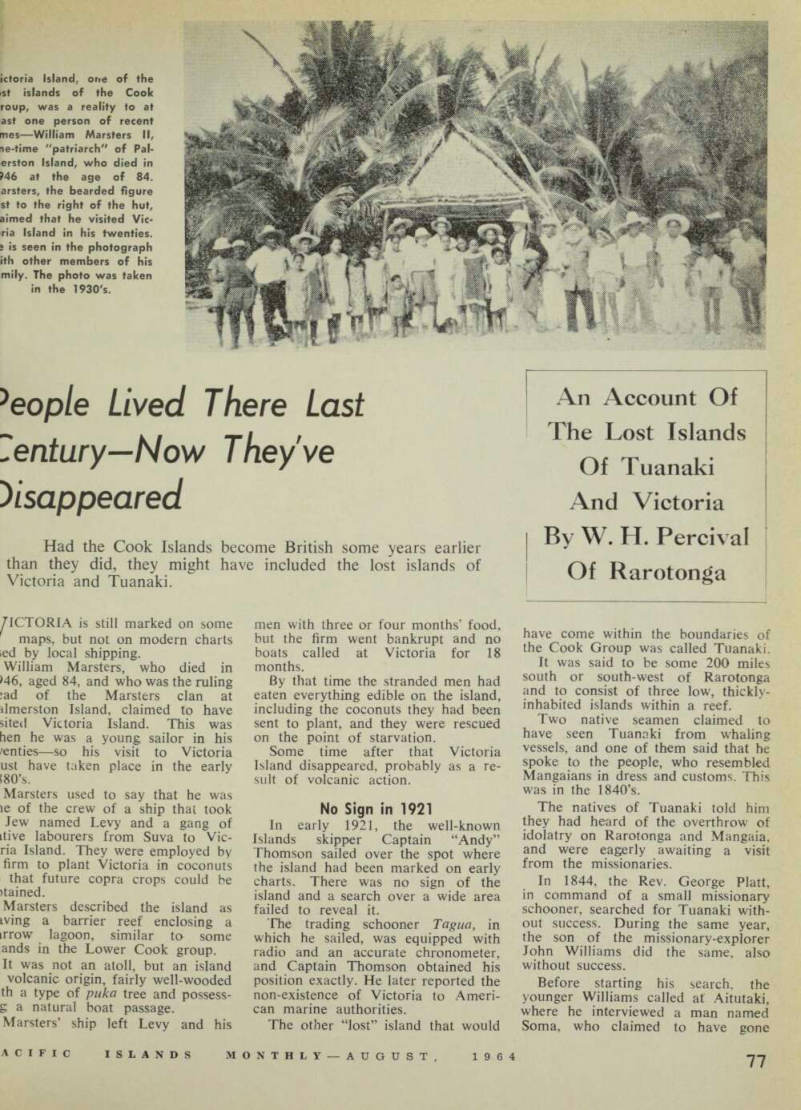
[?]ictoria Island, one of the [?]st islands of the Cook roup, was a reality to at ast one person of recent mes—William Marsters 11, fie-time "patriarch" of Pal erston Island, who died in [?]46 at the age of 84. [?]arsters, the bearded figure [?]st to the right of the hut, [?]aimed that he visited Vic [?]ria Island in his twenties. [?]is seen in the photograph [?]ith other members of his [?]mily. The photo was taken in the 1930'5.
ore at Tuanaki. Soma’s story was jrpreted and written down on the t. ►oma said: “Two years have passed :e I saw that island. We went her by way of Rurutu Island, and m we found it, our captain rched for the entrance and then r ered a boat into which we tended. There were six of us, the tain making seven.
"House Full Of Men"
When we got ashore we found no on the beach, so the captain 1 to me ‘Go inland and search for people. If you find them, return !.* The captain gave me a sword.
When I reached some way inland w a house which was full of men. vas the house of the chief. The f asked me, ‘Whence do you e, from Araura?’ (This is the native name for Aitutaki, still wn today, but seldom used). [ replied, ‘Yes.’ ‘Come inside the house,’ the chief 5o I went inside. There were 2 but men there, no women, as have a separate house. After d sat down the chief asked again: you come from Araura?’ ~o that I replied, ‘I come from jra.’ ‘Where is the captain of your v told him he was with the boat, is afraid lest you should kill him.’
We do not kill men. We only v to dance and sing. We v nothing of war.’ then returned to the captain asked, ‘How is it?’
They are all there in a house.’
Why do they stay there?’
I do not know.’
'he captain then went inland with taking with him some scissors, and headdresses, and then ed the house and presented the les to the chief. The captain I the chief his name, le replied, ‘Maeva-rua. Tuikura y name, from Rarotonga.
Six Days Ashore he captain and I slept there that , whilst the boat returned to the taking some food—fowls, pigs, and bananas. We were six days r e there. he people are exactly like us. * water is scooped up in a bowl, the leaf of the giant taro. Their zt is that of Mangaia, and they the tiputa (poncho-like garment : of tapa) and use the same kind ms as at Mangaia.” s Mangaia lies 110 miles south from Rarotonga and Tuanaki (Over)
was roughly 200 miles south or sou west of Rarotonga, Mangaia i Tuanaki must have been close gether).
Having heard Soma’s story, Rev. John Williams, Junior, sai off in search of Tuanaki.
On board his ship was a nal convert to Christianity called Man who was to stay at Tuanaki and to convert its people. But they ne reached the island—if, in fact, it s existed.
During the voyage, a violent stc was encountered. Heavy winds i seas snapped a boom and one of masts; Maretu became seriously and the attempt to find Tuanaki 1 to be abandoned.
No one is known to have visi Tuanaki after Soma and his capt spent six days there in 1842, sc cannot be stated for certain wl the island slid beneath the wa> leaving no trace of its existence.
However, among the scanty reco of the period is one that mentii an island that disappeared within modern boundaries of the Cc Group.
A judge, J. A. Wilson, is repor to have said: “A trading vessel fr Auckland was used at one time the forties to visit an island, the ex position of which was kept seci But on a subsequent visit it had ( appeared.”
Position Unknown The Rev. W. W. Gill, a pion missionary in the Cook Islands, s in his Gems From The Coral Islan published in London in 1856, tl Tuanaki was known by tradition all the islands of the Cook Groi But it had not then been discovei by Europeans, and the missionai could not obtain its exact position Rarotongan tradition says i Rarotongans of the pre-Christian < used to visit Tuanaki in their s going canoes, and that the voyi used to take two days and one' nig There seems to be no doubt the fore that Tuanaki did once exist, 1 there is possibly less certainty ab( Victoria Island.
Yet Victoria’s position was ported by somebody with suffice authority for cartographers to inclu it in their maps—such as the 19 edition of Phillips’ Handy Volui Atlas of the World.
Perhaps some PIM reader m know who discovered it, or, at le? how it came to get on the maps.