[?]ed Hargesheimer
pp. 31-33 · Read in the full issue
[?]eeps His Promise
EVER before, even in wartime, had the little village of Evase the coast of New Britain seen h a performance.
Tie trees trembled and the flying
foxes flew from the branches with an angry flapping of their leathery wings.
Startled parrots shrieked from the same trees and a few not-too-con fident natives ran for shelter.
The cause of it all was a thunder ing twin-jet bomber from the United States Navy which dived on Evase waggling its wings and laying a pencil of black smoke and white vapor.
Down below the man who started it all was trying to make a speech, but he had to give up when the jet drowned his voice.
“That darned thing is taking over the ceremony” he muttered with a rich American accent.
The occasion was the official open ing of the Airmen’s Memorial School in the Australian Trust Territory of New Britain. Twenty-one years earlier the native people of the area had saved the life of Major Fred Hargesheimer, an American flier whose reconnaisance aircraft was shot down during the Pacific War.
At the risk of having their heads cut off by the Japanese the village people cared for Hargesheimer for five months until an Australian patrol arranged his escape in an American submarine.
Fred Hargesheimer never forgot what the people did for him, and he sponsored a fund which raised more than $17,000. The money was used to build a school which went into operation at Evase early this year.
By aeroplane and ship a big crowd of visitors came to Evasee for the official opening of the school on July
11. There was Hargesheimer himself (the RAAF flew his there) and Air- Commodore W. Townsend, RAAF, whose life had also been saved by the natives of New Britain during the war.
The Papua-New Guinea Director of Native Affairs, Mr. J. K. McCarthy, whose splendid war record in New Britain is well known, was another visitor. Also at the opening was Mr. Matt Foley, of Rabaul, who as a signals corporal had been in the party which found Hargesheimer, and whom the native people still remem bered as “Master Wireless”.
America was officially represented by the Air Attache to the U.S.
Embassy in Australia, Colonel H.
Ottaway.
Arangements had been made for a U.S. Navy Sky Warrior bomber to make a couple of passes over the school before the ceremony began.
The aircraft arrived on time from Guam, via Townsville, but the crew got carried away by the occasion.
Time and time again the jet roared over the crowd, sometimes little more than 100 feet above the ground.
Speeches were drowned and the school children (140 of them) broke ranks to get a better look.
Ambitious Dream But Fred Hargesheimer did not mind. For him it was the end of a long and ambitious dream to return with something tangible for the people who had saved his life.
Here on PIM we have known Fred Hargesheimer for years as a smiling, friendly and modest fellow, who has achieved his purpose despite odds that would have been overwhelming to lesser men. His particular strength is his sound common sense.
Fred has always been aware for instance that the creation of his school needed careful handling if it was to avoid becoming the rallying point for a new cargo cult. He wanted no cry of “The Yanks Are Back!” and steadfastly stood against native suggestions that the school should be staffed by American teachers, or have other American bias.
It was sufficient for Fred to have collected the money for the school in America (a few dollars here, a decent-sized donation there) and to have seen it built in an area where it would do the most good. (For idealistic reasons it would have been nice to have put the school in the actual village which succoured him, but he insisted that it be placed in an area of larger population, 30 miles away.) Not even Fred is able to say just
what status the school has. It was built by American money, is being operated by the Methodist Mission (which has put three New Guinea teachers in it) but the teacher-incharge, Jim Bye, is provided by the P-NG Education Department.
Fred got the idea of building the school after he made a return visit to New Britain in 1960. It took him three years to collect the money back home in the States, and then last year he returned again with his son to get the school built, because somewhere along the line things had got bogged down. Fred arranged for the timber and for the builder and stayed around for six weeks helping to organise the local labour.
Fred glosses over this part of his interest in the school, but there are a number of people in the Islands who are still annoyed that Fred
Hargesheimer had to make a special trip from the US merely to get the whole project off the ground. A little more activity should have been displayed at the New Britain end, they feel.
Said a former wartime Coast watcher in the New Britain area: “We learned about Fred’s building problems too late. There are a dozen of us up that way who would have got off our bottoms and got the job done for Fred. He’d done enough without having to carry the bricks too!”
But since Fred’s interest in the school hasn’t waned there is still plenty of time for local people to get off their bottoms and give the scheme an added push. Fred has now gone home, but he has plans to provide the school with private boarding facilities, and a medical aid post for the locals.
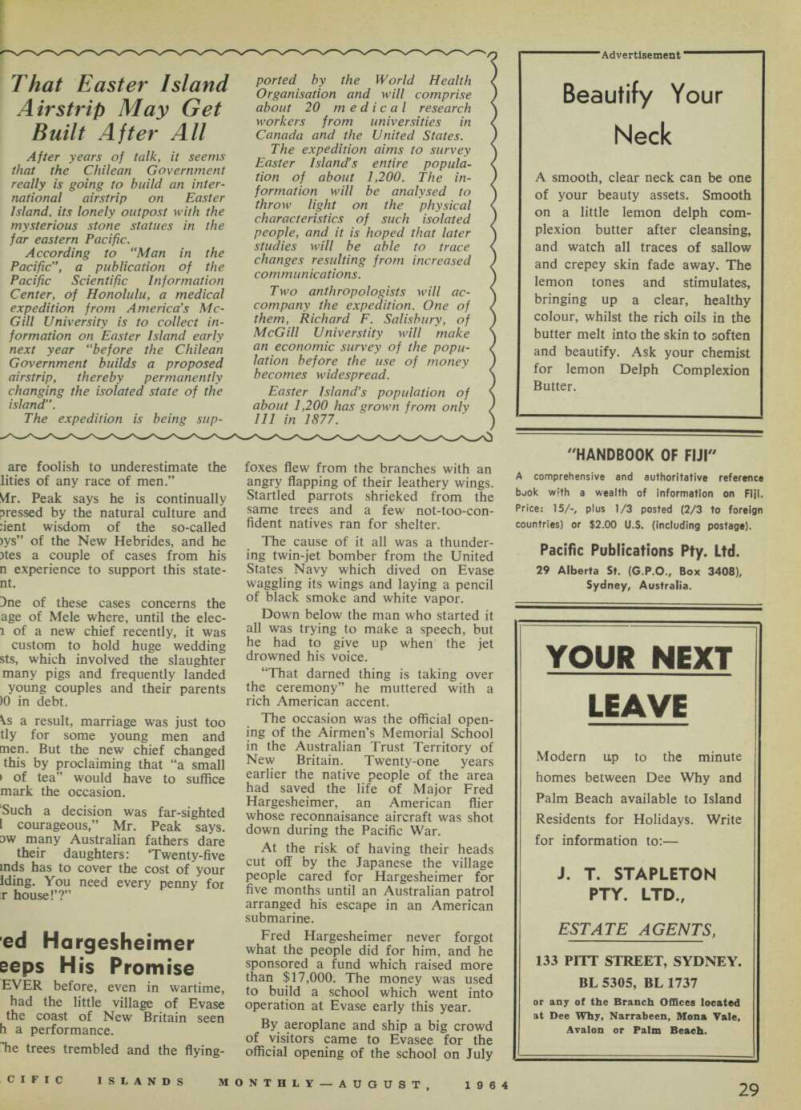
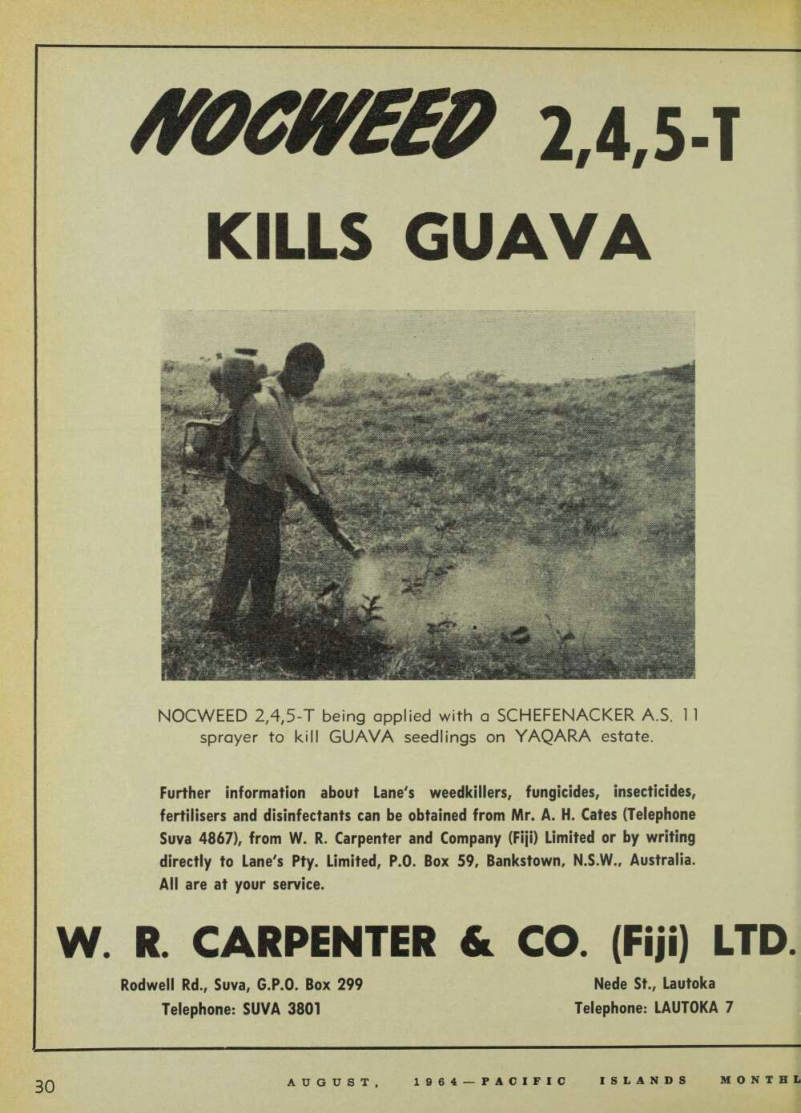
Handshake Reaches
A cross 20 Years
At the dedication of the Air men’s Memorial School, Evase, in July, Air Commodore W. E.
Townsend, RAAF, and Mr. Fred Hargesheimer, now with Reming ton Rand, Minnesota, shake hands across the years. The last time they met in the New Britain jungle was in 1943 (right) when Towns end was a Wing Commander and Hargesheimer a Major with the US Air Corps, and both had been shot down. They have kept in touch and are firm friends. Hargesheimer, with Townsends support, has re paid his debt to the New Guineans who, he says, saved his life.