Tropicalities
p. 29 · Read in the full issue
bout 40 men and women in Rabaul have already taken advantage a relaxation in Australia’s immigration policies which has emitted Australian citizenship for certain people of part-native traction living in Papua-New Guinea.
kTHER applications are still under * consideration, and there is every lication that Australia has taken step (not before time) which has en met with appreciative approval.
The main requirement to obtain jstralian citizenship for a mixed ce person is proof of some Euro an ancestry at the parent or grand rent level.
This is not always easy in a land iere records have been disrupted ■ war, where births were sometimes egitimate and unregistered, and iere children have grown up under e guidance of a mission with little lowledge of their parentage.
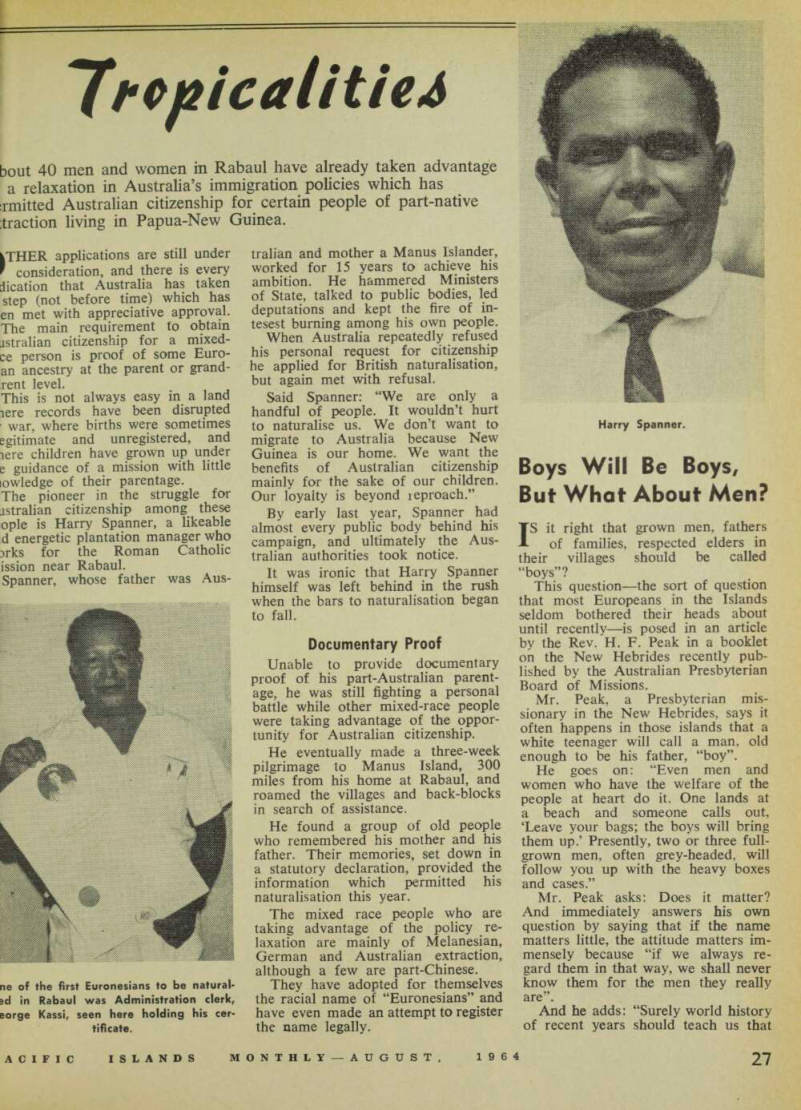
The pioneer in the struggle for astralian citizenship among these ople is Harry Spanner, a likeable d energetic plantation manager who irks for the Roman Catholic ission near Rabaul.
Spanner, whose father was Aus-
tralian and mother a Manus Islander, worked for 15 years to achieve his ambition. He hammered Ministers of State, talked to public bodies, led deputations and kept the fire of in tesest burning among his own people.
When Australia repeatedly refused his personal request for citizenship he applied for British naturalisation, but again met with refusal.
Said Spanner: “We are only a handful of people. It wouldn’t hurt to naturalise us. We don’t want to migrate to Australia because New Guinea is our home. We want the benefits of Australian citizenship mainly for the sake of our children.
Our loyalty is beyond reproach.”
By early last year, Spanner had almost every public body behind his campaign, and ultimately the Aus tralian authorities took notice.
It was ironic that Harry Spanner himself was left behind in the rush when the bars to naturalisation began to fall.
Documentary Proof
Unable to provide documentary proof of his part-Australian parent age, he was still fighting a personal battle while other mixed-race people were taking advantage of the oppor tunity for Australian citizenship.
He eventually made a three-week pilgrimage to Manus Island, 300 miles from his home at Rabaul, and roamed the villages and back-blocks in search of assistance.
He found a group of old people who remembered his mother and his father. Their memories, set down in a statutory declaration, provided the information which permitted his naturalisation this year.
The mixed race people who are taking advantage of the policy re laxation are mainly of Melanesian, German and Australian extraction, although a few are part-Chinese.
They have adopted for themselves the racial name of “Euronesians” and have even made an attempt to register the name legally.
ne of the first Euronesians to be natural ed in Rabaul was Administration clerk, eorge Kassi, seen here holding his cer tificate.