Rabaul Police
pp. 19-21 · Read in the full issue

Lessons Of The
Strike
At Rabaul, in the Australian
idministered Trust Territory of
Sew Guinea, there was trouble jarly in July among the native police who make up the ranks of
he Royal Papua and New
Guinea Constabulary.
rHIRTY police went on strike during a sixteen-hour period, and ibout 50 police (including the trikers) were involved in a dis urbance which preceded the strike, ndustrial claims from the police >recipitated the strike.
The newspapers of the day variously described the incident as ‘riot”, “racial demonstration” and ‘rebellion”.
Any suggestion of rioting is un rue, and can be dismissed without ;omment. However, the suggestions ►f racial demonstrations and rebellion ire at least worthy of some con ideration.
The Papua-New Guinea police orce is constituted in the military tyle and carries the label “Royal” in ront of its name.
Under these circumstances the igorous and vociferous refusal of the anks to carry out the orders of heir officers is, indeed, a type of ebellion in the technical sense. In he wider and more general sense of tie term, however, the Rabaul isturbance was not a rebellion.
From the racial point of view the olice strength at Rabaul consists of n all-native rank and file and an 11-European officer component, herefore when the ranks kicked ver the traces and shouted at their fficers, a situation existed in fact here black men were shouting at hite men and refusing to do what le white men wanted them to do.
Some Home Truths In the process it cannot be denied lat a few home truths slipped out, ut to consider the process as a race emonstration is stretching the issue.
Taken by and large, the fairest ascription of the Rabaul police in ident would be to call it an industrial emonstration which got out of hand nd which did produce some racial deling as a side issue.
The initial issue was one of dis sent among the ranks concerning leir employment and conditions.
They claimed that their quarters were like pigsties, that their meat rations were not fit to eat, that their pay was not high enough, and that their uniforms were not as good as those worn by the officers.
The police at no time lodged any formal submission of their grievances, and this told heavily against them in subsequent events. Several of the officers must have been aware for some time however that all was not happy among the ranks.
Under these circumstances it seems a pity that some ex gratia attempt was not made by the officers to formalise the grievances before trouble occurred.
One policeman claimed later that the final straw was an unkindly cut from an officer of “All the money to run this country comes from Aus tralia, so you will d well take what you get and like it”.
The trouble came when police for
a 4 p.m. to midnight shift refused to work and became abusive when ordered to do so.
After a shouting match in which they gave vent to their grievances the men dispersed into the streets and subsequently spent the night in their barracks refusing to work. Some men from the following shift also went on strike and there were attempts to intimidate men who were prepared to work.
No Rioting, No Damage
Groups of civilian natives, aware that the police had internal problems, began yah-hooing in the streets. Two groups tried to stop cars driven by European women, but it seems likely that only two of the striking police were involved in any of the street incidents.
There was no rioting and no damage to property, althought it is problematical what would have hap pened to the women drivers if their
ars had in fact been stopped.
By midday on the following day ie police were back on duty, (though the situation continued to ause concern for several days.
The Papua-New Guinea Police lommissioner, Mr. C. Normoyle, ew to Rabaul. Four days later he ddressed a full-scale parade of more lan 170 men in which he delivered formal reprimand to the police ivolved in the incident.
He announced later that no further unishment was considered necessary, s a spokesman for the men had pologised.
The people of Rabaul felt more oncern over Mr. Normoyle’s attitude lan they had over the actual in idents. There was a general feeling lat greater firmness —even sacking ie ringleaders—would have been the nly way to avoid a repetition of rouble.
No one denied the rights of the olice to express industrial grievances indeed there was considerable sup ort for the grievances) but few eople could stomach the manner in ffiich the police claims had come o light.
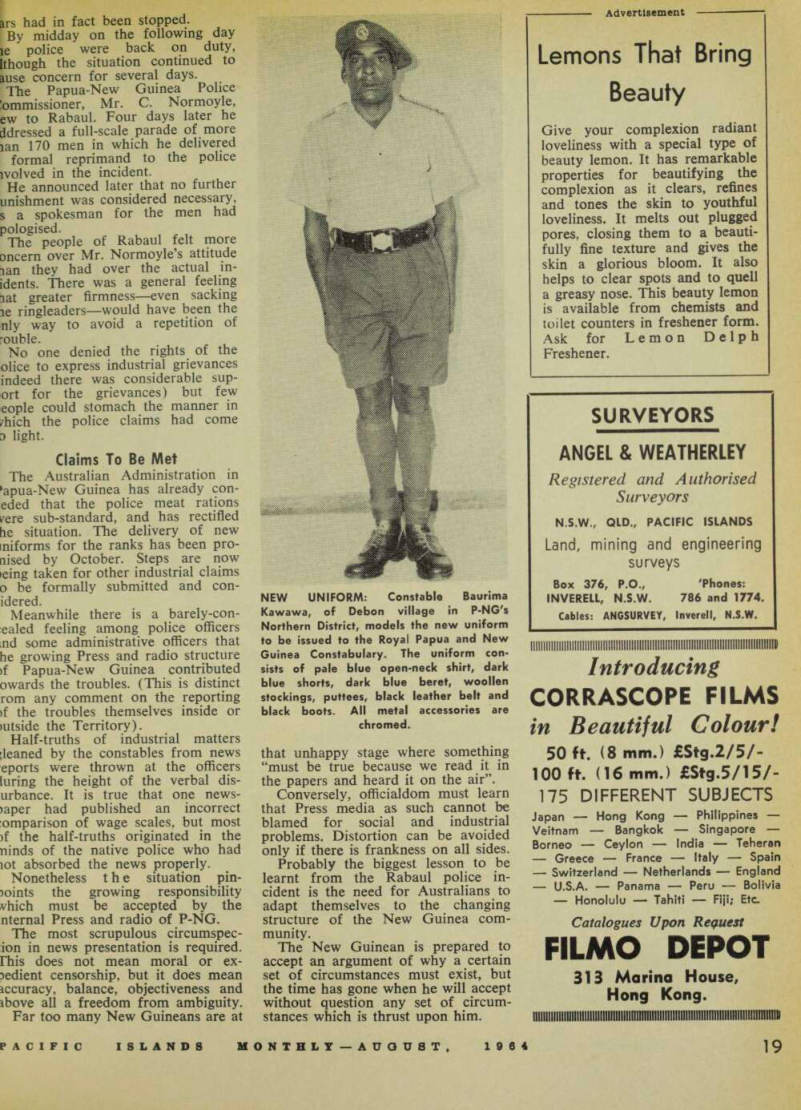
Claims To Be Met The Australian Administration in *apua-New Guinea has already con eded that the police meat rations /ere sub-standard, and has rectified he situation. The delivery of new iniforms for the ranks has been pro mised by October. Steps are now icing taken for other industrial claims o be formally submitted and con idered.
Meanwhile there is a barely-con ealed feeling among police officers nd some administrative officers that he growing Press and radio structure >f Papua-New Guinea contributed owards the troubles. (This is distinct rom any comment on the reporting >f the troubles themselves inside or »utside the Territory).
Half-truths of industrial matters [leaned by the constables from news eports were thrown at the officers luring the height of the verbal dis urbance. It is true that one news >aper had published an incorrect :omparison of wage scales, but most )f the half-truths originated in the ninds of the native police who had lot absorbed the news properly.
Nonetheless the situation pin points the growing responsibility vhich must be accepted by the nternal Press and radio of P-NG.
The most scrupulous circumspec ion in news presentation is required.
Phis does not mean moral or ex pedient censorship, but it does mean accuracy, balance, objectiveness and above all a freedom from ambiguity.
Far too many New Guineans are at
that unhappy stage where something “must be true because we read it in the papers and heard it on the air”.
Conversely, officialdom must learn that Press media as such cannot be blamed for social and industrial problems. Distortion can be avoided only if there is frankness on all sides.
Probably the biggest lesson to be learnt from the Rabaul police in cident is the need for Australians to adapt themselves to the changing structure of the New Guinea com munity.
The New Guinean is prepared to accept an argument of why a certain set of circumstances must exist, but the time has gone when he will accept without question any set of circum stances which is thrust upon him.
NEW UNIFORM: Constable Baurima Kawawa, of Debon village In P-NG's Northern District, models the new uniform to be issued to the Royal Papua and New Guinea Constabulary. The uniform con sists of pale blue open-neck shirt, dark blue shorts, dark blue beret, woollen stockings, puttees, black leather belt and black boots. All metal accessories are chromed.