New Guinea Is Going
pp. 15-18 · Read in the full issue
It’s Time We Knew Where New Guinea Is Going
• Some Pertinent Comments On The New Guinea
Scene By Stuart Inder
The time is near, if it hasn’t already arrived, when Aus tralia has to make an announcement about the political future of Papua-New Guinea.
IWO million people, including - 28,000 whites, aren’t very much nger going to be content with a t of airy fairy generalisations about adependence” and “educating the sople to a point where they can de- Je for themselves.”
There are 57 varieties of independ ce.
And who, anyway, decides when e point is reached for them to de le for themselves?
It is too early to formulate details, it not for a general outline to be etched out so that thinking on the icstion can be tested. A recent uple of weeks in Papua-New Guinea s left me in no doubt of that.
For some years now there have en statements by the more think g P-NG residents about the need lay down a political pattern. But w everybody appears to feel the ed for something more specific.
“The Territory is stretched tight e a piece of elastic,” said a leading clesiastic. “We can’t stretch any rther, but where are we headed?”
Colonel J. K. Murray, P-NG Ad inistrator under the pre-Menzies abour) Government and one of the P’s invited to attend the opening the new House of Assembly, mdered out loud to me whether ybody officially had yet faced the uation of two million New jineans being allowed entry to Aus dia—or the situation created by o million New Guineans not being owed entry to Australia.
Former Patrol Officer Barry Hollo ly, now a member of the House Assembly, got to his feet on the estion of New Guinea’s future a uple of times during the session. lan Downs was another who jched on it—pushing the barrow r Federalism. He has since pub hed an excellent editorial in the ghlands Bulletin arguing that if JW Guinea is to succeed in self vernment the people need the as rance of continued association with
Australia to guarantee their security and human rights.
The wish of New Guineans to re tain this Australian protection, he says, is now “overwhelmingly clear”.
And it is clear that most New Guineans see their future as being closely connected with Australia. So what are we waiting for?
Are we waiting for organised agitation from outside directed at tell ing the New Guineans they don’t want what they want at all?
Shades of West New Guinea and Malaysia!
Barry Holloway’s solution is for the Government to set up a com mission to look into the problems and round-up some ideas. He stressed it was important to get the right man to head the commission.
He named no names but he had in mind that of Professor J. W.
Davidson, Professor of Pacific History at the Australian National University, Canberra.
Jim Davidson is one of those too rare birds, the practical academic. He proved himself with the West Samoan Constitution and has recently taken a leading part in giving the Cook Islands a practical plan for self government.
Mr. Barnes, meet Professor David son! ☆ ☆ ☆ ALTHOUGH Australian Pressmen have not been able to gain entry to Indonesian-controlled West New Guinea (their visa applications are not refused, they simply fail to get granted) Indonesia has now sent one of her Pressmen to Papua-New Guinea. I gather he had no trouble about his permit, so I hope our gen erosity will have its own reward.
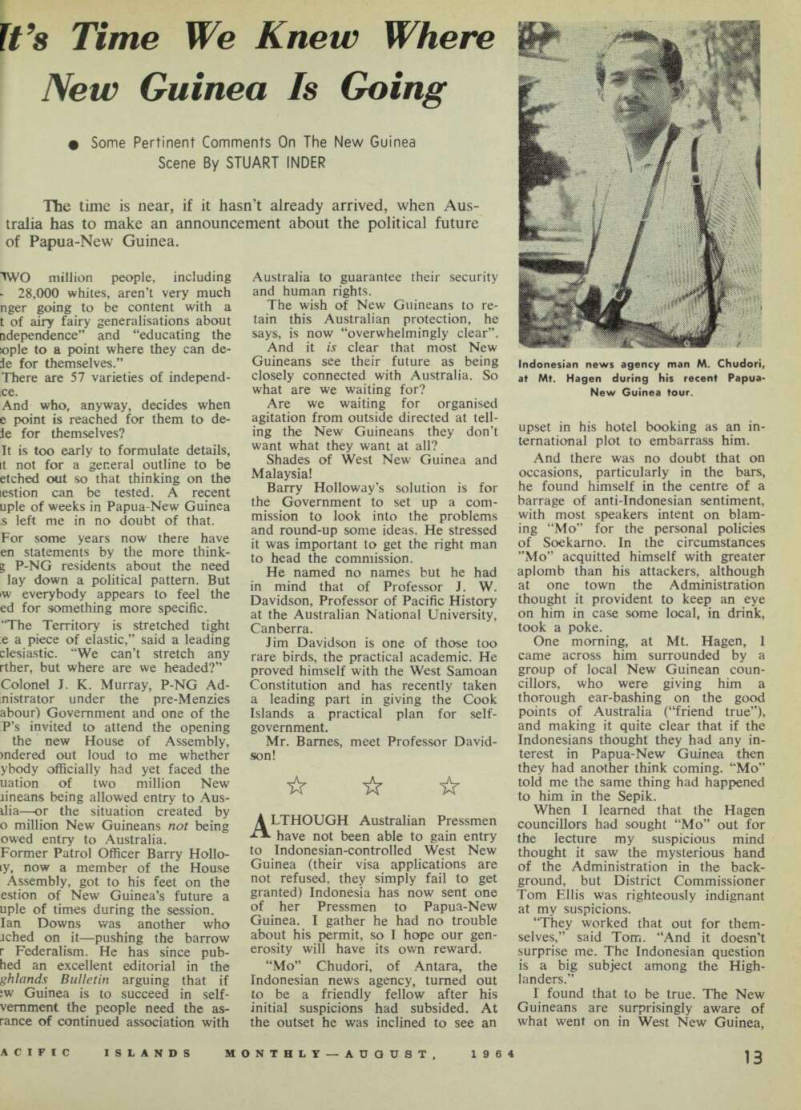
“Mo” Chudori, of Antara, the Indonesian news agency, turned out to be a friendly fellow after his initial suspicions had subsided. At the outset he was inclined to see an
upset in his hotel booking as an in ternational plot to embarrass him.
And there was no doubt that on occasions, particularly in the bars, he found himself in the centre of a barrage of anti-Indonesian sentiment, with most speakers intent on blam ing “Mo” for the personal policies of Soekarno. In the circumstances ”Mo” acquitted himself with greater aplomb than his attackers, although at one town the Administration thought it provident to keep an eye on him in case some local, in drink, took a poke.
One morning, at Mt. Hagen, 1 came across him surrounded by a group of local New Guinean coun cillors, who were giving him a thorough ear-bashing on the good points of Australia (“friend true”), and making it quite clear that if the Indonesians thought they had any in terest in Papua-New Guinea then they had another think coming. “Mo” told me the same thing had happened to him in the Sepik, When I learned that the Hagen councillors had sought “Mo” out for the lecture my suspicious mind thought it saw the mysterious hand of the Administration in the back ground, but District Commissioner Tom Ellis was righteously indignant at my suspicions.
“They worked that out for them selves,” said Tom. “And it doesn’t surprise me. The Indonesian question is a big subject among the High landers.”
I found that to be true. The New Guineans are surprisingly aware of what went on in West New Guinea,
Indonesian news agency man M. Chudori, at Mt. Hagen during his recent Papua- New Guinea tour.
I feel strongly that the Dutch juans weer sold down the river, f the Indonesians find their way the Highlands they will probably eaten. ☆ ☆ it ■IE Australia New Guinea Corporation is very active in the ritory, as it seeks out interests ing to share in the organisation. : planter who was approached I me that the corporation did not essarily want control of New nea investments —just a stake in n. here is no doubt that a new ction of capital, especially from ariety of sources, is going to help d up the Territory’s economy, and general publicity and interest in tralia can do nothing but good. ,t the same time I suspect the loration is finding some passive, lot active, resistance among the blished big firms. A lot of this ue to the burst of publicity the aoration got, which resulted in ly Australians believing that the blished firms had done nothing the Territory and that outside rests were left to do the “right g”. This not unnaturally has some New Guinea noses out of L was myself surprised to learn, e making some inquiries about new £250,000 luxury hotel to be ed in Lae shortly by Steamships ling Company, that Steamships in 18 months to last December, had sted £853,000 in additional assets ie Territory. his is by way of both new tal from shareholders and ghed-back profits, and the figure jfter their takeover of Colyer son (NG) Ltd., and of course n’t include the hotel, his effort hasn’t got a word of ial adoration or acclamation.
it it it
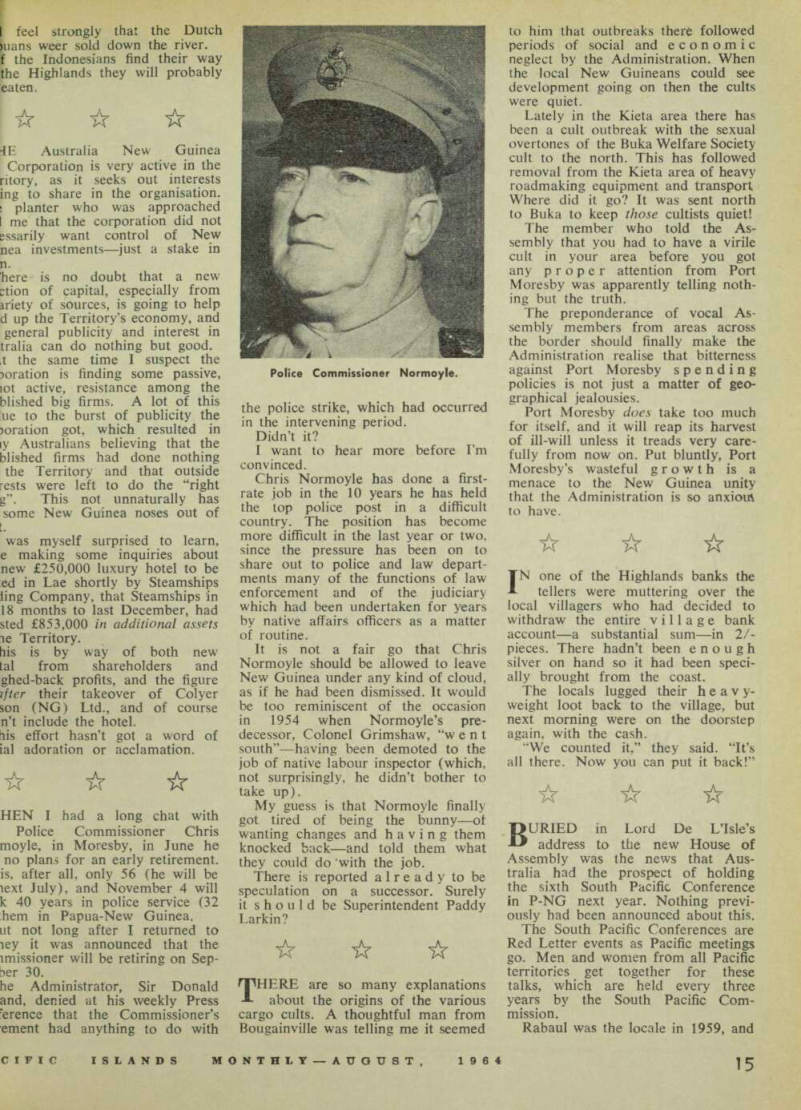
HEN I had a long chat with Police Commissioner Chris moyle, in Moresby, in June he no plans for an early retirement, is, after all, only 56 (he will be lext July), and November 4 will k 40 years in police service (32 hem in Papua-New Guinea, ut not long after I returned to ley it was announced that the imissioner will be retiring on Sep ber 30. he Administrator, Sir Donald and, denied at his weekly Press ? erence that the Commissioner’s ement had anything to do with
the police strike, which had occurred in the intervening period.
Didn’t it?
I want to hear more before I’m convinced.
Chris Normoyle has done a first rate job in the 10 years he has held the top police post in a difficult country. The position has become more difficult in the last year or two, since the pressure has been on to share out to police and law depart ments many of the functions of law enforcement and of the judiciary which had been undertaken for years by native affairs officers as a matter of routine.
It is not a fair go that Chris Normoyle should be allowed to leave New Guinea under any kind of cloud, as if he had been dismissed. It would be too reminiscent of the occasion in 1954 when Normoyle’s pre decessor, Colonel Grimshaw, “went south”—having been demoted to the job of native labour inspector (which, not surprisingly, he didn’t bother to take up).
My guess is that Normoyle finally got tired of being the bunny—of wanting changes and having them knocked back—and told them what they could do 'with the job.
There is reported already to be speculation on a successor. Surely it should be Superintendent Paddy Larkin?
i? it it
THERE are so many explanations about the origins of the various cargo cults. A thoughtful man from Bougainville was telling me it seemed
to him that outbreaks there followed periods of social and economic neglect by the Administration. When the local New Guineans could see development going on then the cults were quiet.
Lately in the Kieta area there has been a cult outbreak with the sexual overtones of the Buka Welfare Society cult to the north. This has followed removal from the Kieta area of heavy roadmaking equipment and transport Where did it go? It was sent north to Buka to keep those cultists quiet!
The member who told the As sembly that you had to have a virile cult in your area before you got any proper attention from Port Moresby was apparently telling noth ing but the truth.
The preponderance of vocal As sembly members from areas across the border should finally make the Administration realise that bitterness against Port Moresby spending policies is not just a matter of geo graphical jealousies.
Port Moresby does take too much for itself, and it will reap its harvest of ill-will unless it treads very care fully from now on. Put bluntly, Port Moresby’s wasteful growth is a menace to the New Guinea unity that the Administration is so anxiom to have.
it it it
IN one of the Highlands banks the tellers were muttering over the local villagers who had decided to withdraw the entire village bank account—a substantial sum—in 27pieces. There hadn’t been enough silver on hand so it had been speci ally brought from the coast.
The locals lugged their heavy weight loot back to the village, but next morning were on the doorstep again, with the cash.
“We counted it,” they said. “It’s all there. Now you can put it back!” ☆ ☆ ☆ BURIED in Lord De L’lsle’s address to the new House of Assembly was the news that Aus tralia had the prospect of holding the sixth South Pacific Conference in P-NG next year. Nothing previ ously had been announced about this.
The South Pacific Conferences are Red Letter events as Pacific meetings go. Men and women from all Pacific territories get together for these talks, which are held every three years by the South Pacific Com mission.
Rabaul was the locale in 1959, and
Police Commissioner Normoyle.
at the Pago conference in 1962 it was generally assumed that Papeete would be the scene in 1965.
But France’s nuclear bomb plans in that area, with accommodation at a premium because of defence per sonnel, seem to have put paid to that idea.
Lae looks like being the site. The delegates would take over the tech nical school, which is being expanded. ☆ ☆ ☆ WHEN Moresby people talk of the “Top Pub” they mean the Hotel Papua. The title was never intended to identify the Papua’s position in the ranks of the Pub Peerage, despite what visitors think, but to distinguish it from the Hotel Moresby down the hill, which is the “Bottom Pub”.
Nevertheless, rightly or wrongly, the Top Pub has the reputation of being the top pub, and as a result it has had among its clientele in recent years numbers of New Guineans brought to Port Moresby to attend the Legislative Council as members or observers, or to take part in VIP outings.
They have been billeted in the Top Pub not necessarily because they wanted to go there but because the Administration was anxious to stress (to whom?) the lesson of equality.
Now there is a New Guinean majority in the House, and every body has £5/5/- a day and is expected to make his own arrange ments, it will be interesting to see who stay at the Top Pub by choice.
Some who were booked in there at the inaugural session didn’t last
the distance, for it didn’t take them long to work out that with a tariff between £4/10/- to £5 a day (not including your laundry) there is no change from £5/5/- at the Top Pub.
Zure Zurecnuoc, an able man from Finchhafen who is now Under secretary for the Treasury, was one who booked out. He moved in with friends among the Administration drivers, and what he saw there caused him to become vocal in the House.
The drivers did not have a kitchen and were living “like pigs and dogs”, he said. If it was all right for them to drive “very important people” in big shiny cars then it was all right for them to be given decent living conditions.
If Zurecnuoc’s exposure achieves anything for the Administration drivers I hope they appreciate that it’s partly because the Top Pub and equality are not necessarily synonomous terms! ☆ ☆ ☆ TN PlM’s pages we have noted be fore that while Japan couldn’t by force during the Pacific War achieve her dream of a Greater East Asia Co-Prosperity Sphere, she has managed to do pretty well for her self in recent years through peaceful trade penetration.
This was underlined in Moresby during the ceremonial opening of New Guinea’s new Parliament. When the Governor-General, in plumed hat, arrived, his limousine was preceded by two outriders from the Royal Papua and New Guinea Constabulary —both on Japanese motor bikes. ☆ ☆ ☆ TO end on the note I began with, if the Territory of Papua and New Guinea is to have an identity then the place has to have a name, and so have the people in it. Terri torians themselves have been arguing names for years without result, and a recent outbreak of weird suggestions hasn’t taken the problem any further.
Officially of course it is the Territory of Papua and New Guinea, and it will have to stay that way until offi cially it becomes something else. But we on PIM, who weep at “indigenes” and shudder at the current tongue twisting usage of “Papuans and New Guineans”, have finally settled for plain New Guineans—whichever side of that non-existent border they live.
Except when they live in trees, when they’re natives—with apologies to nobody. We’ve started from this issue.
And if you want our suggestion for a name for the combined Territory, here it is—New Guinea. After all, who else has it?