oroka's Colourful Show
pp. 139-141 · Read in the full issue

[?]n Again This Year
Although upwards of 60,000 natives are expected um out for this year’s Goroka Show (August 29-30), lay not be quite the Biggest Show of Earth. But it will ainly be amongst the highest in the South Pacific.
IROKA, in the Eastern High lands of New Guinea, is at a sant 5,200 feet, or just on a high. oroka, which inaugurated High s shows, has been in retirement the last couple of years, and Mt. sn has done the Show honours. of Goroka’s difficulty was loss i showground; but for months , native volunteers—2,ooo of i have turned up each Sunday— : helped hew out a new 27-acre and sow it to grass. By Show 2, everything will be in readiness, s usual, the accent at the Show be on the natives. The “talk” has idy gone all over the Highlands right down to the coast and, re groups have been practising ■ dances for months. Some of people who will attend will walk a week or more to get to Goroka once there will melt into the scape. o particular measures are taken iccommodate these thousands of fie although food is a different more important matter. It is ulated that 500 tons of kau-kau jet potato), will be needed to them over the two days—that ' lb per head per day.
New features at the Show this year will include a model native village, occupied under as normal living con ditions as possible; a conch shell band from the Morobe District; a zoo; a museum; an artificial lake; an archery competition; and a display showing how native weapons are made.
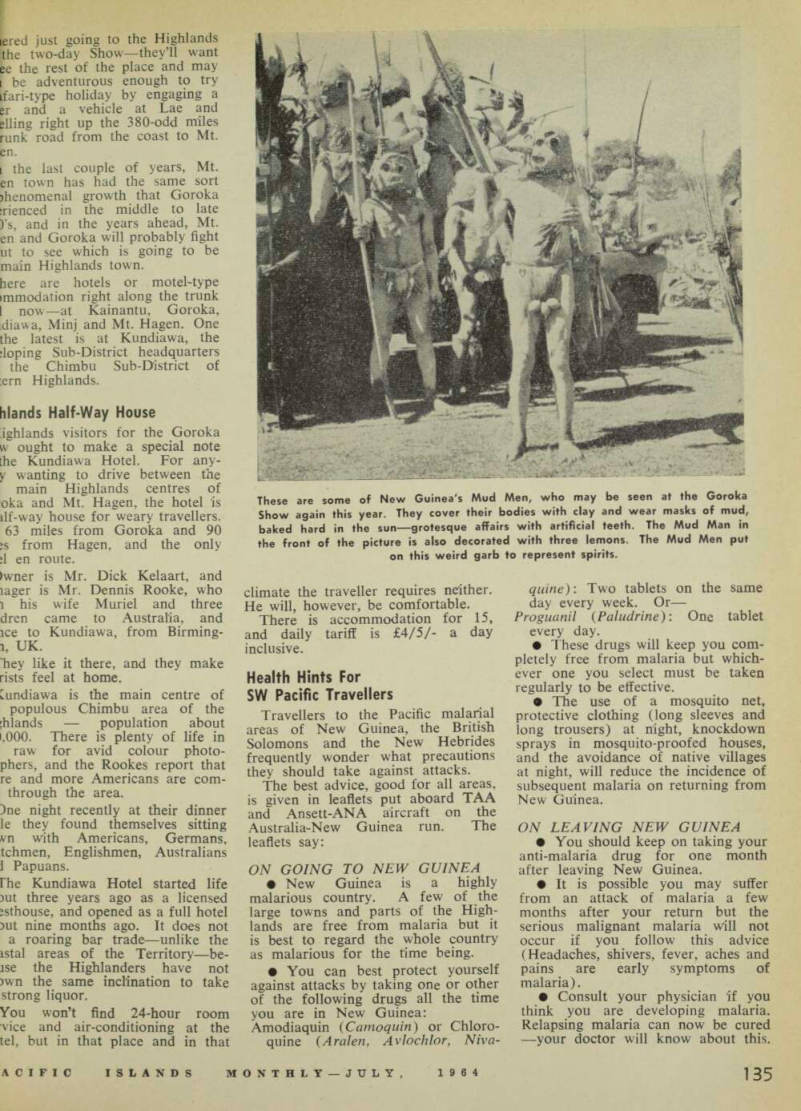
No doubt the celebrated “mud men” will again do their stuff and there will be the almost non-stop sing-sings provided by various groups—thousands of near-naked brown bodies, arrayed in kapul- fur neckpieces, shells, and flaming orange Bird of Paradise plumes, or blue, white and red feathered head dresses.
Although these people are less than a generation removed from savagery, and although the gathering consists of hundreds of different tribes who only a few years ago were in a state of perpetual tribal war with one another, there never have been any incidents at these Shows. They are the biggest spectacle that New Guinea puts on, providing a seething kaleidoscope of colour that tempts visitors to shoot off literally miles of colour-film.
There probably is nothing quite like the Goroka or Hagen Shows anywhere else on earth and they are given extra piquancy by the very fact that, in their freshness and spontaneity, anyway, their days are numbered by the march of civilisa tion.
Chartered planes from all over Papua-New Guinea will fly local Europeans to the Highlands for the Show and considerable numbers of overseas visitors are expected to be there.
Even so, it is expected that no more than 1,500 privileged beings
will see the two-day spectacle, and even this number will strain ac commodation to the limit.
Goroka’s two hotels haven’t a hope of coping with this number of visitors —nor have all the hotels in the High lands put together. However, some people will be accommodated privately and others will be en couraged to make a camping/picn'ic of it.
Local natives have been hard at work making palliasses, and all visitors can be sure of a welcome, food and somewhere to lay their heads.
Few overseas visitors will be
"Pacific Islands Monthly" is a member of the Australian National Travel Association and the Pacific Area Travel Association.
iered just going to the Highlands the two-day Show —they’ll want ee the rest of the place and may i be adventurous enough to try ifari-type holiday by engaging a er and a vehicle at Lae and elling right up the 380-odd miles runk road from the coast to Mt. en. [ the last couple of years, Mt. en town has had the same sort jhenomenal growth that Goroka irienced in the middle to late )’s, and in the years ahead, Mt. en and Goroka will probably fight ut to see which is going to be main Highlands town, here are hotels or motel-type immodation right along the trunk I now—at Kainantu, Goroka, idiawa, Minj and Mt. Hagen, One the latest is at Kundiawa, the sloping Sub-District headquarters the Chimbu Sub-District of :ern Highlands.
hlands Half-Way House
highlands visitors for the Goroka w ought to make a special note the Kundiawa Hotel. For any y wanting to drive between the main Highlands centres of oka and Mt. Hagen, the hotel is ilf-way house for weary travellers. 63 miles from Goroka and 90 ;s from Hagen, and the only ;1 en route.
Iwner is Mr. Dick Kelaart, and lager is Mr. Dennis Rooke, who i his wife Muriel and three dren came to Australia, and ice to Kundiawa, from Birming i, UK.
'hey like it there, and they make rists feel at home.
Lundiawa is the main centre of populous Chimbu area of the ;hlands population about i,OOO. There is plenty of life in raw for avid colour photo phers, and the Rookes report that re and more Americans are corn through the area.
Dne night recently at their dinner le they found themselves sitting vn with Americans, Germans, tchmen, Englishmen, Australians 1 Papuans.
Ihe Kundiawa Hotel started life iut three years ago as a licensed jsthouse, and opened as a full hotel iut nine months ago. It does not a roaring bar trade—unlike the istal areas of the Territory—be ise the Highlanders have not )wn the same inclination to take strong liquor.
You won’t find 24-hour room vice and air-conditioning at the tel, but in that place and in that
climate the traveller requires neither.
He will, however, be comfortable.
There is accommodation for 15, and daily tariff is £4/5/- a day inclusive.
Health Hints For SW Pacific Travellers Travellers to the Pacific malarial areas of New Guinea, the British Solomons and the New Hebrides frequently wonder what precautions they should take against attacks.
The best advice, good for all areas, is given in leaflets put aboard TAA and Ansett-ANA aircraft on the Australia-New Guinea run. The leaflets say:
On Going To New Guinea
• New Guinea is a highly malarious country. A few of the large towns and parts of the High lands are free from malaria but it is best to regard the whole country as malarious for the time being. • You can best protect yourself against attacks by taking one or other of the following drugs all the time you are in New Guinea: Amodiaquin ( Camoquin ) or Chloro quine ( Aralen, Avlochlor, Niva
quine): Two tablets on the same day every week. Or — Proguanil ( Paludrine ): One tablet every day. • These drugs will keep you com pletely free from malaria but which ever one you select must be taken regularly to be effective. • The use of a mosquito net, protective clothing (long sleeves and long trousers) at night, knockdown sprays in mosquito-proofed houses, and the avoidance of native villages at night, will reduce the incidence of subsequent malaria on returning from New Guinea.
On Leaving New Guinea
• You should keep on taking your anti-malaria drug for one month after leaving New Guinea. • It is possible you may suffer from an attack of malaria a few months after your return but the serious malignant malaria will not occur if you follow this advice (Headaches, shivers, fever, aches and pains are early symptoms of malaria). • Consult your physician if you think you are developing malaria.
Relapsing malaria can now be cured —your doctor will know about this.
These are some of New Guinea's Mud Men, who may be seen at the Goroka Show again this year. They cover their bodies with clay and wear masks of mud, baked hard in the sun —grotesque affairs with artificial teeth. The Mud Man in the front of the picture is also decorated with three lemons. The Mud Men put on this weird garb to represent spirits.