Pacific Commerce and Produce
pp. 127-130 · Read in the full issue
Copra Is King
In Booming
New Ireland
• But Rubber And Cocoa Get A Go, Too The coconut is king in New ;land. Planters have a faith in conuts probably not seen since
; early German times, and cer
nly their enthusiasm for copra greater than in any other dis
ct of Papua-New Guinea.
COCONUTS have been New Guinea’s stand-by for years, some districts have neglected m in the new enthusiasm for oa,” says Mr. Jim Grose, a lead- New Ireland planter who now resents the area in the new House Assembly. ‘Coconuts are virtually disease ;, don’t require much in the way factory equipment and can even id neglect. Much more could be le with them.”
Increasing Development
'Jew Ireland is doing much more h them.
'he district already produces 25 cent, of the Territory’s copra, in the last few years develop it has increased—not only with (anting, but many new plantings ight along the long (160 mile) t coast road. impressive number of planta is are native-owned.
Jew palms in all stages of develop it can be seen along mile after e of the road. im Grose’s enthusiasm for the ire of copra apparently rubbed on some members of the World ik survey team who visited the ritory last year, and whose report ■ be available in a month or so.
'he team members had long talks i Mr. Grose, and one section of r report, according to Canberra rces reported in PIM in June (p. , will suggest that much more can done to build up copra produc i, instead of neglecting it for new nour crops such as cocoa.
The New Ireland planters are probably luckier than most because the rhinocerous beetle is not yet as troublesome there as in other districts.
And other conditions are excellent.
New Ireland growers are just a little tired of the long neglect of their district on the ground that it is a backwoods outpost with com paratively poor conditions and no future.
They say it never was poor, and its future is almost here.
The few visitors who have seen it since the war have looked at the dying coconut palms within 40 miles of Kavieng, the main centre, and have decided that these represent the district.
Wrong Soil
“Coconuts like the soil near the sea,” says Mr. Grose, “and the habit on New Ireland in the past has been to plant them from the sea right back to the property line, on the higher ground, “But the soil as a rule was never right for them on the higher ground —too much clay—and consequently visitors driving down the road have tended to see only the weak or dying palms,”
These days, cocoa or rubber are replacing these old and poor stands, for the local planters certainly don’t make the error of neglecting every thing else for their copra. They say there is room for many things.
Jim Grose was the first to bring in rubber. He got the idea from Robin McKay, who has recently sold Aropa plantation, on the east coast of Bougainville, and who successfully grew rubber on Aropa for a number of years.
Jim Grose’s late father, planting pioneer Mr. W. E. Grose (who like his son was a member of the New Guinea legislature) planted some rubber just before the Pacific War, but wasn’t able to see it mature. The idea was neglected until 1961, when Jim put in some Malayan material.
He plans to have about 10,000 trees in the next 18 months.
Only Rubber
Mr. Ross Irvine, of Libba planta tion, about 80 miles from Kavieng, is concentrating wholly on rubber on his ex-service block. He has 80 acres in and is still going strong.
The rubber replaces old coconut stands.
Mr. Wally Lussick, of Kapsu plantation, is another man who is replacing old coconuts with rubber, although his property is not exclusively rubber.
Rubber takes about six to seven years to mature.
Both Jim Grose and his attractive wife, formerly Diana Stanfield, are Territory-born. Their plantation is Kamiraba, which is one of four plantations of Poliamba Estates, a family company of which Jim Grose is managing partner.
Lakuramau, Poliamba, Lossu and Kamiraba between them produce about 1,000 tons of copra a year and 100 tons of cocoa.
And production of both products is increasing—especially the coconuts!
Tuna Fishing Company To
Be Dissolved in Noumea
A COMPANY formed in Noumea just over 12 months ago by Taiyo Gyogyo, of Japan, and New Caledonian directors is to be dis solved, according to the Noumea newspaper Bulletin du Commerce.
Operating under the name of Societe I’Ocean, the company had a fleet of tuna boats fishing in New Caledonian waters. The fish were brought into Noumea and stored aboard the refrigerated vessel Eiyo Maru, anchored in a bay of Noumea Harbour. The catch was picked up periodically by Japanese vessels and taken to the United States and Japan.
Bulletin du Commerce says that the company is being dissolved be
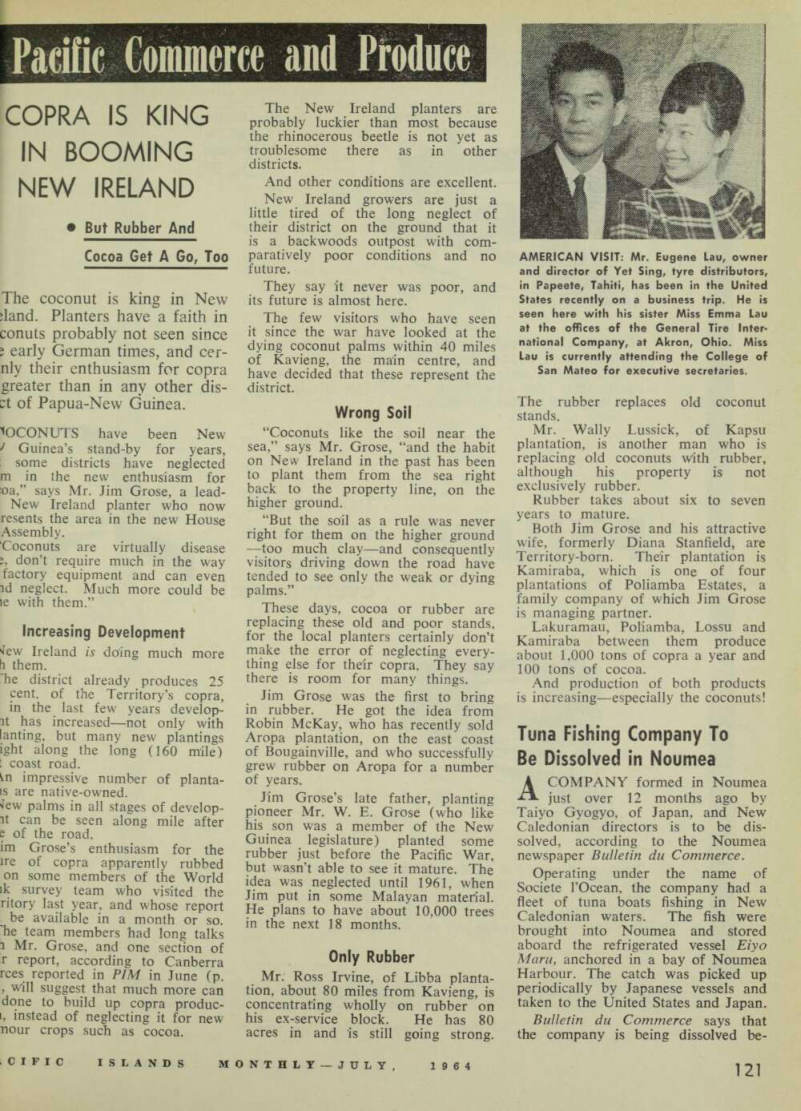
AMERICAN VISIT: Mr. Eugene Lau, owner and director of Yet Sing, tyre distributors, in Papeete, Tahiti, has been in the United States recently on a business trip. He is seen here with his sister Miss Emma Lau at the offices of the General Tire Inter national Company, at Akron, Ohio. Miss Lau is currently attending the College of San Mateo for executive secretaries.
se high costs have made its opera l unprofitable. It adds that the ipany’s closure will mean a loss Noumea of 5 million to 6 million ics a month (£A25,000 to ,000). he company was formed with a ital of 5 million francs (£25,000) owing years of negotiations.
>acco Growing Plan
The Cook Islands
[TEMPTS are to be made to commercialise tobacco growing he Cook Islands. W. D. and H. O.
Is is sending an adviser from New [and, who will train a man to srvise a trial planting of 300 acres joor soil, which previously pro ;d a peanut crop. Seed is to be from Britain and the experiments concentrate on cigar leaf and tobacco. he experiment is being sponsored the Department of Island Terri 's. obacco grows wild in the Cook ids and some of it is used for I consumption. fills operate cigarette factories in i Papua-New Guinea and Fiji and v some tobacco in both groups. [. Noel I. Schaefer, 48, was re ly appointed the company’s ager in P-NG. He was previously > manager.
G Clears Way
Decimal Currency
IPUA-NEW Guinea in June cleared the way to adopt the ralian decimal currency system le same time as Australia adopts i 1966. A currency bill was id by the House of Assembly in Moresby. iscussion on the bill gave the unistration the opportunity to say : it has in mind for the future id to draw reaction from elected ibers. le P-NG Treasurer, Mr. New , said that in preparing the bill Administration had given “serious ideration” to adopting a Terri currency as distinct from an ralian one. It was “elementary”, said, that “working as we are irds the independence of P-NG, cal currency will be introduced )me time or other”, it a local currencv would mean anking system and a Currency •d, and since P-NG was working n imbalance of trade there would no overseas confidence in the sncy. / adopting the Australian
Currency Act, 1963, with some local modifications, the Territory could go ahead immediately in educating the people about what the conversion would mean.
The Government, as in Australia, would meet the cost of converting, or compensating for, machines affected by the changeover.
Mr. Don Barrett (West Gazelle) said it was vital that the education programme should be got moving quickly in the Territory, where so many people still had their money at home instead of in a bank.
There could be a good deal of misunderstanding that could under mine confidence in the currency.
Mr. lan Downs (Highlands) said he did not agree with Mr. Newman about the “inevitability” of the Territory having its own money under a new name. He hoped that the idea wouldn’t be entertained for a long time.
“If you are interested in getting secondary industry established up here, or getting investment, I can think of no better way of frightening people than to suggest that you start some new kind of currency here,” he said.
New Guinea currency might be a kind that nobody wanted. But Aus tralian money was in such widespread use that it was a habit and he hoped the habit would continue.
In reply, Mr. Newman said a big campaign like the election campaign might be introduced to educate the people.
Later, the Administration an nounced the appointment of a Cur rency Conversion Commission, whose members are: Mr. B. C. Goodsell (general manager, Burns Philp, NG), chairman; Mr. F. K. Milne (P-NG Treasury), deputy chairman; Mr. M.
I. Phillips (Reserve Bank of Austra lia, Sydney); Mr. A. Pike (chartered accountant, Port Moresby); Mr.
Elliott Elijah (Administration co operatives inspector, Port Moresby).
With Push, Samoa Breaks
Into NZ Taro Market
NEW ZEALAND accountant David Ashby is a man who speaks his mind and doesn’t like being pushed around. As a result, Western Samoan taro growers earned £2,800 from 1,664 cases of taro shipped to New Zealand in April and May, and it appears that this new market will take up to 1,000 cases a month at 16/10 or more a case.
Mr. Ashby is a New Zealand Volunteer for Service Abroad (corresponding to the US Peace Corps plan) and is working as advisory accountant to the produce
section of the Samoan Agriculture Department.
His plan to break into the NZ taro market almost completely dominated hitherto by Fiji—was born following the floods in Fiji at the end of March.
The Auckland merchants. Turners & Growers, feared a serious shortage of taro after the floods, and cabled Samoa that they could take up to 500 cases a ship. They also asked the Department of Agriculture to stimulate grower interest in taro for the NZ market.
Mr. Ashby, who was looking after the Samoan side of things, responded enthusiastically. Samoan growers responded, too, and 500 cases were shipped as requested. However, while the cases were on the water, Turners & Growers cabled again to say the situation was not as serious as expected and that there was no need now for Samoan growers to worry about the NZ market.
“This was a heck of a situation,” says Mr. Ashby. “Here we were organising production and getting a good response from growers, and then we were expected to tell them: ‘Sorry chaps, a false alarm after all.’ ”
He was determined that Samoan growers would not be let down, and decided that the 5,000 Samoans liv ing in New Zealand should be asked to do something to help their own people back home.
He went ahead shipping taro to Auckland produce merchants, and, at the same time, a circular was mailed to 400 homes of Samoans liv ing in Auckland. The circular said: “Dear Fellow Samoan: Your Mother Country, Western Samoa, is endeavouring to establish a market for Samoan taro in Auckland and eventually throughout New Zealand.
“Western Samoa, being newly independent, badly needs new export markets to help development, and wishes to have a share of the present trade, as at present nearly all the taro imported to New Zealand comes from other Pacific Islands.
“Help your people back home to help themselves and insist on Samoan taro from your greengrocer or market. ‘“Small shipments are landing regularly on the Tofua and Matua for various Auckland produce merchants.
“Remember HELP YOUR
Mother Country—Ask For
Samoan Taro.”
The circular was signed by Prime Minister Mataafa “for the people of Western Samoa”.
The appeal must have worked for the market is growing, and more than 50 growers had participated to the middle of June.
The Department of Agriculture is continuing with trial shipments of other produce and reports that prospects and demand are excellent for papaws and avocados, and especially for vi and coconuts.
Everything From Tonga's
Coconuts Will Have A Use
WHEN Tonga’s new desiccated co conut factory starts in Pago Pago later this year, something like 30 million coconuts will be shipped there from Tonga annually.
Each coconut will be de-husked be fore shipment, and the husks will be processed into a hard wallboard at a factory in Nukualofa to be built by the Tonga Copra Board, This will mean that every part of Tonga’s co conuts will be put to some use.
The machinery at the factory will be similar to that used in Japan for making hardboard from wood waste.
Two thicknesses of wallboard will be produced—one-eighth inch and three-sixteenths—besides corrugated roofing, finished with a plastic paint for extra water-proofing.
The board will be suitable for flooring too, using a strip of wall board, then a strip of corrugation, topped by another strip of wallboard
for maximum strength. Off-cu the corrugated wallboard will be as reinforcing for boxes.
The processing of coconut I into wallboard will be a great to building in Tonga, as the C Board expects to produce the board cheaper than it can be ported.
Other projects that the C Board has been interested in some time are a coconut fibre fa and the manufacture of paper strips of banana tree trunk.
At an experimental coconut factory established by the board ployees have been turning out brushes, door mats, rope in va thicknesses, and filling for mattr Another product is matting floors—squares, about 12 in. in are made in various designs and joined together to give any siz quired.
The Copra Board now hopes stall further machinery and go full production.
Interest in “banana paper” fo the dispatch to Japan last Janua a strip of banana tree trunk for cessing, experimentally, into pap This sample recently came ba the form of quite stiff, light b paper. The experts say the c could be lightened if the trunk < be processed sooner after being The Tonga Copra Board Tonga Produce Board will nov cide whether it will be worth establishing a factory in Tong make use of the thousands of be trunks cut and allowed to rot year.
Increased Output By P-t
Secondary Industries
THE value of output for secoi industries in Papua-New G for 1962-63 was 23 per cent, h than the output for 1961-62, Administration Statistician, Mi L. Walters, announced recently, The value for 1962-63 £13,199,000 or £2,476,000 more in 1961-62, Mr. Walters said.
The gain to the Terril economy from manufacturing £5,622,000 —18.4 per cent, 1961-62.
A total of 331 factories ope throughout the Territory in the financial year. These employed i people, 5,625 of whom were na The main secondary indu were classified as being indu metals and machines, food, drinl tobacco, and sawmills, including wood and joinery.